


Divers will be inspecting Tauranga marinas this week on the lookout for marine pests.
A team from NIWA will be undertaking the survey on behalf of MAF Biosecurity NZ.
The team is looking at what's living in Tauranga Harbour as part of a nationwide surveillance programme targeted at detecting a range of different marine pests.
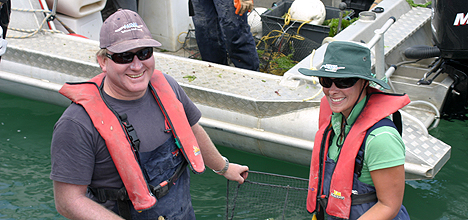
Matt Smith and Sheryl Miller, underwater alien hunters from NIWA.
The field team will be in the harbour until Friday.
The programme is looking for a range of marine pests in some of New Zealand's busiest and therefore high risk locations – namely ports and marinas of first entry for international vessels.
The surveys began last year and continue until 2011 on the current programme, which builds on the results of ongoing surveillance and baseline survey programmes that have been undertaken since 2001.
It looks at commercial ports and marinas nationwide, producing a snapshot of what's there, and providing a useful tool to measure the effectiveness of border control and other management practices.
The programme's key objective is to detect potentially invasive and harmful marine animals and plants early enough to maximise the chance of removing or controlling them, says MAF Biosecurity's senior marine adviser Justin McDonald.
'This is done by targeting the search effort towards certain species and their preferred habitats within these ports and marinas,” says Justin.
The NIWA team will use from crab and fish traps diver surveys and shore surveys.
'Targeting surveillance at high risk locations increases the chance of early detection, but it does not guarantee detection and is only a small component of an effective surveillance system,” says Justin.
'As long as international vessels visit New Zealand it's inevitable some introductions will occur, so there's always going to be a need for monitoring and surveillance.
'The more eyes we have looking out for problem species, the greater our chance of detecting potential pests early enough to do something about them.
'People who spend a lot of time around the sea are the best placed to notice something out of the ordinary. Exotic organisms can establish and spread very quickly so it's important that marine users are alert for sea life that looks different and report it immediately.”
The Marine High Risk Site Surveillance Programme will be repeated in Tauranga Harbour at approximately six monthly intervals (in summer and winter) until at least 2011.

0 comments
Leave a Comment
You must be logged in to make a comment.