


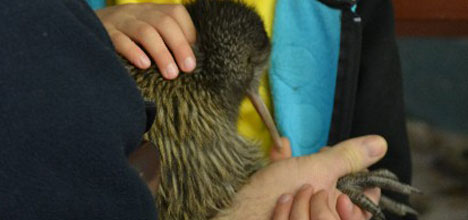
A close encounter with a live kiwi, coupled with sunshine and sizzling sausages, brought a great crowd of volunteers, supporters and sponsors to Otanewainuku forest on Saturday.
Staff from the Department of Conservation, Western Bay of Plenty District Council and Tauranga City Council, and their families, were on hand to share the celebration.
Tait, the young male Kiwi chick. Photo by Heather White.
Mamaku, an 11 year old male kiwi, and Tait, a six month old male kiwi chick, were welcomed to the forest by many well-wishers, giving a real boost to those who have worked so hard to trap pests, monitor birds, clear lines and do all the myriad tasks that make a community group work.
'This is a special day, and only possible because of the great efforts made by all our volunteers,” says Otanewainuku Kiwi Trust chairman Peter Crane.
The mihi whakatau or welcoming greeting started the formalities, with a karakia for the wellbeing of the kiwi and to give thank for the many taonga of Tane Mahuta. These were given by one of our trustees, Des Heke-Kaiawha, supported by Kevin Taylor, representing local iwi.
The kiwis were brought to the forest by staff from Kiwi Encounter in Rotorua, and both birds were fitted with transmitters to allow their progress to be monitored.
It is hoped Mamaku, who is from the captive breeding stock at Kiwi Encounter, will be a mate for Matariki, the female kiwi who has kept the monitoring team on their toes for months with her wandering ways.
'Tait is a chick from Whirinaki and is part of the partnership agreement between the local trust and the Whirinaki Kiwi Trust whereby we supply the transmitters for the adult male kiwi in Whirinaki forest, they are tracked while incubating eggs, and the eggs are lifted close to hatching to be reared in safety for six months in the creche facility at Kiwi Encounter,” says Peter.
'Whirinaki and Otanewainuku share the resulting chicks and the long term goal is to have a sustainable population of North Island brown kiwi once again living in our local area.”
Kiwi are at risk in the wild from stoats, which kill 70 per cent of chicks born in the forest, and from dogs, wild cats and ferrets which kill hundreds of adult kiwi every year.
The trust is working hard to educate visitors to the forest to leave dogs at home, as Otanewainuku is a kiwi zone and dogs are not permitted.
Otanewainuku Kiwi Trust has done integrated pest control in the forest for nine years, working in partnership with the Department of Conservation, and supported by a keen team of volunteers, businesses and local councils.
The increase in birdlife, such as robins, tomtits, fantails, grey warblers, whiteheads and kereru, and proliferation of flowers and seeds on the forest trees is showing the results of this work.
Volunteers from the trust also provide educational talks and guided walks to students and groups to promote understanding of the values of this very special place.

1 comment
awesome
Posted on 23-07-2011 00:33 | By traceybjammet
it was very special to be close to these amazing birds if only for a short time. impressive
Leave a Comment
You must be logged in to make a comment.