


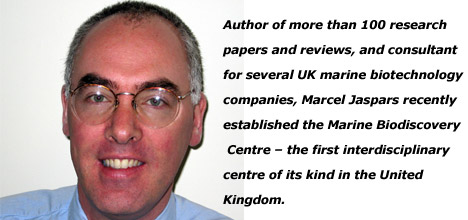
An internationally-recognised scientist is visiting Tauranga to give a free public lecture about the marine biotechnology opportunities available in New Zealand.
Professor Marcel Jaspars.
The University of Waikato's Faculty of Science and Engineering is hosting Professor Marcel Jaspars from the University of Aberdeen, who will explore the issues surrounding marine biotechnology based on his research of natural products, particularly those from marine organisms.
The university's chair of coastal science, Professor Chris Battershill, says marine organisms have developed complex biochemical machinery, or toxins, to protect themselves and cope with changing environments and scientists are using these findings to generate innovative biomedicinal and agrichemical leads.
'By far the majority of drugs in use today have come from nature rather than synthetic chemicals,” says Chris.
'Exploring natural bioactive chemistry is where future discoveries will be made and diverse marine environments, such as the Bay of Plenty, offer considerable research opportunities.”
Chris says marine biodiscovery is in no way invasive to coastal areas, as advances in technology require only very small samples to be extracted, with a focus on organisms that can regenerate such as sponges, algae and seasquirts.
Professor Jaspars will discuss the challenges and opportunities facing marine biotechnology and will shed light on how New Zealand can realise its potential to make a global contribution.
The free public lecture is on Wednesday, July 20 from 6.30-7.30pm at the Bongard Centre, lecture theatre 106, at 200 Cameron Road, Tauranga.

1 comment
Bio-piracy?
Posted on 17-07-2011 20:18 | By ronillian
This sounds very much like an excited industry-funded scientist doing the bidding of his funder, keen to commodify nature and convert nature into profits. It's time we questioned whether these "innovative" technological advances are advancing the interests of humans as they would claim (of course) or, as I suspect, the interests of large agrichemical and biotech corporations for the benefit of their shareholders. It is time we examined and thought hard about humans' relationship to the natural world and our position in it rather than exploiting it as a "resource" for us to manipulate in pursuit of monetary gain.
Leave a Comment
You must be logged in to make a comment.