


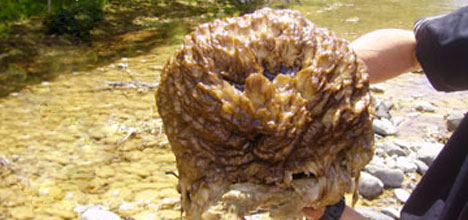
Western Bay of Plenty residents are being asked to help stop the spread of the deadly microscopic freshwater algae called didymo.
Didymo can't be seen by the human eye in its early stages and this means people who move between fresh waterways can easily spread it without realising.
Didymo.
The Ministry of Agriculture and Fisheries has launched a new campaign with the aim of engaging people to help slow down the spread of the pest.
Acting manager consumer, education and marketing, Wendy Billingsley says MAF's challenge is to change the behaviour of freshwater users and get them all to take personal responsibility for reducing the risk of didymo spread.
'The campaign has helped to limit didymo, so far, to South Island waterways.
'We knew we had a real challenge on our hands.
'Traditional pest management control strategies would not work for didymo.
'It had not been eradicated anywhere else in the world and we couldn't just close off New Zealand rivers.
'So it made sense to use social marketing as an intervention.
'MAF needed people to voluntarily adopt aquatic hygiene practices.”
The pest was first detected in New Zealand in 2004 and a key response by MAF was the development of social marketing behaviour change programme.
The first stage of the programme was to identify the issue of need.
'When established, didymo clogs up waterways – causing shading, depleting oxygen and undermining the aquatic food chain,” says Wendy.
'It also causes problems for users such as boaties, fishers and irrigators and poses a threat to the country's clean, pure branding.”
The Clean, Check, Dry programme is now focusing on minimising the spread of all aquatic pests.

0 comments
Leave a Comment
You must be logged in to make a comment.