


A Tauranga recycling advocate says the current submission period on how the city council deals with the rubbish is giving residents a once-in-six-year shot at solving a seriously wasteful problem.
Waste Watchers Ltd director Marty Hoffart supports Tauranga City Council's proposed new plan to reduce waste, and the possibility it will result in an organic waste collection service for every household.
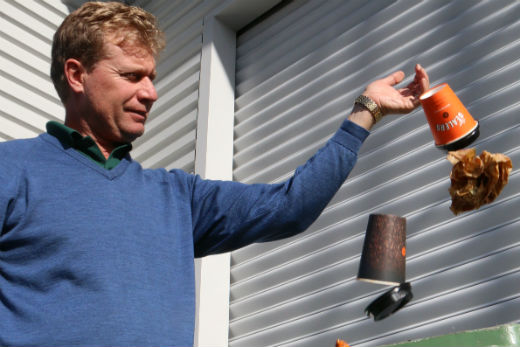
Waste Watchers Ltd director Marty Hoffart.
'What we're doing now just isn't working,” says Marty. 'We need to radically change the way we're dealing with household waste. Yes, some people are composting and worm farming, but almost half of what we dump on a weekly basis is organic waste.”
There are 18 truck and trailer loads of Tauranga waste sent over the Kaimai Range and into landfills in the Waikato every weekday.
Each truck carts a 22-tonne load, roughly half of which is easily compostable food and garden waste, says Marty.
Tauranga City Council has to pay the government levy of $10 for every tonne of rubbish that goes to landfill, in addition to the tip charges and cartage.
The issue is illustrated by the city council's rubbish bag schematic showing about 30 per cent of what goes to landfill is food, 16 per cent greenwaste and eleven percent paper – about 60 per cent and all recyclable. The amount of rubbish going to landfill is climbing with the population growth.
'What it means is all the time and money spent on education, composting, worm farm workshops; they are not making the big step in the graph. It's not decoupling the waste from population growth,” says Marty.
The problem facing pretty much every council in the country is, how to get the food out of the rubbish?
'Without getting the food out you are not going to make a big difference,” says Marty.
'A lot of people when they think of the most harmful waste that can go to landfill, they think of hazardous chemicals but hazardous chemicals are only one per cent of the total waste stream.
'The most harmful waste to go to landfill is banana skins and apple cores and carrot peelings, because those are the things turning into greenhouse gases underground.”
Some former landfill sites have even set up methane gas collection systems, but they only capture a fraction a tiny amount of the gases produced, says Marty.
'Most of the places are really progressive around the world, they have banned organics from landfills. I have seen photos of landfills with no seagulls. There's no smell, nothing in there rotting.
'All the grass, the trees the food has been turned into compost.”
The Central Otago District Council collects rubbish only every two weeks and accepts no organics at the landfill. There is a free greenwaste only drop-off for small loads.
In Tauranga there are contractors who already collect greenwaste, but Marty says separating out the food is only going to happen when it becomes part of a ratepayer funded approach.
It has changed his thinking to favour a rates funded collection, says Marty. Under a contractor collection, customers see an additional bin as extra cost.
'They don't get it. They see that second bin, that third bin, as an additional cost. ‘Why do that if you can just put it all in one bin?' They don't get it, the organics have to come out of there. The only way they would do it, is if it is rates funded,” says Marty.
'If you just let people throw it in the bin forever you will never ever make a reduction.”
And it's ridiculous to bury rubbish that somebody wants.
'Why would you bury paper, cardboard, grass, when somebody wants to make something out of it, and we have all the systems in place locally,” says Marty. 'That's the crazy thing. Hauling this stuff out of town at great cost is really silly. When I look at waste I think we are burying jobs and opportunities.”
Figures the council presented to an April Joint Governance Committee meeting indicate that by 2026, the sub-region will be sending in the order of 100,000 tonnes of material to landfill, a further 60,000 to cleanfiil, while green waste grows to about 10,000 tonnes, other organics to 7,000 tonnes, recyclables to 28,000 tonnes and scrap metal to 18,500 tonnes.
At present, organic rubbish is about 32.4 per cent of the total, at 28,271 tonnes per annum that is going to landfill and costing the council and ratepayers $282,710 in levies.
The figures are in a report presented to the city council and district council Joint Governance Committee in April by Eunomia Consultants.
The different options are discussed from page 180, and the cost comparisons for the different scenarios from page 204.

4 comments
Wisechief
Posted on 07-07-2016 09:46 | By Wise Chief
Good idea to have organic rubbish bins dotted about the town which are free to use so those on benefits, pensions and working poor can afford to dump their rubbish rather than dump stuff on side of roads. Some common sense needs to prevail and lets hope to hell we don't have another silly Pommy or other know it all foreigners tell us how and what to do about setting up such bins.
Food
Posted on 07-07-2016 10:36 | By Mackka
India has no food waste problems. They throw it out into the street and the wandering scavengers - pigs, cows, rats, monkeys, squirrels etc do an excellent job of the almost instantaneous cleanup! Might not apply here though.
Hey Chief.....
Posted on 07-07-2016 15:59 | By Jimmy Ehu
you been away dude?, still an angry confused person though, and with you on the "Pom" thing, they cannot even catch an Eskimo on grass!, why would we have them tell us what to do with our rubbish!, shock! horror!, we are so smart that we don't have a trash problem, sorry what was the actual story about now?, no worries Chief you stand for Council and you can ruin many a "Poms" day, and you never know, it could in history be called "kiwixit"!!!, Chief for Mayor, I say.
Overit
Posted on 07-07-2016 16:25 | By overit
So who is Waste Watchers? In Wanganui grass clippings, leaf material is free to dump. It is then turned into compost. Now I don't know about banana peels etc but lets play with that idea Marty-build on that.
Leave a Comment
You must be logged in to make a comment.