


Instead of being loaded at the Port of Tauranga, many containers will be delivered to packhouses to be filled with trays of export kiwifruit this season, a practice which could be a biosecurity risk for the industry.
'However, from what I've seen of the cleaning and inspection process for these containers, I believe we can be reasonably confident they do not present a risk,” says Kiwifruit Vine Health CEO Barry O'Neil.
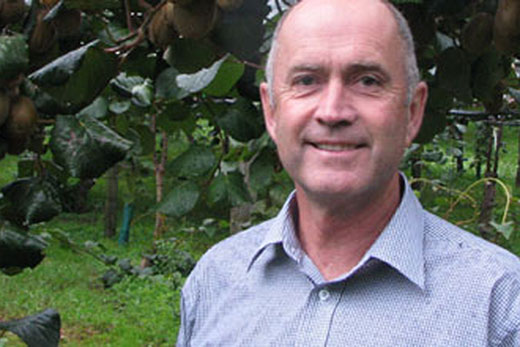
Barry O'Neil.
Containers will be cleaned and inspected before delivery to packhouses and once filled with pallets of fruit, returned to the Port of Tauranga for loading onto ships.
Reducing the risk of biosecurity incursions for the kiwifruit and indeed all primary industries is the motivation behind the Biosecurity Operational Excellence at Port of Tauranga, a scheme aiming to encourage everyone involved in port activities to play a role in keeping pests out of New Zealand.
The initiative has arisen from a working group formed by the Port of Tauranga Limited, KVH, the Ministry for Primary Industries and local government and industry organisations.
As part of the project, the group produced a calendar featuring 12 unwanted pests which could arrive through the port. Barry says within one day of the calendar being circulated around the port, staff reported three finds of what they thought was the unwanted pest, the brown marmorated stink bug.
'Fortunately, the insects they found were NZ natives but the fact they spotted and reported them is excellent,” says Barry.
Those reports are just what the initiative aims to encourage – that everyone involved in port activities works together to better understand the common biosecurity risks faced, and do their bit to identify and manage those risks. The working group also explores opportunities to innovate and strengthen MPI's current screening and inspection programmes to reduce risks even further.
While the scheme is Bay of Plenty-focused and tailored to the organisms and particular imported goods most relevant to the region, the opportunity exists to develop the model and apply it across all NZ regions and ports.
KVH chairman Peter Ombler says the kiwifruit industry knows only too well the cost of biosecurity incursions after the devastating impacts of the vine disease Psa-V discovered in NZ in 2010.
Keeping the Port of Tauranga border safe from pests and diseases is vital to the whole region, including those who work at the port, as a serious incursion could threaten jobs, says Peter.
'Ninety-per cent of the kiwifruit produced in NZ is grown in the Bay of Plenty. The industry employs 9800 permanent staff and 8600 seasonal workers, of which 1500 are employed under the Recognised Seasonal Employer scheme.
'Kiwifruit represent six per cent by volume, and 70 per cent by value, of the exports through the Port of Tauranga.”
Peter says if a fruit fly was found in the Te Puke area, it could cost the kiwifruit industry $430 million year on year.
'We know it is impossible to eliminate all risks, because we are a trading nation, but we all have much to lose from a biosecurity incursion which is why we must work together to make concerted effort to make a difference.”
Barry says the kiwifruit industry fully supports trade and tourism but wants to ensure that trade is safe.
Scientists are working on new ways to detect pests, and sentinel trees planted near the port to attract unwanted insects may be a worthwhile addition to traps already in use, says Barry.
Minister for Primary Industries Nathan Guy, who officially launched the Biosecurity Operational Excellence at Port of Tauranga initiative in February congratulated those involved in the scheme.
Nathan says up to 84 cruise liners are due at the port this year, including one carrying 5000 passengers and 1500 crew, which is among the reasons MPI has increased its investment in biosecurity.
'In last year's Budget we allocated an extra $27 million to strengthen our biosecurity system. As a result, MPI has employed 90 new frontline biosecurity staff and introduced 24 new biosecurity detector dog teams.”

1 comment
THIS IS AWESOME
Posted on 24-03-2016 11:19 | By The author of this comment has been removed.
What a great idea Barry,this wouldsave a lot of sore backs and pushing a trolly in container, This is awesome and save a lot of time, forklift it in at all packhouses,drive in drive out no sweat, some of those pallets are heavy and pushing them around can put great strain on your shoulders etc AWESOME Barry.NO1 in the Bay Thankyou
Leave a Comment
You must be logged in to make a comment.