


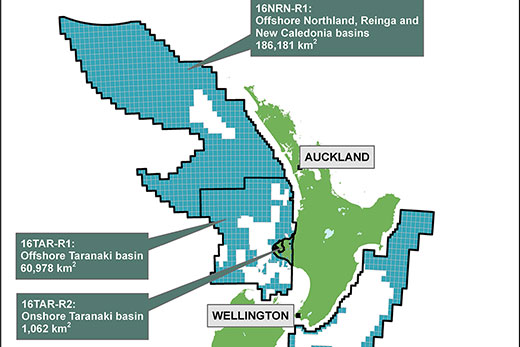
Energy Minister and Tauranga MP Simon Bridges has offered four offshore areas in the New Zealand Exclusive Economic Zone for oil and gas exploration.
The 2016 Block Offer invites response from oil exploration companies to seek hydrocarbon deposits in the Reinga-Northland Basin, the Taranaki Basin, Pegasus and East Coast Basins, and Great South-Canterbury Basin.
Deep see oil exploration avoids the Bay of Plenty this year.
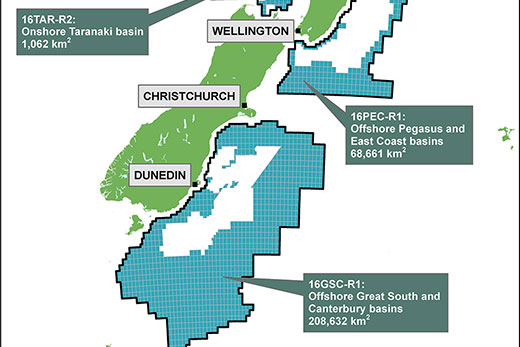
There is also one onshore release area in Taranaki.
The total acreage included in the tender is approximately 525,500 square kilometres. This includes about 1060 km2 onshore. The oil industry has about six months to prepare bids for this tender. All bids are due by September 7.
'My intention is that permits will be announced in December this year,” says Simon.
Since 2012, the National Government has granted 44 exploration permits throughout New Zealand by way of the annual Block Offer.
'We've attracted new operators to our shores including Chevron, Statoil, Woodside and ONGC Videsh, which indicates to me that the Block Offer is an effective means of promoting New Zealand's potential,” says Simon.
The Release Area in the Northland- Reinga Basin includes 186,000 km2 of available acreage.
While the government has seismic data dating back to the 1960s, it is large and still relatively unexplored. It is believed to be prospective for oil and gas, and it shares a lot in common with the Taranaki Basin.
The Taranaki Basin is a proven province and has seen some significant discoveries – such as the Maui, Pohokura, Tui and Maari fields - but there is still plenty of scope for further exploration.
The Release Area in the offshore Taranaki Basin includes almost 61,000 km2s of available acreage.
The Release Area in the Pegasus and East Coast Basins includes more than 68,000 km2.
'These two basins are considered among New Zealand's most promising. Both are prospective for oil, gas, and gas hydrates gas, and both are under-explored,” says Simon.
This year's Block Offer includes new acreage on the East Coast, following a Government funded survey over the area. The results of the survey are available in this year's Petroleum Exploration Data Pack.
Block Offer 2014 saw three 15-year petroleum exploration permits granted in these basins to a joint-venture between Chevron and Statoil, and one to OMV.
The Release Area in the Great South and Canterbury Basins includes approximately 208,000 km2.
These basins have seen exploration activity since the early 1970s, with a number of sub-commercial discoveries. Both basins are considered prospective for gas, condensate and oil, says Simon.
Just over 1,000 square kilometres is available in this year's Block Offer for onshore Taranaki.
Onshore Taranaki is where New Zealand's petroleum industry began. The basin is prospective for oil, gas and condensate, and has been producing oil and gas commercially since the early 1900s.
The basin has 20 producing fields today.
'Considering that almost a third – 14 out of 44 – of the permits issued since 2012 have been in onshore Taranaki, it is clear the area still has untapped potential,” says Simon.
Since the mid-1970's, New Zealand has produced 510 million barrels of crude, condensate and natural gas liquids; and almost 190 billion cubic metres or 7000 petajoules of natural gas. Industry has paid billions of dollars in royalties - not to mention taxes - to the Crown.
'For a small country in a corner of the Pacific, those are quite impressive numbers,” says Simon.
'Some of the activity going on right now is a vote of confidence in the future of the industry. For example, Shell's Caledonia Basin seismic survey is providing never known before scientific information in the most frontier of basins.”
Oil remains a significant export earner and natural gas is a vital input to industry, electricity generation and is used in more than 300,000 homes in our country, says Simon,
The industry provides highly skilled and well paid jobs, and pays several hundred million dollars in royalties each year which fund essential infrastructure and services for all New Zealanders.
All of this comes from the Taranaki Basin, and there are 17 other underexplored basins in the NZ EEZ.
'I am particularly interested in our untapped potential for natural gas. For a long time New Zealand has been considered, rightly or wrongly, 'gas-prone”. These days that label may work more in our favour,” says Simon.
'As the cleanest fossil fuel, countries are increasingly choosing gas as an alternative to coal for electricity generation. According to the United States Environmental Protection Agency, greenhouse gas emissions fell to their lowest level in 17 years in the world's largest economy, largely due to a rapid drop in coal-fired electricity, and the rise of electricity generated by cleaner fuels, particularly natural gas.
'The International Energy Agency predicts natural gas demand will continue its expansion as the fastest growing fossil fuel, and speak of it as a very important bridging fuel to a lower-carbon global economy.
'This role as a bridging fuel is even more relevant in the wake of the Paris Climate Change Agreement, as countries around the world take a hard look at their energy use and how they can reduce their carbon footprint.
'Internationally gas is in major growth mode. Japan, South Korea, China, and India are already big consumers of gas for electricity generation. There is real potential for significant growth in our most populous nations, China and India, as they currently rely heavily on coal.”

0 comments
Leave a Comment
You must be logged in to make a comment.