


The size and timing of tsunami waves reaching New Zealand after the Japan earthquake closely matched the National Institute of Water and Atmospheric research's early risk estimations, says NIWA principal scientist Dr Rob Bell.
Tsunami waves that reached Tauranga harbour from Japan over the weekend topped out at just over one metre according to data from NIWA.
With adjustments for tide, the maximum wave height at Moturiki was 1.04m from crest to trough. The peak amplitude – how high it was above normal sea level was 0.52m.
At Whitianga the maximum height was 1.61m, while the amplitude measure was 0.78m.
Tsunami generated by last Friday's magnitude 9.0 Japan earthquake reached all coasts of New Zealand, and even registered at 0.05m on a sea-level gauge at Scott Base in Antarctica.
'The accuracy of this information is vital for Civil Defence and emergency management when they are making decisions about tsunami warnings to ensure the hazardous impacts of a tsunami event in New Zealand are minimised,” says Rob.
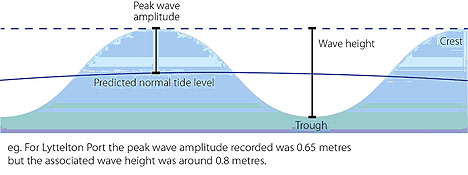
Getting peak wave amplitude right is important when assessing a likely tsunami hazard on land from a sudden surge in water above normal predicted tide levels.
The wave height from the crest to the trough provides information about the possible tsunami hazard in or on the water – for example, how boat moorings, mussel farms or ports will be impacted by surging currents generated by the waves.
At most sites the highest waves recorded didn't occur for some time after the first wave arrived, say Rob.
In Timaru and Sumner in Christchurch, the largest waves didn't occur until 33 to 40 hours after the first wave hit, compared with nearly three hours at Mount Maunganui.
The delays are caused by the waves bouncing off continental shelves all around the Pacific including South America and local coastal headlands and offshore ridges, diminishing slowly over several days.
'It's important to understand that tsunami waves can continue for some time after the first few waves hit,” says Rob.
'It's not safe to assume that once you have seen one wave, the risk subsides and all returns quickly to normal.
'We are still recording obvious wave heights at our sea-level gauges now, days after the earthquake, which are affecting currents in harbours and estuaries.”
The waves began arriving on the New Zealand coast at least 12 hours after the earthquake first hit Japan at 5.46pm New Zealand time on Friday, March 11.

1 comment
Posted on 17-03-2011 14:59 | By pat tucker
Well done NIWA
Leave a Comment
You must be logged in to make a comment.