


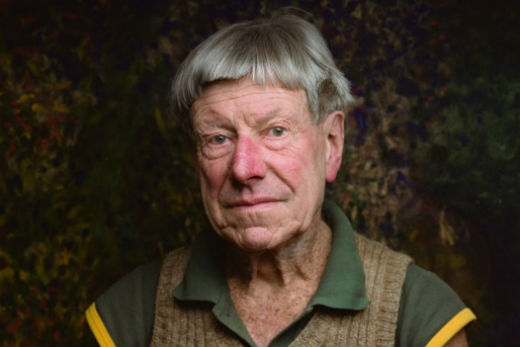
Potter, artist, conservationist and railway enthusiast Barry Brickell has died.
One of New Zealand's most endearing and enduring potters, he was also the owner of the popular Driving Creek Railway, north of Coromandel town.
Barry Brickell. Photo: Fairfax.
Brickell originally moved to the area to teach high school in the 1960s.
But his love of art soon took over and he soon quit teaching to set up a pottery studio and kiln on his property in Driving Creek.
There he was able to focus on his pottery, eventually becoming one of New Zealand's most celebrated ceramic artists.
Brickell spent 33 years building the Driving Creek Railway.
He also funded the native bush restoration, wildlife sanctuary and railway by selling commercially popular pottery.
More recently he proposed a 1.2 kilometre wharf built out into the northern end of the Coromandel harbour, with a price tag of $18 million. It would be the longest pier in the country, allowing boats of up to 2m draught to berth in all tides.
Barry Brickell loved his railway as much as his art. Here he is celebrating the railway's one millionth passenger in 2012.
In a 2013 interview Brickell said he didn't like answering to the trendy title "ceramicist".
"I'm not a ceramicist. It's a horrible word, for goodness sake. I'm a potter. I make pots, tiles and bricks. The word ceramicist is trying to put you on a pedestal." Brickell related his work to his environment and rejected all fashionable influences since pottery first became the bulky dinnerware du jour in the 1960s and 70s. David Craig, a sociologist with an interest in the arts, once described Brickell as one of New Zealand's greatest potters.
Craig came across Brickell's work when he called at the Coromandel studio and bought a bowl to celebrate a wedding anniversary.
Some of Barry Brickell's huge sculptural works on display at the Dowse.
"It turned out we had a lot to talk about."
Brickell worked at the heart of a seminal period of New Zealand's potting history when there was "a Driving Creek kind of style of forms and glazing", Craig said.
Brickell concentrated on and stuck to local materials, clay and glazes. He created work that "shouldn't be too slick, shouldn't be too flashy, or show that they were beholden to fashion colours".
"He used textures and a palette of colours of the landscape."
Brickell became "increasingly autonomistic and he felt that an oddity. Sometimes he played up to it and sometimes it outraged him. For him it had to be indigenous, from here".
To have employed the brilliant colours of Castle "would have been outside his natural circuits".
"He could be regarded as the main visionary of indigenous clay culture. He was producing work that resonated across the New Zealand aesthetic we had in the 1960s and 70s, a very fruitful moment of New Zealand art."

1 comment
Paying respect
Posted on 24-01-2016 16:43 | By nerak
To a softly spoken, humble, extremely clever and gifted man, his imagination knew no bounds, and his fire lasted a lifetime. His love of, and care for the environment, particularly in the area he worked and called home, was notable. As an early visitor to the Driving Creek Railway, I enjoyed a ride on his train, and as much enjoyed talking with Barry, an exercise I repeated some years later to again marvel at what he had achieved. His pottery is memorable, as is the man and his eccentricity, which made him the character he was. RIP Barry.
Leave a Comment
You must be logged in to make a comment.