


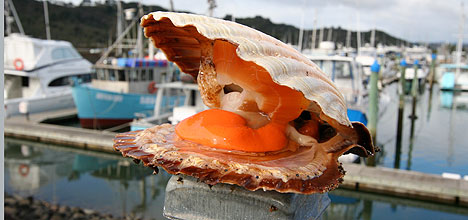
More tests are required before any announcement can be made about lifting the health warning on shellfish in the Bay of Plenty.
Bay of Plenty shellfish remain off the menu.
Paralytic shellfish poison levels in the region have been at dangerous levels since December 2009, affecting the Bay of Plenty from Tairua to Whakatane.
Hopes raised this week that the area of the ban would be reduced, have not been upheld.
'We are still waiting for more data to come in,” says on call Medical Officer of Health Dr Neil de Wet.
'It is still the same – the warning is unchanged. The area is the same. Until we have enough data to make an announcement, there aren't any changes.
'There's been some indication that some of the levels are starting to trend down, which looked like we might be able to reduce the size or extent of the area, but we still haven't got all the data that we need to make a decision.”
The results of the additional sampling will come in Wednesday next week, says Neil.
'We are not in a position yet to make any change; it all depends on the data that's still to come in.
'If there is a change we will get that information out straight away.”
Weekly monitoring since the original warning was issued in December 2009, has until now shown continuing high levels of paralytic shellfish poison (PSP) present in shellfish along the BOP coastline.
The affected area includes the entire coastline from Tairua (including Tairua Harbour) south, including Opoutere, Onemana, Whangamata, and Whiritoa, east along the Bay of Plenty coastline from Waihi beach, including Tauranga Harbour to the mouth of the Whakatane River in the Eastern Bay of Plenty.
Included are all inshore islands within the above area. The coastline eastward from Ohope beach remains unaffected.
The health warning applies to all bi-valve shellfish including mussels, pipi, tuatua, cockles, oysters, scallops as well as catseyes and kina (sea urchin).
Paua, crayfish and crabs can still be taken but as always, the gut should be removed before cooking.
Consumption of shellfish affected by the paralytic shellfish toxin can cause numbness and tingling around the mouth, face or extremities; difficulty swallowing or breathing; dizziness; double vision; and in severe cases, paralysis and respiratory failure.
These symptoms usually occur within 12 hours of a person consuming affected shellfish.
Anyone suffering illness after eating shellfish should seek medical attention.

0 comments
Leave a Comment
You must be logged in to make a comment.