


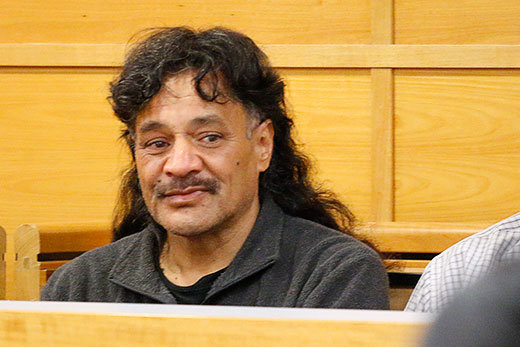
A Te Puna man who was sentenced to prison for his alleged role in an attack on a Te Puna family has had his conviction quashed.
Jack Simon Ake was one of three people sentenced to jail for the alleged attack which left Andrew Duncan unconscious in November 2012.
Jack Ake during his sentencing in December 2014. Photo: File.
The attack involved around 20 people on the Duncan family's property in Te Puna, including Derek Michael Drewry and Jasmine Borrell, who were also sentenced in December 2014.
Earlier in the evening, Borrell and Drewry had arrived at the property asking about a person who was not there. A fight broke out and the pair left before returning 15 minutes later with a larger group.
Read more about the attack here.
Following a trial, Ake was found guilty of wielding the spade which knocked Duncan unconscious. Ake admits he was at the property, but maintains he didn't attack Andrew.
Andrew was then set upon by others and suffered a broken nose, cuts to his face, boot prints to his chest and bruising over the rest of his body.
Matthew Cooper, a friend of the Duncan family, sustained a deep laceration to his forearm during the attack and continues to have issues with his arm.
Judge Christopher Harding sentenced Ake to four years and nine months in prison on December 3, 2014.
However, after sentencing, Ake appealed his conviction with the defence citing 'significant issues regarding the identification of Mr Ake”.
'The initial focus of the appeal was against a pre-trial ruling allowing the prosecution to lead what the District Court Judge characterised as ‘observation evidence',” says a court of appeal ruling.
'In summary, the challenged evidence comprised a purported identification of Mr Ake by two witnesses, each of whom had been shown by a police officer a set of photographs of four persons (three male, one being Mr Ake, and one female) said to have been involved in the alleged offending.”
The officer stated the purpose of showing witnesses these photographs was to assist in identifying what role the defendants played in the assault.
During the trial, the same two witnesses who identified Ake from his photograph and described what they saw him doing at the scene during the investigation, gave what amounted to a dock identification.
It seems from the transcript of evidence that these dock identifications were unanticipated by the prosecutor.
In his directions to the jury, Judge Harding said the following about the identification evidence:
'This is a case where the Crown clearly is relying on the accuracy of a number of identifications of the defendants as the people who did the particular acts of violence that you've heard about, and the defence contends that the Crown witnesses are mistaken or not adequately clear and a mistaken identification can lead to a serious miscarriage of justice.
'Where that is so, the law requires me to warn you of the special need for care before relying on the identification evidence as the basis for a conviction.
'The reason for that is that experience has shown that it's quite possible for a perfectly honest witness to be mistaken about identification.
'An honest witness who's convinced of the accuracy of what he says may well come across as a convincing witness but still be mistaken, and if one such witness can be mistaken so can a number of them.
'You need to bear in mind that we sometimes all can make mistakes in thinking that we recognise people, even those we know well.
'That's not to say that you can't rely on identification evidence. Of course you can but you do need to be careful in deciding whether the evidence is good enough to be relied on,” Judge Harding went on to say.
'Can I suggest you think about the circumstances under which the witness saw the person at the time? For example, how long was the observation? How far away was the person? What was the lighting like?
'Was there anything that physically impeded observation? Had the witness ever seen the person before? Was it somebody they knew well?
'Was there anything about the situation that would cause the witness to take particular note of the person and how long elapsed between the events and any subsequent identification of the person and what about the description?
'If there was one given at the time how well did that match the particular defendant? So those are the sorts of issues you need to think about carefully to see if you can rely on evidence of identification.”
After examining the evidence for the appeal and the judge's above directions, the Court of Appeal found the summing up didn't explain to the jury what was involved with the process of identification either in court during the trial or during the investigation.
'Neither did the Judge give a properly-tailored direction by providing an appropriate warning in terms of the Evidence Act in relation to the dock identifications,” says the Court of Appeal ruling.
'Given the two unintended dock identifications, the Judge's failure to warn the jury about the dangers of relying on such evidence was significant and caused prejudice to Mr Ake's defence.
'We conclude that these omissions comprise legal errors that, in the present circumstances, constituted a miscarriage of justice. We therefore allow the appeal.”
There has been no order for a retrial.

3 comments
Overit
Posted on 19-08-2015 13:01 | By overit
He still should be charged for being on the property, an accomplice to the fact. They were up to no good. Dont let him walk!!
Ake's Guilty
Posted on 19-08-2015 13:19 | By b2
Book him for trespass and at least a directly connected party to the serious outcome for Mr Duncan. He was there and by his presence is culpable. B
How do these people sleep at night
Posted on 19-08-2015 15:12 | By Calm Gully
How do this group and their solicitors sleep at night???
Leave a Comment
You must be logged in to make a comment.