


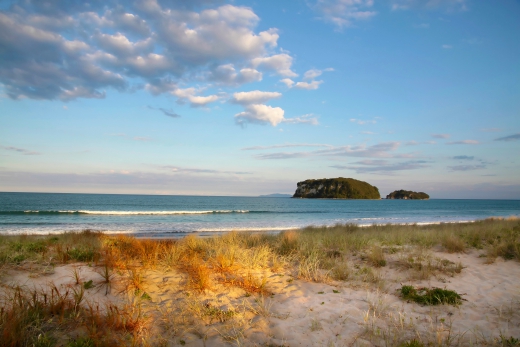
In order to protect Tairua, Pauanui and Whangamata beaches a Coastal Management Plan has been drafted up this week.
Presented to the Tairua-Pauanui Community and Whangamata Community Boards, it serve as a guide on how to manage beaches and estuary shorelines that are susceptible to coastal erosion.
A Coastal Management Plan has been drafted up for Tairua, Pauanui and Whangamata this week. Photo: cmfotoworks/Thinkstock
The draft plan was derived following workshops, field visits, plus feedback and input from local community organisations, iwi, district and regional council staff and elected members.
The Tairua-Pauanui Community Board received the plan this and has asked Thames-Coromandel District Council staff to now work on an action plan.
'This is a really good guide,” says Tairua-Pauanui chair Bob Renton. 'But we now need an action plan so we can see a defined work schedule, what needs to be done and how that will be achieved.”
The Whangamata Community Board also received the plan and requested an action plan for future coastal management work, including indications of what such work might cost.
Whangamata deputy chair Terry Walker adds: 'Very good work has gone into this plan but now we need to look at how we move forward.”
Along with this draft management plan, council is also constructing a 530m long geotextile sandbag wall at Brophy's Beach to mitigate erosion. The wall is expected to be completed by mid-December, at a cost of $862,000.
A dune planting day will also take place on the central section of Buffalo Beach in Whitianga on Saturday, September 5.
RECOMMENDATIONS FOR THE MANAGEMENT OF COASTAL HAZARDS:
For ocean beaches:
- Dune restoration and management on ocean beaches. Particular guidelines need to be given to development of dune restoration for central and southern areas of Pauanui where little to no natural dunes exist.
- Coastal erosion in Whangamata can generally be managed using setbacks and development controls and ongoing dune restoration and management but certain sites may require their own specific strategies
- Dune areas dominated by invasive exotic species at all sites are require particular attention as these species displace native species, which are more effective in keeping the dunes in place.
For estuary shorelines:
That coastal erosion can generally be managed with 'soft” approaches, specifically beach nourishment and readjustment when necessary.
Existing engineering structures can be softened using beach nourishment and unnecessary and unsound, unsafe structures should be removed over time
New protection structures should be used as a last resort and typically where they are required to protect important public infrastructure or maintain narrow coastal reserves.
Minimum floor levels (including appropriate provision for future sea level rise over the design life of the dwelling) would be adopted in areas subject to coastal flooding.
Recommendations for protection and enhancement of public access and recreational values are also provided for and opportunities to enhance ecological values should be taken where possible.
To download the draft Eastern Seaboard Coastal Management Plan click here.

0 comments
Leave a Comment
You must be logged in to make a comment.