


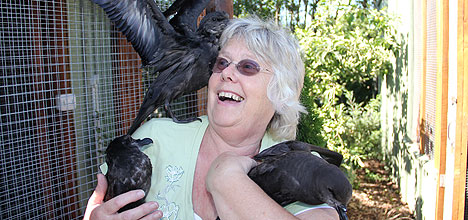
Unprecedented numbers of petrels washing ashore on Western Bay of Plenty beaches are straining the accommodation at the Animal Rescue and Rehabilitation Centre.
Chrissy Jefferson with some of the petrels washing ashore in the Bay of Plenty.
Centre manager Chrissy Jefferson says she's got nine of the sea birds kept in a walkway at present and has looked after 17 since Christmas.
'I released three last week,” says Chrissy.
'DOC did say before Christmas that this was going to be happening, and they said it was to do with the El Nina weather pattern, but why and what, I don't know.
'These birds are coming in way below weight, absolutely exhausted, as if they have done a really, really long flight – and I've got nine. There're no physical injuries on them.”
The birds are high maintenance, requiring hand feeding twice daily.
'I've got one who's eating by himself – but he won't eat unless I hold the dish, so it's taking as much time.”
The centre urgently needs $1500 to pay for the materials to build a sea bird enclosure.
'I'm desperately short of space and I'm trying to get enough money together to put up a sea bird enclosure,” says Chrissy.
'I've just got all these petrels in the walkway because I've got nowhere else to put them.
'You know they are not like little tiny birds, they are of considerable size and they need room to be able to flap their wings.”
If the birds lose muscle tone during the rest and recuperation ashore they are unable to be returned to the sea, says Chrissy.
'You have got to go to a high point and throw them up, If they haven't got room to be able to open their wings and keep flapping them, they are not going to be able to do it.
'You are just going to throw them up and they are just going to come down like a stone.”
SunLive went to marine photographer Dr Kim Westerskov for an expert opinion as the Department of Conservation staff that normally answer sea bird questions are on leave.
Kim has a PhD in Marine Sciences and an international reputation as a marine wildlife photographer. He spends much time at sea in the Bay of Plenty waters onboard Gemini Galaxsea, Graeme Butler's dolphin watch ketch.
He says that the spring of 2010 saw the highest concentrations of krill, and blue whales and associated birdlife feeding on the krill that they have ever seen in Bay of Plenty waters.
Petrels eat small shrimps and krill that the whales also feed on.
'In September or October on one particular day we came across more sea life than I have ever seen anywhere before, certainly in the bay, says Kim.
'All based on huge concentrations of a kind of krill about 20mm long, there were so many of them that the water was just dark, mile after mile; seaward of Karewa.
The krill brought in at least three blue whales, a couple of broodies whales and the largest number of storm petrels Kim's ever seen in the bay.
'I was seeing hundreds and hundreds and hundreds, where normally you would see two or three, and if it's a really good trip you might see a dozen,” says Kim.

0 comments
Leave a Comment
You must be logged in to make a comment.