


Costs for the Bay of Plenty Regional Council to repair flood damage to river scheme works from the August floods earlier this year will be more than $3 million.
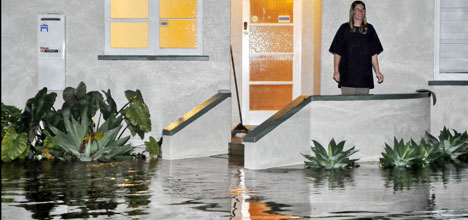
Scenes from the August floods.
Meetings have been held with river scheme liaison groups to discuss the damage and options to fund the repairs, including possibly deferring planned maintenance works.
The deficit needed to repair the flood damage, without deferring maintenance work or receiving Local Authority Protection Programme insurance payments, totals $1.9 million.
Options to fund the deficit will be brought to the council early next year.
The Kaituna Catchment Control Scheme liaison group spokesperson Roger Hinz praised council staff who had worked long hours during the August 2010 flood to ensure that pumps were operational to minimise the time that pasture was inundated.
He says the group had elected to undertake the priority work and defer some maintenance to get priority repairs done.
'We need to undertake the priority work now and can then assess funding options for the remainder of the work,” says Roger.
The council's group manager rivers and drainage Ken Tarboton says key issues which arose during the August 13-15 event were a partial breach of the Te Rahu Canal, a tributary canal to the Whakatane river, overtopping of low level stopbanks on the Whakatane river and the fuse at the Whakatane spit not breaking until high tide on the morning of Sunday 15 August, after the Whakatane river had peaked.
'Following the flood event, comprehensive inspections have been undertaken to assess flood damage to all of our rivers and drainage schemes. The greatest damage was to the Whakatane-Waimana scheme, due predominantly to the high river flows and saturated ground conditions before the event,” says Ken.
The most expensive repairs; on the Whakatane-Waimana scheme, would cost more than $1 million with priority works costing about half that.
'Damage is predominantly erosion and scouring of the riverbanks which require stabilisation to prevent further damage, through either rock armouring of the banks or willow trenching. Across the river schemes approximately 6.8km of rock protection work is needed at a cost of $1.8 million and 5.2km of willow trenching at a cost of $750,000.”
The deficit is a large proportion of the 2010/2011 operating expenditure budget for the major schemes, ranging from 12 per cent for the Rangitaiki-Tarawera scheme to 56 percent of the Whakatane-Waimama scheme budget. The Whakatane-Waimana scheme liaison group asked council staff to look at options to fund the deficit at the same time as starting on the high priority work.
Ken says these deficits may be reduced with anticipated savings by minimising routine maintenance costs for the current financial year and possibly with an insurance contribution.
'Schemes may need to uplift internal loans to do the repairs, depending on funding options to be presented to council.
'The Waioeka-Otara scheme elected to raise loans immediately in order to undertake priority repair work.”

0 comments
Leave a Comment
You must be logged in to make a comment.