


 |
Andrew von Dadelszen Former Regional Councillor |
Reading through the submissions to our regional council Ten Year Plan I have been disappointed at the negativity to high rate increases without any suggestions for solutions.
For me if the regional council doesn't address its over-staffing issues (back office planners and paper shufflers) then it just can't hope to contain rate rises to the cost of inflation.
A few weeks ago I wrote about staff numbers, believing they currently employ around 275 staff. I have now been given the numbers from council staff and find that the figure has risen to 288 (and this doesn't include some consultants that seem to be permanently employed by the regional council).
When local government was last restructured and the regional council established in 1989, this organisation employed less than 160 staff!
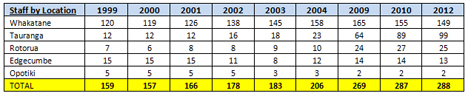
Don't get me wrong – our regional council does a lot of good work, and is genuinely trying to improve its performance – but the biggest driver in its annual budget is staff costs, and unless this is addressed (as central government is currently undertaking), then ratepayers will continue to pay exorbitant rate increases year in year out (the 10Year Plan suggests a 130% rate during the next 10 years).
The purchase of a substantial office in Tauranga was supposed to see staff numbers increase in Tauranga to around 100 (in line with the increased workload in the sub-region), but it was also planned to reduce Whakatane staff to around 100. The table above shows that this just hasn't happened.
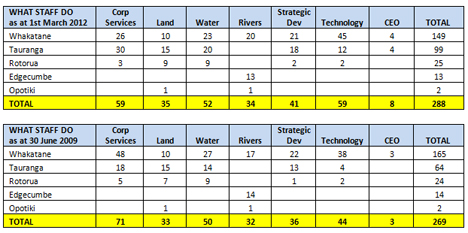
When we look at 'What staff do” (Table above) we see some rationalisation in Corporate Services, but countered by a huge blow out in Strategic Development, Technology and CEO Support. Eight staff to support the CEO – are you joking!
My submission to the Ten Year Plan asks for positive action. This includes:
- Immediately instigate a ‘sinking lid' policy on non front-line staff. The aim should be at least a 15% staff reduction during the 10 year period (40 less staff) – this is an absolute minimum requirement.
- Implement genuine benchmarking to help with effectiveness and efficiency.
- Focus activities around ‘direct action', even if this means reducing the level of community and iwi consultation.
Come on regional councillors – insist on accountability. Ask the hard questions and make some genuine cost savings for your ratepayers.
If you have a view on these or any other local government issues, I invite you to email me at [email protected]