|
Laura's screening with Laura Weaser |
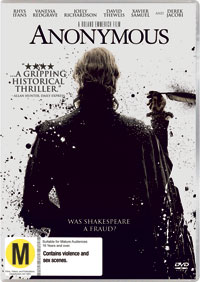
Anonymous. Directed by Roland Emmerich. Out now on DVD.
What if one of the greatest literary figures of our time was nothing more than an illiterate idiot who was merely a mouthpiece of a well-known Earl? That is the peculiar question – factual or otherwise – proposed by Anonymous.
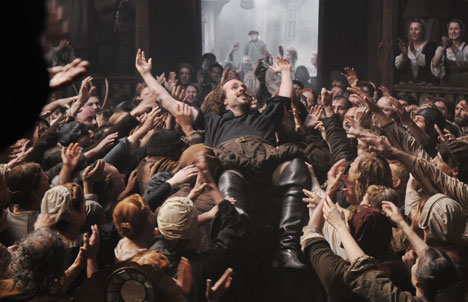
Loved and adored, or a big giant fraud?
Switching backwards and forth between time and place, Anonymous focuses on the Earl of Oxford (Rhys Ifans) from his teenage years to the important political position he holds in later life. Having always been a writer, Oxford has the passion drilled out of him by a puritan upbringing. Writing in secret, it is not until 40 years later his plays are on the stage. He realises plays are the best way to strategically weird the masses to his own political desires. Employing young Ben Jonson (Sebastian Armesto) to put on his plays under his name, Johnson feels unable to tarnish his bad name and leaves the task to none other than William Shakespeare – a drunkard, a cheat and a terrible actor.
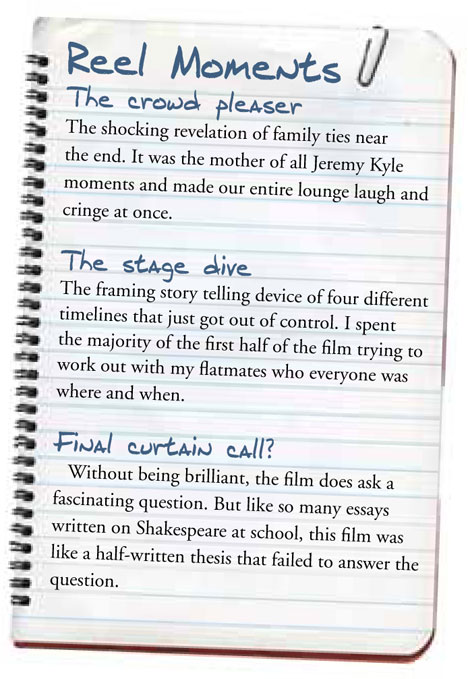
I can hear the die-hard Shakespeare fans crying over this film, throwing popcorn at the screen with the horrid portrayal of what Emmerich thinks Shakespeare was truly like. Like any die-hard Shakespeare fan, I too want to deny the concept of Shakespeare as a fraud but the way this film was set up certainly offered up an intriguing notion. Driven by political struggles, tarnished with scandalous relations and family drama that would rival a night of Coronation Street, Anonymous paints a grim, gritty picture of the Tudors and the time in which some of the greatest works of literature was forged.
 The film's story is told in a peculiar way that sort to grab your attention, but just left me lost Bookended by a modern day production of what seems to be the film (a curious device) the ‘live production within the film' fades to the film itself, plays out, and then returns to the modern day ‘production of the film' at the end, narrated by Derek Jacobi (interestingly one of the greatest Shakespearian actors).
Confused? I was too. But don't get too comfortable – there was more time travel. The introduction to the film was quickly followed by three different timelines in one, jumping backwards between the most recent historical timeline, and back another five years, before taking us back 40 years. The film then spent the next two hours between the ‘five years ago' and the '40 years ago', before doing an Inception style trick of bringing us back through the timeline layers to the most recent historical time and returning to present day. Whew.
With a host of different characters all not named or identified for at least 30 minutes, I spent the beginning of the film dazed, confused and with a mild case of motion sickness.
I'll admit Shakespeare is not everyone's favourite having had it stuffed down your throat for anyone that sat NCEA. But Anonymous was much more than just a film about Shakespeare. It tried to paint a picture of the time, when political unrest was in question and power struggles for the throne of Queen Elizabeth was a hot topic. However, there was too much all at once, and not enough focus pulled on one subject to warrant any historical lesson of the time or scandalous conclusion to the questions of Shakespeare's fraud. It trend to blend both but without any great success.
Filled with illicit scandals, interesting family relationships, and an intriguing idea that Shakespeare was nothing more than an idiot who could read but couldn't write, Anonymous had promise. However, it seemed to lack the real pizazz that could have elevated this film from straight to a DVD shelf to a blockbuster hit. Dizzying trips back through time, there was no effort to make us identify with the characters, and there wasn't enough Shakespeare to capture the die-hard fans.