


 |
The Wild Side by Brian and Claire Rogers |
Flounder spearing is one of those hunting methods that strips everything back to the basics. Man and spear, stalking his prey by hand, just as mankind (and some of the stroppier womankind) have done for thousands of years.
Okay, so our caveman ancestors might not have had super-bright, LED underwater lights, but otherwise, the concept hasn't changed much through the millennia. It's incredibly satisfying to handpick your breakfast, to select and choose – rather than merely accepting what swims into a net or onto a hook. And a trudge over the mudflats for an hour or two is good exercise!
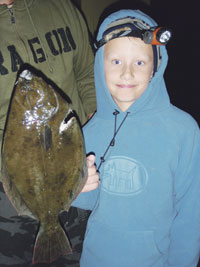 Darcy's first flounder from a few years ago, and the fish that piqued his interest in spearing. |
One of my most exciting memories as a kid was going flounder spearing with dad. The prospect of being allowed to stay up late; the pungent wafts of kerosene and the hiss of the tilly lamp; sneaking through the darkness, eyes as wide as dinner plates, peering through the calm estuary waters for a sign of the elusive flatfish delicacy.
On one excursion during a family holiday up north, we were plodding through the long kikuyu on the beachfront, wielding sacks and spears, when dad cautioned, 'watch out for the hole”.
'What hole…arrghhh” my tender young voice pierced the still night air as I fell into a six foot chasm into complete darkness. Undaunted, those early days of floundering are special memories and I'm enjoying seeing the new generations picking up the thrill of the kill; and enjoying the cruisy flounder breakfasts at the bach the next morning.
These days the tilly lamps have been superseded by a variety of flashy new electronic lights, and while it's taken some of the atmosphere and romance away from flounder spearing, it's added some practicalities.
The greatest benefit has been the ability to run lights under water, which improves fish spotting immensely, firstly by eliminating wave distortion; but also putting the light source very close to the sand, so every little contour is dramatically highlighted. Much like a plasterer shining a light over a wall to spot humps and hollows, the flounder stand out impressively on the seabed when the light source is from the side.
Our early efforts to make electric lights found mixed success. Full size 12 volt light bulbs, sealed into jam jars, worked pretty well, although they needed a car battery lugged around in dinghy or kayak to power them. Smaller bulbs were okay and didn't suffer the same heat build up, but it was hard to find ones powerful enough, with a narrow beam.
The advent of little halogen downlights, running on 12 volts, revolutionised the home-built flounder light scene, and it wasn't long before commercially-made models meant it was a bit pointless to build our own.
Lately, even the halogen lights and their bulky batteries have been upstaged by the LED lights, now with AA batteries in their handles. Some turn on automatically when immersed in seawater, taking away any issues with overheating in the air while turned on, then cracking once submerged.
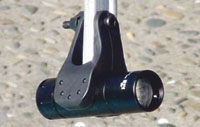 The three watt cree LED submersible. |
These days we're using single 3watt cree LEDs with Lithium rechargeable batteries, giving a burn time of four hours on low, or an hour or so on high beam and 250 lumens. They're light, powerful and a far cry from the complications of batteries, cables or the kerosene lamps of old.
These underwater lights can also be used for squid fishing from the boat – but that's a yarn for another day.
Headlamps can be used in a pinch, on very calm nights. But it doesn't take much of a surface ripple or a bit of sediment in the water, for above-surface lights to become suddenly quite less effective. We flick them on once a fish is speared to locate the bag; and for getting to and from the fishing grounds, otherwise, they're off while the underwater lights are on.
Spears can be as simple or as complicated as you want. The old timers used anything from stiff wire to parts of old farm machinery. I remember us boys always had single prongs, but dad had the Rolls Royce version – two pitch fork prongs. Once speared, the shaft was driven deep through the fish, into the mud. Then a hand was slid under the fish, holding it on the shaft, till it was manoeuvred over the sack or fish bin. The flounder was then easily slid off the spear.
These days, many spearos use barbed spears. It means the fish can be pulled from the water with one hand, leaving the other free to open the catch bag or bin. The fish is harder to remove, but generally there's less chance of an escape.
We always try to spear flounder from directly above to avoid the light-bending parallax, aiming just behind the head, to avoid spoiling any of the good eating flesh. If you manage to strike the headbone or gill plates, the barbs may not engage, so the old ‘hand underneath' technique is a good fall-back plan.
There's great debate in our family as to the best time for floundering. Dad always says it needs to be a calm night with no moon, no rain and an incoming tide. Getting all those prerequisites lined up doesn't leave many good nights in a year!
|
|
But generally, as long as the tide is rising, there's a good chance of nailing one or two. Sandy estuary flats are good. The flounder will be lurking in the channels, just waiting to have a crack at the crabs as the tide rises. They are in shallow. You don't have to get your shorts wet usually, just ankle depth provides good size fish. Best policy is to walk into the current, so the stirred up sediment doesn't cloud your view ahead. The edges of harbour channels, ocean surf beaches and any sandy areas with crabs will attract flounder. Sometimes you can walk for miles and not see any, then find three or four within a few steps.
Flounder are most bountiful and in top condition in summer. There's a few around in winter, but much sparser and you've got to be a bit hardy to leave the comfort of a cosy fire to waddle around in cold seawater. We've had winter success drifting in kayaks – tucked up warm under a spray deck, with a tottie for good measure; underwater light on one side of the kayak and spear in the other hand – poling along quietly. You need a barbed spear for this technique to successfully boat a fish. It does mean you can fish deeper water.
They are very simple to clean, probably the easiest of any fish. A small slit with a knife just behind the right gill, or on the underside and the guts and organs can be flicked out with your finger. A quick sluice in seawater and it's done.
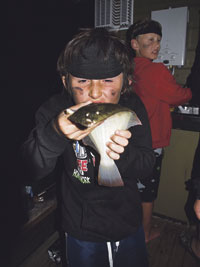
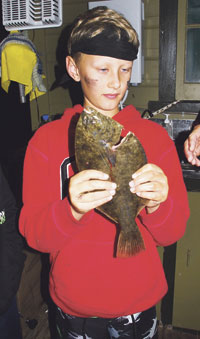
Our latest outing was a special request from grandson for his tenth birthday. With three mates, we trudged the mudflats for an hour. They bagged two and missed several. We mulled over many that were legal size, but felt it better to leave them for another day. The boys had a ball – the excitement of spotting even a small flounder was electric. Plus they heard bird and animal calls, marvelled at the speed of herrings darting around in the light, gave some eels a hard time and spent a lot of time pulling their shoes out of bog holes. Eventually, they figured floundering was better with bare feet – pretty much as the ancients did it.
The breakfast was equally entertaining, granny cooking up the flounder on the barbecue and the lads helping themselves to delicious portions of fresh, white fish.
I'd urge anyone having a go at floundering: Don't feel you have to fill the bag. One or two each is usually plenty. Our policy is restraint. It's about the experience, not the bag limit. We don't freeze flounder, but prefer it fresh and only catch enough for the morning. So generally 2-4 is enough. There's no point nailing everything in sight, struggling back to shore with a bulging bag, ending up with a big cleaning task and potentially leaving fewer for the future.
I cringe when I hear stories about people going netting and filling the freezer with 40-50 fish. Not only is it well over the legal limits, but from a sustainability point of view, senseless. We want our offspring and theirs to have enough flounder around for generations to come.
Many thanks to my forebears for lighting the lamp and igniting that primeval urge to hunt with spear. It's a simple satisfaction that has to be experienced to understand.