


New Zealand's underwater mountains are home to unique animal communities which need careful environmental management.
That is the message following research from Victoria University of Wellington and the National Institute of Water & Atmospheric Research (NIWA).
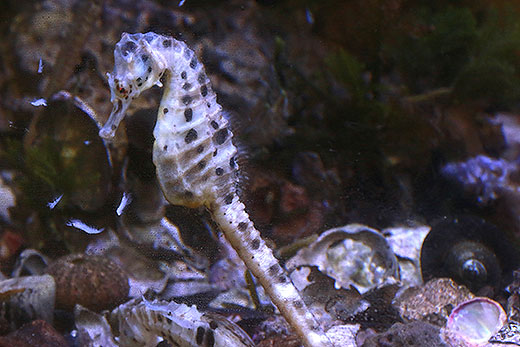
Seahorses are just one of many creatures that benefit from the mineral deposits.
The collaborative deep-sea study discovered that the hydrothermal activity of these mountains - known as seamounts - helps to create unique sets of biological communities.
PhD student Rachel Boschen, working under the supervision of Professor Jonathan Gardner from Victoria's School of Biological Sciences and Dr Ashley Rowden and Dr Malcolm Clark from NIWA, says seamounts generate special minerals due to their location near tectonic plates.
'Cold water filters through the seabed, heats up and shoots out as hot acidic water,” explains Rachel.
'As this water cools, minerals containing gold, silver, copper and zinc form giant black chimneys on the sea floor. These chimneys collapse and reform, creating large mounds of metal-rich mineral deposits.”
These mineral deposits are hugely valuable, not only for mining but also to deep-sea species, she adds.
Rachel says: 'Some of the chemicals, such as hydrogen sulfide and methane, support communities that exist without sunlight, instead relying on bacteria that metabolise chemicals from the hot water.
'Animals in such communities can't survive away from the sites that supply these chemicals.”
The research team studied three seamounts along the Kermadec volcanic arc, each with different levels of hydrothermal activity.
By towing a video camera at depth from a ship and using an echo sounder, they were able to gather data on local ecologies as well as the environment and terrain.
'We found that each seamount has a unique groups of animals,” says Rachel 'Depth and seabed terrain helped to explain differences in communities but the most important driver was hydrothermal activity.”
The study, published this week as a featured journal article in Marine Ecology Progress Series, may have implications for the mining of these areas.
'To carry out seabed mining you must have protected ‘set-aside' areas to conserve ecologically important parts of the seabed,” she adds.
'But because each seamount contains unique communities, you may need to have a number of set-aside areas distributed over multiple seamounts to protect all of them.”
The results also suggest seamounts with low hydrothermal activity may support communities not found elsewhere within the region.
'Previously it was thought the protection of communities at sites where hydrothermal activity was low or had ceased was of less concern,” says Rachel.
'But the groups of animals at these sites don't exist elsewhere, suggesting they need to be protected as well.”

2 comments
Overit
Posted on 19-03-2015 12:36 | By overit
This is very important to protect the oceans. I watched Wild Coasts last pm and it was said "if we lose the oceans, humanity will be lost too. Plants on land give us 50% of our oxygen, and plants ie. seaweed, lichen, give us the other 50%.
@overit
Posted on 20-03-2015 06:02 | By Jimmy Ehu
start by advocating for the eradication of the black swans in our harbour then!!!!.
Leave a Comment
You must be logged in to make a comment.