


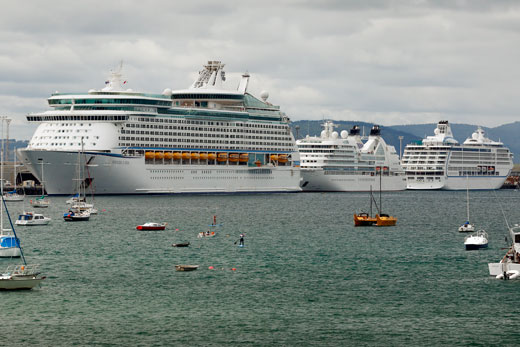
While the three cruise ships at the Port of Tauranga today are good news for the region's tourism trade and local businesses, their operators have come under attack from a prominent environmental group.
The vessels in port today include the 312m-long Voyager Of The Seas, capable of carrying about 3000 passengers, the 216m Seven Seas Mariner with about 700 on board and the 199m Seabourne Odyssey, capable of carrying 462.
The three ships in Tauranga Port today. Photos: Bruce Barnard.
However, all three have failed the environmental assessment set by international network Friends of the Earth.
Though millions of passengers take cruise holidays every year, the organisation maintain that taking a cruise is more harmful to the environment than many other forms of travel.
Friends of the Earth's 2014 Cruise Ship Report Card marks each of today's ship operators with a ‘D' based on environmental and human health impacts.
Voyager of the Seas' operator Royal Caribbean International receives As for sewerage and water quality, but an F for air pollution, while Seven Seas Mariner's operator Regent Seven Seas Cruises is marked with a C+ for sewerage, an A for water quality and an F for air pollution.
The Seabourne Odyssey is marked A for sewerage and F for air pollution.
All of the operators receive an F for transparency – meaning they failed to co-operate with Friends of the Earth's information gathering process.
Their intention is to pressure cruise lines into cleaning up their act by influencing passenger choice on environmental grounds. The report card enables passengers to choose a cruise line with a better environmental record.
The U.S. Environmental Protection Agency estimates a 3000-passenger cruise ship like the Voyager Of The Seas generates 150,000 gallons of sewage per week — enough to fill 10 backyard swimming pools, which adds up to more than a billion gallons of sewage a year for the industry.
Cruise ships are also responsible for significant air pollution from the fuel they burn, which Friends of the Earth claim can lead to serious human health problems, especially in port communities.
Cruise ships often continue to run their engines while alongside to power the ship's systems, though some cruise lines are now running via off-shore power.
According to the EPA, each day an average cruise ship is at sea it emits more sulphur dioxide than 13 million cars and more soot than a million cars.
Friends of the Earth's Cruise Ship Report Card compares the environmental footprint of 16 major cruise lines and 167 cruise ships.
The grading methodology marks the cruise lines on four environmental criteria: Sewage Treatment, Air Pollution Reduction, Water Quality Compliance and Transparency.
The grades for each of the four criteria were averaged to calculate the final grade for each cruise line.
The three ships expected alongside on February 14 are Voyager Of The Seas, L'Austral and Diamond Princess.

2 comments
Meanwhile
Posted on 07-01-2015 21:51 | By Capt_Kaveman
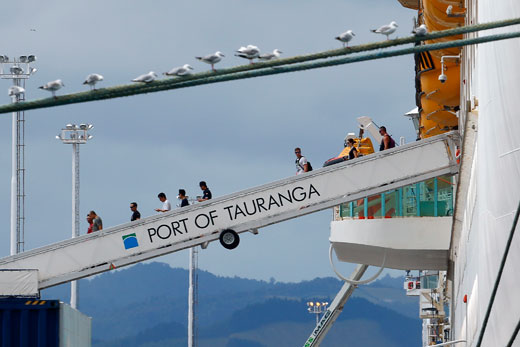
The gulls dont give a toss and while resting on the rope they just might leave a deposit behind
Pass the Gold test
Posted on 07-01-2015 23:27 | By Murray.Guy
These cruise ships may not pass some 'green test' in the opinion of someone BUT they certainly pass the 'GOLD TEST'!
Leave a Comment
You must be logged in to make a comment.