


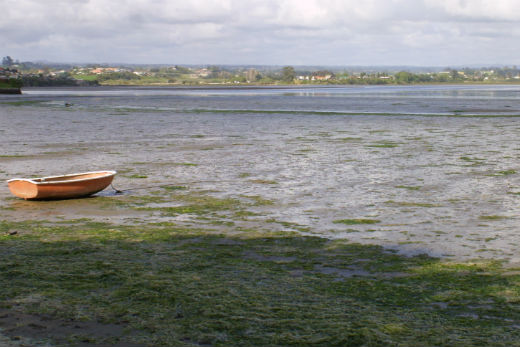
Bay of Plenty Regional Council remains alert to what is forecast to be a 'large” amount of sea lettuce this summer, despite a subdued start to the season.
So far this summer the regional council has received five complaints and inquiries relating to five different parts of the harbour from Ongare Point at the northern end to Tauranga City harbour and ocean beaches.
Sea lettuce. Photo: File.
A naturally occurring green algae native to New Zealand, sea lettuce can cause problems when it grows during summer months and is deposited on beaches and foreshore areas in large quantities
Bay of Plenty Regional Council strategic communications manager Sue-Ellen Craig says on top of the five inquiries there have been two clean-ups at city beaches, in front of Fergusson Park and Kulim Park.
The regional council and Tauranga City Council work in conjunction to employ a contractor who has specialised equipment for clean-ups.
No figures for the total tonnage removed from the beaches have been released, but Sue-Ellen says it sits with preliminary figures at the same point last year.
'It's an El Nino year,” she says, 'so we have been expecting sea lettuce will be quite large because of the westerlies. As expected at this point in time, nothing more nothing less.
'I do know right back at the end of September we were surprised we hadn't received as much as we thought we would.”
Sea lettuce varies in abundance from year to year and place to place. Its presence is most strongly influenced by uncontrollable factors such as wind, tides and coastal currents which affect water temperature and natural nutrient levels.
Research by Regional Council has shown that large sea lettuce blooms in Tauranga Harbour are a natural event that is linked to the El Nino weather pattern, when persistent westerly winds drive coastal water offshore.
According to the regional council the green algae tends to find its way back to the beach year on year because of the clear, shallow and temperate waters of the Tauranga Harbour, Maketu Estuary and Waihi Estuary, which all provide an ideal habitat for it.
The blooms of sea lettuce have been checked every two months since 1991 by the regional council.

1 comment
Westerlies?
Posted on 05-01-2015 13:11 | By YOGI BEAR
That would mean that the sea lettuce would head out to sea, or at least in the Opotiki direction. So the theory based on El-nino makes no sense. The more realistic answer is that the sea has been usually cool this spring, now that it is warming up the lettuce growth has exploded and now is washing up mega fold. The nutrients are there in the habour regardless as the main source is resulting from human residues and fertilizer dumped into the habour and immediate ocean areas.
Leave a Comment
You must be logged in to make a comment.