


The pressure is on the Bay of Plenty Regional Council to begin dredging the Opureora Channel before the resource consent expires at the end of July 2015.
The channel, filling in.
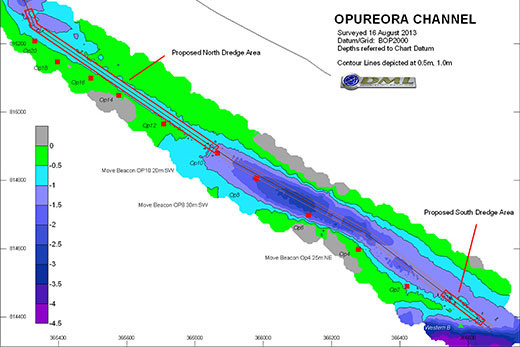
The Opureora Channel is a dredged channel about 1.8km long and the main access channel to Matakana Island for the Omokoroa vehicle ferry, and it is silting up.
'I was on the ferry mid-December at low, low, tide and he touched the bottom, swirled around a bit,” says, BOPRC's Tauranga Harbour principle advisor Bruce Gardner.
'If he'd had a loaded milk tanker on board we would have been in trouble.”
Bruce says it's not just day-to-day to access, but emergency services also need to get to Matakana Island from time to time.
A rescue helicopter has been used to get sick or injured people off the island in a hurry, but they cannot always operate.
There was an occasion when high winds prevented the chopper operating, with surface transport being the fall back.
The issue is the council needs to vary the resource consent, says Bruce. There is a consent to do dredging but no corresponding consent to get rid of the dredged material.
'We have to get that; and secondly, we want to alter conditions around the existing dredging consent because when it was applied for it was believed the best way of going about the dredging would be by using a specific method – a digger on a barge – so the consent is kind of tied to that method.”
A report by Tonkin and Taylor released in May 2014 shows using a cutter section dredge, and piping the dredged material somewhere, means the project can be completed significantly cheaper.
Tipping the dredgings onto the Opureora spit will cost $380,000 compared with the $565,000 estimate for transporting it to Matakana Island, or $622,000 to carry it across to Omokoroa or Motuhoa or Rangiwaea.
The digger on barge consent restricts digging to the outgoing tide, limiting the time that can be spent on the job each day.
'If we didn't get a change to the consent then whoever wins the tender would be restricted to just using an excavator on a barge,” says Bruce.
The July 2015 deadline means BOPRC has eight months in which to begin a consultation process, obtain variations to the original consent, go through a tendering process, award a contract and get the contractor up and running.
'So it's going to be a busy time. We are just in the very final stages of getting the consent applications prepared.
'We need that so can at least start doing some consultation before Christmas.
'The application may not be lodged but we can get the consultation largely underway, get the feeling of potentially interested and affected parties so we can work on anything that can come out of consultation during that Christmas break with a view to lodging the application early in the New Year.”
The dredging consent allows for up to 12,000m3 of material to be removed from the Opureora Channel over an area 20m wide by 850m long.
The vehicle ferry requires a minimum water depth of 1.2m below Chart Datum for all-tide access when fully loaded.
The council is considering an overdredging buffer of 200mm resulting in the following two dredging volume scenarios: 10,500m3 based on a minimum cut depth of 1.4m below Chart Datum, or 7100m3 based on a minimum cut depth of 1.2m below Chart Datum.

0 comments
Leave a Comment
You must be logged in to make a comment.