


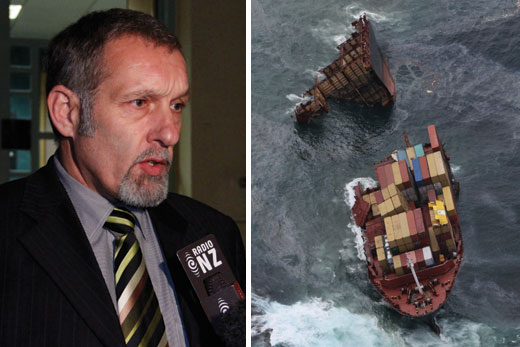
Lessons learned in the grounding of the Rena on Astrolabe Reef will be part of an extensive coastal navigation safety review undertaken by Maritime New Zealand.
The review, starting next week, looks to identify risks and assess current and potential safety measures as part of a focus on developing an intelligence-led, risk-focused approach to maritime safety.
Maritime New Zealand director Keith Manch and the Rena as it broke up in 2012.
'In order to appropriately manage risks in the coastal environment we need an accurate and up-to-date picture of what those risks are,” says Maritime New Zealand director Keith Manch.
'We are seeing an increased number in ship visits to New Zealand, an international trend toward larger ships, and technology changes in the field of navigational aids – all these factors mean a review of coastal navigation risks is timely.”
The review process will involve consultation with government agencies, local government and private sector interests. It will consider such issues as types of activity being carried out in the coastal environment, human factors, and technology.
Keith advises the review is not a response to any particular incident, but says MNZ will consider what can be learned from major incidents, such as the grounding of the Rena.
The containership struck the Astrolabe Reef, about 25km off the coast of Tauranga on October 5, 2011. The ship leaked more than 350 tonnes of heavy fuel oil into the environment and broke up, spilling containers and cargo into the ocean, washing up on beaches across the Bay of Plenty.
Just this month 53 businesses seeking redress for losses sustained over the grounding settled with the former containership's owners and insurers in a confidential agreement.
Bay of Plenty Regional Council maritime operations manager Reuben Fraser believes any work being done to assist with the management of risk in the coastal environment is a good thing.
He says council looks forward to contributing to this piece of work having previously worked with MNZ on the reviews of both the Port and Harbour Marine Safety Code and the Harbour Control Functions for Large Ships.
Keith says the first phase, likely to take about 12 months, will involve assessing the nature of risks around coastal navigation and how they are being managed.
"We are taking an open-minded approach, so the first thing to do is establish what risks actually exist and what measures are in place to address them," says Keith.
"If changes are recommended as an outcome of the risk assessment, then the next step will involve consideration of options to improve coastal navigation safety."
The annual numbers of ships, voyages and port calls are continuing to increase year-on-year since 2009/10. Voyages are defined as ships arriving, leaving, or arriving and leaving New Zealand within the stated time period.
In the 2010/11 year, 790 ships made 2,167 voyages and 5386 port calls. In the 2012/13 year, 869 ships made 2342 voyages and 5622 port calls.

0 comments
Leave a Comment
You must be logged in to make a comment.