


Today kick-starts Elder Abuse Awareness Week and Age Concern is urging New Zealanders not to turn a blind eye if they suspect an older person is being abused or neglected.
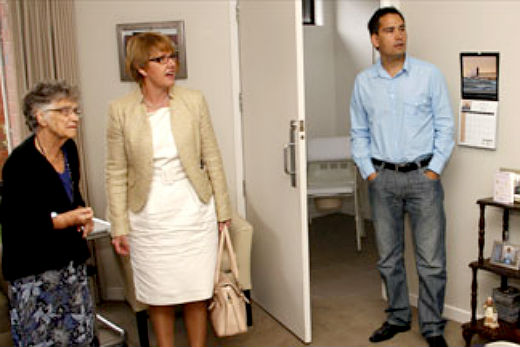
Senior Citizens Minister Jo Goodhew and Tauranga MP Simon Bridges during a visit to Tauranga last year.
Elder Abuse Awareness Week runs from June 15-22 and the purple ribbon campaign aims to inform people that elder abuse - including financial, psychological, physical abuse and neglect - is a widespread issue in New Zealand.
Chief Executive of Age Concern NZ Robyn Scott says people need to pay more attention to the signs and realise that elder abuse is happening in their communities.
'You might think that elder abuse doesn't happen in NZ, but it does. Age Concern receives eight referrals of elder abuse every working day.”
Robyn says nationwide, Age Concern's Elder Abuse and Neglect Prevention (EANP) services receive more than 2,000 referrals each year.
'We know that's just the tip of the iceberg. But it doesn't have to be this way. The more people understand about elder abuse and what they can do to stop it, the better.
'It's vital that people speak out if they believe an older person may need help. We urge people to contact their local Age Concern or the local authorities if they suspect an older person is being abused or neglected.
'Don't let fear of meddling in someone else's business stop you from reaching out and helping someone. It is time to stop elder abuse and if we all pull together and decide to take an active role, we can achieve this,” she says.
Age Concern also works in communities to educate people about the signs and effects of abuse to help prevent it from happening and how to challenge disrespectful attitudes towards older people.
Elder abuse is fuelled by ageist attitudes and lack of respect for older people. Age Concern's EANP teams work closely with older people and their families to resolve issues of abuse and ensure it does not reoccur.
In NZ the most commonly reported types are financial and psychological abuse.
"Some people think that because someone is old it doesn't matter what happens to them anymore or they don't need money to spend,” says Robyn.
'They make decisions for the older person without even asking them what it is they want. Or, they ridicule them about the decisions they do make. Sometimes, they pressure older people into doing things they don't really want to do – like giving a loan, selling their house or letting a family member move in with them for free.
"Attitudes like these show a lack of respect for the older person, for their quality of life and for their needs.”
Robyn says three quarters of elder abuse and neglect in NZ occurs at the hands of family members. About half of abusers are adult children and about half of the abused elders are over 80-years-old.
'This is one of the reasons it stays hidden. Many older people feel ashamed their own flesh and blood is treating them badly, so they won't talk about it,” she says.
'We know that family are very precious to older people. We help people recognise that older people have a lot to contribute and are very valuable members of families and the community.”
Senior Citizens Minister Jo Goodhew says older people are entitled to feel safe and live free of fear.
'Elder abuse can take many forms and includes behaviours or neglect which causes physical, psychological, financial or sexual harm to an older person."
Jo says Elder Abuse Awareness Day is a timely reminder that a whole of community approach is needed to address this issue.
'Communities need to share responsibility for their older people's wellbeing. In a caring, inclusive community, elder abuse and neglect will not go unnoticed.
'As a Government, we want an environment where older people can live life as healthy, independent, connected and respected members of our communities.
'I express my gratitude to all those who work to fight elder abuse and neglect, to raise awareness, and provide support and training. It's through the efforts of these people that older New Zealanders are supported to live safe, healthy lives as active and valued members of our communities.”
There are 24 government-funded specialist EANP services across NZ, with two new specialist services being established in Wairoa and in Rotorua, which will also cover Kawerau.
'I urge anyone who is worried about their situation, an older person or relative, to seek further information on EANP services," says Jo.
"These can be found on the Ministry of Social Development's website or by calling the Family Violence Information Line on 0800 456 450."

1 comment
Sad but necessary.
Posted on 15-06-2014 15:08 | By morepork
To most of us it is hard to conceive how this could happen, but it obviously does, and a week to raise this issue is a very good idea. The same mentality that thinks it is OK to bully kids and be cruel to animals, would think it's OK to do this. Anyone in this category needs to think again and realize that the community as a whole is not prepared to stand for it. Victimizing people who are weaker than you has to be seen to be not an option, whether it is at school, in the workplace, at home or in the retirement village. Remember that what goes around comes around, and even if you think you're the fastest gun in the west, one day you'll meet someone faster...
Leave a Comment
You must be logged in to make a comment.