


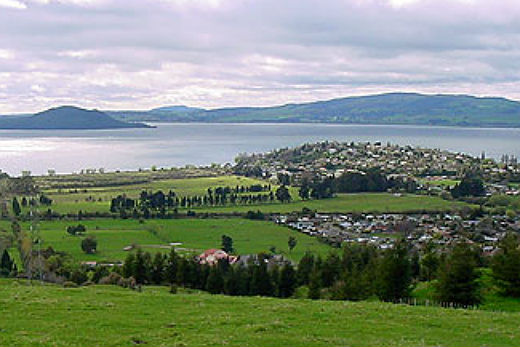
The competition to find a way of reducing Lake Rotorua's nitrogen levels has failed to find a winner, but Bay of Plenty Regional Council says it has raised awareness of the burden.
Photo: file.
The Innovation Challenge needed to provide long-term, measurable nitrogen reductions and research and analysis detailing the solution's economic viability.
But the competition with a $20,000 prize failed to find a winner, the judges announced this week.
'The Challenge has reinforced that there is no silver bullet for landowners to reduce nutrient losses. Landowners will need a suite of solutions to reach the nutrient reduction targets,” says judge Bill Murphy.
'While we didn't get an overall winner, the Challenge has helped raise awareness of the Rotorua Te Arawa Lakes Programme and the challenges in particular for the Lake Rotorua catchment.”
The competition was run as part of the Rotorua Te Arawa Lakes Programme to find solutions to reduce nitrogen from land use for water quality objectives.
Entries ranged from changes to land management practices and robotic devices to treat urine patches, to alternative horticultural crops that can be grown in the Rotorua district.
Before final judging, all entries had to pass a science panel of nutrient experts to assess nutrient calculations. Three entries failed to pass the science panel review.
'After much discussion we decided not to award the $20,000 prize money,” says Bill.
'We scored each entry based on the level of innovation, the significance or scale of proposed solution and the business analysis supporting the feasibility of the idea.
'We found some entries were really innovative but didn't provide the business analysis to support the solution or feasibility. Other entries, while feasible, didn't score well on the innovation side. Overall no entry scored over 50 per cent and we could not in good conscience award the prize.”
The 12 entries will be used to start a toolkit of alternative land-use options for landowners, says Bay of Plenty Regional Council General Manager Natural Resource Operations, Warwick Murray.
'We are committed to helping find solutions for nutrient reductions and will continue to work with the community, farmers, industry and research institutes to provide options for landowners,” says Warwick.
Seventy per cent of the nitrogen entering the lake comes from agriculture.
Nitrogen entering the lake needs to be reduced by 320 tonne per year, says Warwick. To achieve the target an integrated approach of rules and incentives will be used, and farmers and landowners in the catchment need to be involved.
'We need to reduce the impact that farming has on lake water quality through both best farm practise and land use change. To do this we need buy-in from farmers and to include them in the process,” says Warwick.
The sustainable nutrient load is estimated at 435 tonnes.
'Our previous activities focussed on treating nutrients in the lake, and this has provided great short-term benefits.
'To reach long-term sustainable targets, the way we use the land needs to change. We need to stop the nutrients entering the lake. We need to turn off the nutrient tap up in the catchment.”
The judging panel includes founder of Bay of Plenty's Enterprise Angels, Bill Murphy, Scion CEO Dr Warren Parker, creator of Waikato's entrepreneurship hub SODA Inc, Cheryl Reynolds, and former NIWA chief scientist on the NIWA science executive Dr Charlotte Severne.

3 comments
Every Simple
Posted on 16-06-2014 08:10 | By Capt_Kaveman
ban non organic fertilizer and reduce the number of dairy/km and plant more fruit and veges,now where do i collect my 20K?
Nitrogen Pollution
Posted on 16-06-2014 09:12 | By peecee09
Farmers must take responsibility and stop this disgusting ongoing pollution of our lakes and waterways.Last week I observed a dairy herd overnighted for several nights right on the stopbank of the Pongakawa stream.The ground was muddy and wet and the effluent was flowing directly into the stream. Illegal ? Ithink so. Dissgusting ? Definitely !!! The farmer concerned should be prosecuted or dealt to by Fonterra.
Been down Kopurererua Valley (Route K)
Posted on 16-06-2014 12:19 | By Murray.Guy
Been down Kopurererua Valley (Route K toll road). 300 or so hectares owned by Tauranga City Council ratepayers and in part leased for cattle grazing! Through the centre and heading directly into the (Tauranga) harbour we have Kopurererua river/stream that fills with effluent every time it rains, especially so in times of flooding!
Leave a Comment
You must be logged in to make a comment.