


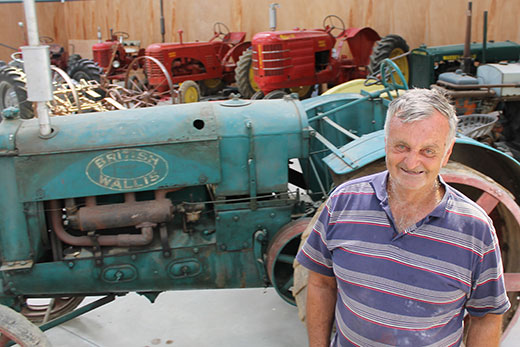
John Walsh collects stories – but not in the form of books and the written word. Few libraries would be big enough to accommodate them.
Instead the stories John's been gathering for 20 years are ‘told' by 53 tractors and countless implements on the Walsh family farm near Morrinsville.
John Walsh, with one of his favourite and rarest tractors – a British Wallis tractor built by Ruston & Hornsby of Lincoln under licence from the J.I. Case Plow Works, Racine, Wisconsin.
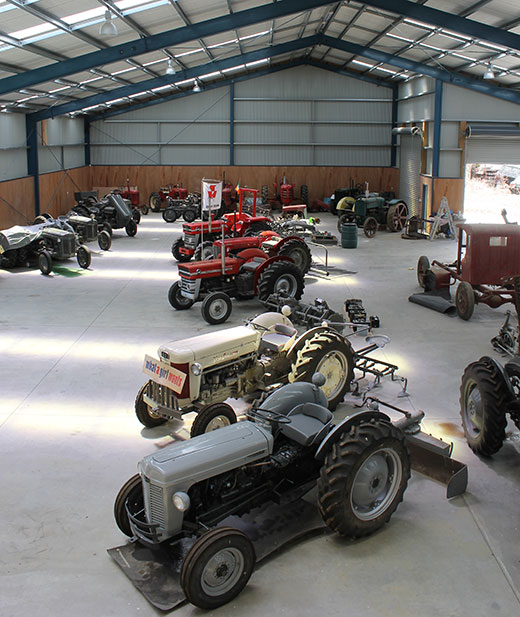
O'Neill Engineering of Morrinsville built the huge single-span structure to house John Walsh's tractor and machinery collection.
'Every one of these tractors and pieces of machinery has a story. It's the story of our history. That's why I like collecting them,” says John, who has restored most of the tractors on show in the large building he commissioned for his private museum.
O'Neill Engineering of Morrinsville built the huge single-span structure to John's specification – it had to be light and airy, have no internal pillars and have doors high and wide enough to allow access to some very large machinery. As well as the open display space, there is also a 'proper” library filled with books about tractors and machinery, including rare tractor manuals.
'I wanted a high stud in the building so when I start a tractor or vehicle for visitors, they didn't get overcome with fumes,” says John.
His love of machinery goes back to childhood and growing up on the farm his parents Theo and Mavis Walsh bought in 1942.
Fascination
Theo was more used to horse-drawn farm machinery but John had a fascination for 'modern” machines – and early on he showed an aptitude for repairing them when a neighbouring farmer encouraged him to 'have a go.”
'He used to say: ‘don't be afraid to try to fix something', and with the early tractors and machines, everything was very mechanical and not hard to figure out.”
John's been figuring out, fixing and restoring machinery ever since.
Theo Walsh's first tractor was a Ferguson and John has its burnt out remains, which he might restore one day, but also has a complete tractor very similar to his father's. In fact, much of his collection comes from the Ferguson and Massey Ferguson stables.
John is fascinated by the ingenuity of tractor pioneers like Harry Ferguson and can talk knowledgably about his inventions, which enabled tractors to not only tow but also to operate a range of mechanical implements, revolutionising farming.
It was Harry who patented the linkage to integrate and control implements fitted to tractors in 1925 and later the ‘suction side' hydraulic control system for three-point mounted implements. These developments were largely responsible for the success of Ferguson and later Massey Ferguson ‘Ferguson System' tractors, including the well-known (and well-loved) TE and TO 20 models.
David Brown
In 1936 Harry went into partnership with David Brown and produced about 1300 Ferguson Brown tractors for two years.
'Harry fell out with David Brown because he was experimenting with bigger tractors, which were heavier than horse and plough, which was the weight Harry believed tractors should be. After that David Brown developed his own tractors,” says John.
John recounts how in 1938, Harry demonstrated his tractor to Henry Ford, the famous American car manufacturer, on Ford's estate and the 'gentleman's agreement” – a handshake – which saw Ford producing Ferguson tractors in Detroit by 1939. About 300,000 Ford Ferguson tractors were produced up until 1947.
Among John's collection are tractors and implements which are examples of the engineering evolution of 20th Century's agricultural machinery; and he provides an informative commentary on each as he guides visitors around his museum.
Mechanic
The introduction of the first tractors to New Zealand didn't just transform agriculture; it also gave a boost to other rural industries. 'Many of the men who returned home from World War 2 had difficulty finding jobs; and those who had been mechanics, set themselves up to repair and maintain farm machinery,” says John. When new tractors became available, many of those rural mechanics were offered dealerships and so became agents as well as mechanics.
However, new tractors were so much in demand, and in such short supply, dealers began buying back near-new tractors from farmers who had bought them the year before, selling them the latest model and on-selling last year's for as much as it cost new.
'In reality, the new models often weren't much better than the previous one.”
Among John's tractors is a Ferguson halftrack, which has caterpillar-like tracks on four of its six wheels, giving it the ability to work in conditions where other tractors can't.
'There's one at Pukekohe, which was used recently by a market gardener when all of the modern tractors were getting stuck,” says John.
Hillary
The 1955-1958 Commonwealth Trans-Antarctic Expedition used seven Ferguson TE-20s and some were fitted halftracks, with steerable front skis, while others in the New Zealand team were fitted with an extra wheel on each side and full caterpillar-like tracks.
Reports back to the Ferguson company from the expedition say the tractors were capable of climbing a one-in-seven slope of 'hard polished ice where a man cannot walk without crampons”, as well as operating in conditions of minus 10 degrees Fahrenheit. Sir Edmund Hillary led the team which drove the tractors to the South Pole, where they were left for the use of American researchers. Two tractors from Hillary's party were later repatriated to New Zealand and went on display; one in the Canterbury Museum in Christchurch, and the other in the Museum of Transport and Technology Auckland.
The ingenuity of early engineers continues to amaze John, who is currently restoring a Ferguson-Twose mounted road roller. This ingenious adaption involved reversing the tractor onto a base frame, mounting it high up on the rollers, with the drive power of the tractor's rear wheels operating the roller drums.
Graveyard
Not all of John's tractors and equipment are bright, shiny and under cover in the museum.
There's also 'the graveyard” outside the former milking shed, where old tractors come to die, or be cannibalised for parts.
Other tractors and machinery awaiting restoration are housed in several sheds around the farm; and today John has the assistance of his son-in-law Mike Garrud to restore the machinery, and along the way learn something of their history.
'I just wish we could download all John knows about tractors and machinery onto a computer for future generations to access,” laughs Mike.
John, who is a member of the Waikato Vintage Tractor and Machinery Club, built the museum to display, protect and share his collection – but he doesn't charge visitors, and it's only open by appointment.
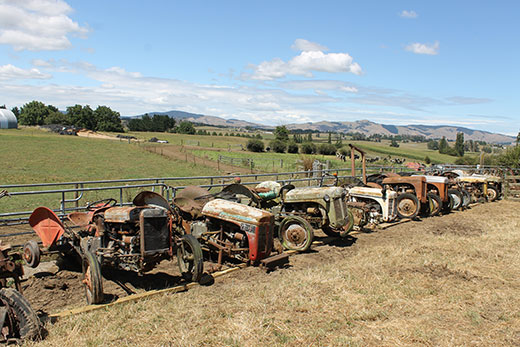
The graveyard – where old tractors come to die, or be cannibalised.
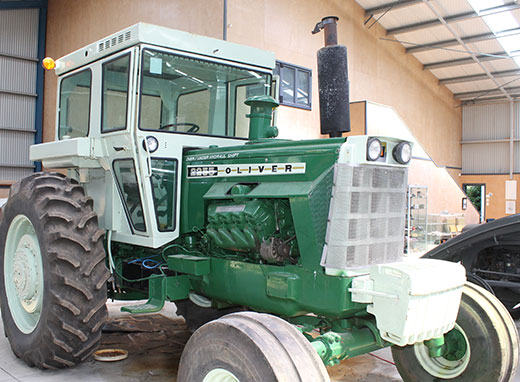
Bright and shiny – this Oliver tractor is among those on display at John Walsh's private museum.
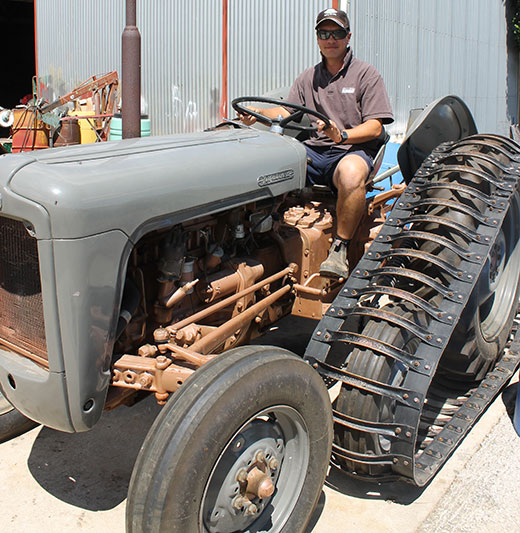
Mike Garrud, on the Ferguson halftrack tractor.
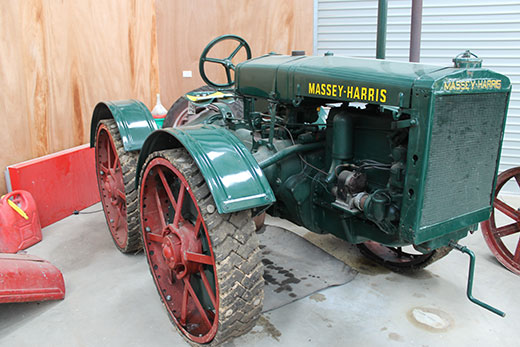
An early model Massey-Harris tractor.

0 comments
Leave a Comment
You must be logged in to make a comment.