


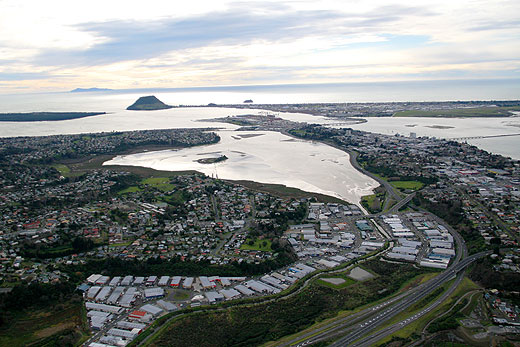
An accusation that planners and SmartGrowth related studies are a major cause of unaffordable housing in Tauranga is rejected by SmartGrowth BOP independent chairman Bill Wasley.
The recently released Demographia survey finds Tauranga and the Western Bay of Plenty is the second most unaffordable housing market in New Zealand and is 'severely unaffordable”.
Tauranga was the second most unafforable city in NZ.
On the unaffordable scale, which works by dividing the median house price by median income, Tauranga had a multiple of 6.6. Housing is considered unaffordable when median house prices are more than three times median income, or more than three on the scale.
The report says Tauranga-WBOP's median house price is $364,800, while the median household income is $55,000.
Auckland was the most unaffordable city with a rating of 8.0, with Christchurch third at 5.8. Wellington had a median multiple of 5.4, while Palmerston North-Manawatu, followed at 4.5 and Hamilton-Waikato, at 4.8.
The Demographia survey compares median prices and incomes in 85 major housing markets.
The survey also says house prices rising much faster than household incomes is invariably associated with urban containment policy, and is most evident in Australia, New Zealand and United Kingdom and some markets of Canada and the United States - all markets rated severely unaffordable.
'That could be one factor,” says Bill.
'They seem to relate housing affordability and land supply as the beginning and end of it, and in our view it is a somewhat more complex situation.
'And if the land supply is constrained and I'm not saying that is the case in the Western Bay, we would argue that with a current uptake rate of just under 500 lots per year there is probably enough zoned land in a range of locations for about 20 years.
'So, if there wasn't adequate land provision a constrained supply could contribute to housing unaffordability.
'We would argue that there's adequate supply throughout the Western Bay sub-region, that there's more to housing affordability than just the supply of land.”
While the supply of land seems to be the focus of the Demographia report, Bill says it doesn't seem to recognise the effect of the cost and provision of infrastructure.
He refers to the cost of transforming a paddock into a housing development with roads and the three waters; piping for water, sewerage and stormwater. Population growth and the cost of building materials also adds to the cost of housing.
The development contributions required of developers to pay for the infrastructure also varies across the country and internationally, says Bill.
In Australia a lot of the state governments pay for infrastructure, but in New Zealand there aren't that many options,” says Bill.
The New Zealand Government pay some roading subsidy, but the three waters are all paid for by local government.
The Demographia report writer, research scholar Alain Bertaud says affordable housing is affected by the same restrictive land use policies that have destroyed the historic relationship between house prices and incomes.
'Typically, land use policy authorities fail to compare credible measures of housing affordability with historical standards,” says Alain.
'When faced with the reality, housing costs rise disproportionately high relative to incomes, they seek to identify virtually any cause except for the principal cause itself: the destruction of the competitive market for land.
'By severely limiting or even prohibiting development on the urban fringe, urban containment eliminates the ‘supply vent' of urban fringe development, by not allowing the supply of housing to keep up with demand, except at prices elevated well above historic norms.
'In addition to higher costly housing costs relative to incomes, the higher densities in urban containment markets are associated with greater traffic congestion and longer average work trip journey times.”
'There is no silver bullet to increase the supply of affordable housing. But if planners abandoned abstracts and unmeasurable objectives like smart growth, liveability and sustainability to focus on what really matters – mobility and affordability – we could see a rapidly improving situation in many cities.
"I am not implying that planners should not be concerned with urban environmental issues. To the contrary, those issues are extremely important, but they should be considered a constraint to be solved not an end in itself.”
The Demographia International Housing Affordability Survey is produced to fill the gap left by urban planning policies that have largely failed to meaningfully monitor housing affordability in the areas under their jurisdiction, says Alain.

5 comments
He would defend it
Posted on 22-01-2014 12:47 | By Bronzewing
Bill Walsey was part of the group that dreamed up smartgrowth when he worked for Tauranga. It was ill conceived then and time has proven it. It has created career paths for many planners who slurp up public and private money and do nothing but expand their bank balances. Just ask Bob Clarkson what is is like to try and do something FOR the community rather than something TO the community
We are not overvalued...
Posted on 22-01-2014 13:36 | By jed
Look in auckland, where the land is bascially selling for over $1,000,000 for 600sqm+, and the house is only worth pocket change. I own what people might call a mansion in Mt Maunganui, yet, could barely afford a do-up in a mediocre suburb in Auckland. And, tauranga prices have fallen in real value by 35% since the GFC. Our problem is wages, not house prices.
Rastus
Posted on 22-01-2014 13:54 | By rastus
Anyone with their ear to the ground would realise that while 'Smart Growth' sounds like a laudable organisation, a little research will reveal that it is an insidious United nations ploy to control the worlds population - yes I can already hear you laughing but be warned it and its agenda are like a cancer slowly but surely taking control with the ultimate aim of 'one world' government - please don't just believe me but take the time to look into the whole rotten plot for yourself!
rastus
Posted on 22-01-2014 18:41 | By whataplace
Rastus your right, haha what a joke!
Surely
Posted on 23-01-2014 09:30 | By RawPrawn
Housing affordability be would better measured by assessing average prices and incomes, rather than median values
Leave a Comment
You must be logged in to make a comment.