



 Click the image above to view slideshow
With the 2014 kiwifruit season approaching, one Katikati family is reflecting on 30 years in the industry, celebrating Hume Pack N Cool's three decades cooling and packing the fruit.
In 1983, with expansion of orchards happening around him, the late Dave Hume had a vision of a need for coolstorage – so set about organising his four sons to do something about it.
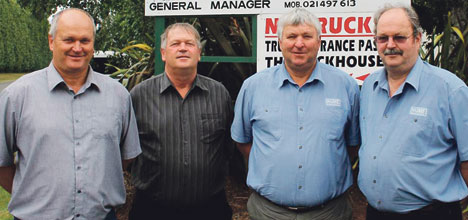
The Hume brothers today - Gavin, Owen, Mark, Jim.
Sons Jim, 32 at the time, Mark, 30, Owen, 28, and Gavin, 22, all had jobs – but a family discussion saw them build a 100,000 tray coolstore on Beach Rd, each taking on different parts of the business.
Back then, growing kiwifruit was a social, family affair with small packhouses on orchards, dotted around the Western Bay – but the dairy industry was struggling and the Government offered low interest Rural Bank loans to encourage orchard growth.
'They'd (small packhouses) service their own orchards and a couple of neighbours. Housewives and children would all come and pack the fruit – but security of coolstorage space was the problem,” says Owen.
'It was like a dairy farm without a cowshed.”
Given $5000 investment each by their father, the boys purchased a second-hand forklift, an office caravan and began a 36-hour work day. The Hume Pack N Cool site was underway and set up just before fruit arrived for the 1984 kiwifruit season.
With no other investment funds, the boys worked extremely hard, doing most jobs themselves.
'We were incorporated in March 1984 and until then were unable to borrow any funds,” says Jim.
'The early intention was a 100,000 tray coolstore; that got done. The next stage was ‘do we build a packhouse or another coolstorage?' – That was when we drew up a plan for the site.”
The second coolstore, a 150,000 tray facility, was built one year later, followed by a canopy.
Owen says the Government putting money into the industry saw massive planting of kiwifruit.
'But then they had to put a damper on it as demand came on – so it was hard to find money to keep up with the coolstorage. With enough orchards in the system, the interest rates jumped from three per cent to seven per cent.
'There were a lot of vines planted, so that growth projection was fairly steep, but there was a lack of money in the whole industry.”
Jim says Hume Pack N Cool's huge throughput in its first year saw big demand for coolstorage, which still wasn't satisfied.
The move away from smaller packhouses began. 'The economics had gone out if it; and hence, in 1987, we put the packhouse up here,” says Jim.
Owen says a major industry change was the NZ Kiwifruit Marketing Board going to single desk entry for kiwifruit exports, under marketer Zespri.
'Plus, I think the shift from all of the smaller packhouses to larger, centralised sheds was big too.”
For Jim, huge increases in the compliance measures contrasted the 1980s. Occupational health and safety requirements, employment laws and human resources processes all grew. 'So long as you weren't in the packhouse you could have smoke, or a cup of coffee while you were packing the fruit,” says Owen. 'Now, well it's a food product – so all of the standards have lifted right up – and it's just a matter of moving with the flow.”
For Owen, technology changes have been mammoth, and possibly most crucial to success.
The first grader had a start button, a stop button and a speed control – now Owen and Jim liken their machine to an aircraft carrier. 'You have a dashboard of speed controllers – it's like driving a 747,” says Jim.
'Every fruit has 14 photographs of it taken, it's analysed, weighed and by the time it gets to the end you know if it's good, bad and the weight, and the computer says where to put it.”
This in stark contrast to when people graded fruit by looking at every piece.
Owen says in the packhouse's year three record throughput saw the grader 'hanging out”. 'We were putting fruit in the cups to achieve 100 per cent cup full – that's maximum and all staff were trained and working absolutely well – we were on the edge at 2000 trays an hour.
'Now, we cruise at about 7500 trays an hour, and we've hit the nines and tens.”
Today, Jim says half of the fruit's quality is decided by computer and doesn't reach workers thanks to accurate data analysis, saying the machine can spot a blemish half the size of his fingernail and accordingly direct the fruit.
Today, mother Irene still keeps an eye on her boys.
Owen says Hume Pack N Cool couldn't have started without the family. 'You wouldn't have the investment and input from individuals. We were able to have the faith of our family trusting us to use the money as wisely as we can – and we worked hard for our own investment.
'Communication, trust and support for each other has been a big thing,” says Jim. 'We all know how each other works – if there's a problem, we sit down, talk it through, have a think about it and come back the next day with a solution.”
One particular advantage of a family-run business is much more cooperation.
'You're all in the same business; you can talk more freely about direction. But you have got a disadvantage of not having so much outside input,” says Owen.
Jim says the four brothers found they were thinking the same way – something Owen says means you need new blood, 'to give the outside perspective and constructive criticism”.
'It's part of being prepared to always be open for change and adoption.”
In 1991, Hume Pack N Cool was one of the first packhouses to form a grower pool; and in 1998 went from family owner to supplier shareholders, and a board of three Humes with four others.
Jim and Owen says there's always been competition between the packhouses but also a strong sense of cooperation – to achieve greater good for the industry.
A deal was once struck between Hume Pack N Cool and Seeka to trade shares for the use of coolstorage space. 'In fact, we were the third largest shareholder in Seeka at one point.”
While the Humes were looking to find funding for a presizer, Seeka called wanting to free up shares. 'There was the solution…the shares were sold to fund the project, so Seeka was happy and we had our presizer.”
The brothers say Hume Pack N Cool's growth and achievement is due to hard work and the dedication of wives, staff, growers and the community.
'All of that brought us to where we are today. When you look around, you can see the dedication to innovation and technology and what has arguably resulted in Hume Pack N Cool becoming one of the best set-up and most versatile sheds in the industry.
'Each step, each addition, each challenge came back to the people – everyone pitching in doing what needed to be done and doing their part.”
Owen says his father, who died 10 years ago, would have been 'as surprised as everyone else” to how the industry has gone. 'He'd have had the same vision, of building a 100,000 tray coolstore, but to look after your own and some other's fruit.”
And what Hume Pack N Cool once packed in a whole season is now packed in a day.
'We did about 80,000 trays in our first season – now we pack over that in a day. In a season now, we pack 3.5 million trays, with a capability of 4.5 million. And remember, that's 33 to 36 fruit in a tray,” says Jim.
Owen says the secret to the business' success is constant re-evaluation of every component – and that future challenges include Psa-V, then the world economy. He believes his father enjoyed what his sons achieved. 'In his own way, he was very proud”.
What started as one coolstore is now 17 coolstores, three dry stores, one pack house with five graders and presizers, an administration office and supportive facilities, 30 permanent and up to 250 seasonal staff, four supportive and successful sons and continued growth.
'If he saw it now – well, its mind boggling,” says Jim.



0 comments
Leave a Comment
You must be logged in to make a comment.