


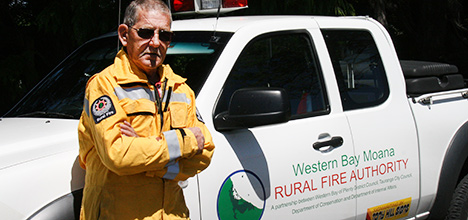
With the heat always on for the Western Bay Moana Rural Fire Authority during the busy summer period, this January its board, principal fire officer and volunteer crews have something to smile about – its turning 10.
Western Bay principal rural fire officer Barry Low, who was involved in forming the authority in January 2004, says it came about from duplication in resources by four local authorities and government agencies.
Western Bay principal rural fire officer Barry Low says Western Bay Moana Rural Fire Authority's 10th birthday is this month.
Back then, the Western Bay of Plenty District Council, the then Tauranga District Council, Department of Conservation and the Department of Internal Affairs were involved in providing fire control services to certain parts of the region.
'Each was a rural fire authority in their own right and maintained their own equipment and personnel – so we thought, let's put them together,” says Barry.
The Western Bay Moana Rural Fire Authority created a single rural fire district and equipment table to controls rural fire within the region and on offshore islands of Matakana, Mayor and Motiti
It's services include fire planning, permit issue, rural fire management and control, and a variety of legislative requirements under the Forest and Rural Fires Act 1977.
Involved in setting up the authority, Barry 'dropped out for a few years”, returning as principal rural fire officer five years ago.
Seeing changes in a decade, Barry says the authority is 'far better off” than when it began.
Today, it has a fire appliance and volunteer rural fire crew based at TECT All Terrain Park. Another rural fire crew is on Matakana Island. Te Puke has a large water tanker, while Greerton operates a smaller 4WD tanker/rural truck – with both tankers housed in New Zealand Fire Service stations. The authority also has a 4WD ute for principal fire officer duties; and has upgraded hose and pump equipment.
'So I think we're doing alright,” says Barry. 'We believe the level of service we provide is up there with the best.”
Barry says member agencies WBOPDC, Tauranga City Council and the DIA fund the authority, while while DOC support includes fire control expertise, equipment and manpower when required.
While the fire authority is known for issuing fire permits – and for following fires lit without permits – much more goes on behind the scenes, says Barry.
'All they see is the fire permit – and perhaps a bill if they've lit a fire without a permit – but there's loads more to it.”
The authority operates three fire seasons: Open (no permits required for open-air fires); restricted (A fire permit is required for all open air fires, with exception of gas-powered barbecues); and prohibited (total ban applies to all open-air fires, with special permits for specific emergencies).
The restricted fire season is imposed from October 1 to April 30 and a prohibited fire season can be enforced any time.
Barry says today the authority has a streamlined system for issuing permits, following up un-permitted fires, setting seasons and responding to fires in the district.
The authority contracts the district's 111 emergency fire calls to the NZFS, with paid or voluntary crews attending rural fires in their area.
'We cannot get the same region-wide coverage, so this allows us access to all of the volunteer brigades in the Bay and three full-time city brigades,” says Barry.
'If necessary, we can bring our own resources to a job. It takes time to organise that back-up, so the NZFS's immediate response capability is appreciated and highly valued.”
Follow-up to un-permitted fires usually sees a verbal warning for the fire-starter. From there, 'if the fire is costly or requires beyond one-hour's response time, further action can be taken”.
'If the NZFS charge the authority for attending an illegal or out-of-control fire, we'll pass the cost onto the person responsible for the fire. We'll also add our own costs to the bill.”
Barry says he is firm on this. 'I see no reason why ratepayers, who fund the service, should bear costs for a fire-starter who ignores permit requirements, fails to observe conditions, breaks the rules, or otherwise acts stupidly where fire is concerned,” says Barry. 'In some cases, prosecution of an offender may also be considered.” Imprisonment or heavy financial penalties can follow conviction for fire permit offences.
Fire seasons require constant weather-watching, and Barry says the authority also looks after region's offshore islands, areas of concern.
'Matakana Island's voluntary fire crew is a great job; they're the first response to fire and other emergencies on the island, but depending on the call we bring in additional resources; fire trucks, tankers, helicopters – whatever is needed to support them.”
Other areas to watch include TECT, a unique combination of commercial pine forest and public park facility – being a high-risk environment, a volunteer crew is based there.
'Another concern, under our jurisdiction, is the Mount [Mauao] itself – this is because it has high public access, year-round access and a high load, meaning it lots of trees, plants and dry grass which will make combating a fire on it difficult.”
Barry says these factors, coupled with difficult terrain, make combating fire on it 'difficult and costly”.
A welcome improvement is Tauranga City Council's high-pressure water pipe-line to a helipad on Mauao's northern side. 'This enables monsoon-equipped helicopters to load water without having to dip from the harbour.”
Surprisingly, Barry's position is the authority's only paid job. 'I am basically it, but I can call on volunteers and contracted brigades to help.
'I'm well-supported by member agencies, in particular by WBOPDC, where I'm based, and I've a number of qualified and experienced deputies,who provide welcome assistance on request.”

0 comments
Leave a Comment
You must be logged in to make a comment.