


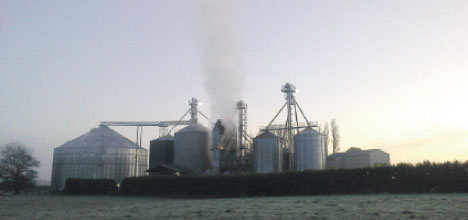
At the height of the autumn harvest, 100 truck and trailer units a day pass through PGG Wrightson Grains Waikato maize drying and storage facilities at Te Awamutu and Walton with wet maize grain coming in and dry grain being loaded out.
'We operate 24 hours day at the peak of the season, just to keep up with harvest,” says Te Awamutu Grain site manager Kevin Flaxman.
Misty morning at the PGG Wrightson Grains Walton facility.
The Te Awamutu facility has the capacity to store 10,500 tonnes of grain while the new high-tech Walton facility can store 10,500 in one silo alone, plus a further 5000 tonne in other silos, says PGG Wrightson Upper North Island manager Graeme Strong.
Timing is important
Logistics planning is crucial during the March to June harvest, says Graeme, because machines can now harvest eight instead of four rows of maize at a time, filling trucks quicker and putting pressure on the processing plants. So it's essential PGG Wrightson staff work closely with growers and contractors to co-ordinate a smooth harvest.
'Harvesting often goes on well into the evening if the weather is about to change. But most contractors have the ability to store some grain on-site in bulk bins overnight, for delivery the following morning,” says Kevin.
The gas-fired plants can dry 25 tonne of maize an hour, reducing the moisture content from about 20 to 24 per cent at harvest down to 14 per cent.
'Drying grain 24 hours a day requires a lot of gas and there was a time when we used so much the gas companies would ask us to shut down because it was affecting their domestic supply. However, that's no longer an issue as the gas supply capacity has improved,” says Graeme.
Suitable for humans
All maize grain processed at the facilities is dried to the highest standard, which it is suitable for either human consumption or animal feed. About 35 to 40 per cent of maize currently grown is used for human consumption, including production of breakfast cereals, corn chips, starches and corn oil. The balance is supplementary feed for dairy cows, pigs, poultry and deer.
Maize is also a favourite food for wild birds and rodents, so pest control is important around the facilities to ensure they don't eat or contaminate the grain.
'Our aim is to produce highest possible yields for growers, along with good grain quality to meet our standard. This is done in consultation with growers and our technical representative beginning with land suitability, growing practices, variety selection, fertilisers, chemical recommendations and crop monitoring throughout the growing period and ultimately harvest,” says Graeme.
'Traceability is important for food safety reasons and a detailed grower log is developed and maintained by our technical representatives together with the grower which can also help with decision-making for the next season recommendations.”
Information technology
When the decision is made to harvest samples are taken and tested from each truck and trailer unit on arrival at the driers before it is off loaded. The vehicles are also weighed as they enter and leave the facility. Graeme says they are now working towards introducing technology to allow growers to receive information about their grain much faster than is currently available.
Constant monitoring of stored grain is now possible, thanks to technology which enables operators to see the configuration of grain within a silo to control the temperature of the product and the ambient air temperature present within the silo. 'Our Walton facility has this technology which has maintained excellent grain quality.”
Changing land use and adverse weather which impacts on maize, and competition from imported feeds, are challenges the company and its growers face. However, PGG Wrightson Grain has strong and valuable relationships with loyal growers who they value and whose grain is contracted each year. 'Some have been with us as long as 40-plus years.”
The Waikato facilities process maize from throughout the upper North Island and PGG Wrightson Grain also has plants in the Manawatu at Palmerston North, Fielding, and at Hastings in the Hawkes Bay.
'PGG Wrightson Grain supports and promotes the growing of domestically produced grain. It doesn't import grain. What we sell is 100 per cent New Zealand grown,” says Kevin.
The Te Awamutu facility had its beginnings in 1976 as a farmer's co-operative called Grain Growers Co-Op, which later became Allied Grain. PGG Wrightson bought the facility in 2009 and is delighted with the support shown and received from previous grower shareholders.

0 comments
Leave a Comment
You must be logged in to make a comment.