


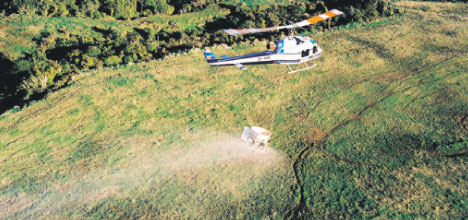
Alan Beck had to prove to the Air Service Licensing Authority there was the need for another agricultural aviation business in Taranaki before he could start a new company.
'It was a three day hearing in June 1973 and I had to give evidence and so did 68 others who supported my proposal,” says Alan.
Beck Helicopters began to spread fertiliser for farmers and that's still the core of its business.
In the 40 years since, Alan has more than proved his case. Beck Helicopters of Eltham is the longest surviving helicopter business in New Zealand.
'The authority put us through the hoops but I think it was a fair and sensible way to do things. Now anyone with the right qualifications can start up an aviation business regardless of whether there is enough work or not.”
Alan believes all competition has done is drive down the price and many operators have gone out of business because they weren't earning enough to cover their operating costs.
Safety
'In the early days I was also guilty of working far too long for not enough reward until I finally woke up and changed tack.”
Fixed wing and helicopter aviation aircraft are costly to operate and Alan believes the safety record of some companies has a direct correlation to the income they are earning.
'We take safety very seriously, as do most operators,” says Alan, who has just been elected chairman of the New Zealand Agricultural Aviation Association, which exists to ensure the sustainability of agricultural aviation in New Zealand. Among its aims is to develop and advocate for best practice in flight and environmental safety.
Technology has helped advance safety and accuracy. GPS systems can ensure fertiliser and sprays are targeted precisely, not only ensuring farmers and growers achieve the best value for money, but also protecting the environment.
Advocate
Alan says advocating for the continued safe use of agricultural products applied from the air is among the roles of the NZAAA and that is not just to protect the livelihood of its members.
'It is also to protect the right and ability of New Zealand farmers and growers to continue to produce food for the world. In parts of Europe pressure from green groups has made it impossible to spray or apply sprays from the air.”
Alan didn't have a helicopter pilot's license when Beck Helicopters was formed in 1972.
'I learnt to fly in a Cessna 150 or a Piper Cub so had to learn to pilot a helicopter.”
The company was formed to spread fertiliser for farmers and that's still its bread and butter.
'We are still essentially a fertiliser spreading company and it is that part of our business which has enabled us to branch into other areas.”
Those other areas include frost protection for vineyards in the Hawke's Bay, rescuing valuable dairy cows, pouring concrete by helicopter and installing chairlift towers or power poles. Rescuing people is something else the company does, and in the past 22 years, Beck Helicopters has assisted in more than 500 rescues. In fact Alan was awarded a Queen's Service Medial for his work in that field.
Iroquois
The company began with a single Bell 47 helicopter, a small hangar and small staff base but has since grown to one which now operates three Bell Iroquois and one Bell Jet Ranger helicopter across New Zealand. Beck Helicopters is the only company licensed for overhauling Iroquois engines and airframes in New Zealand. Helicopter parts from New Zealand and off-shore regularly arrive at the Eltham workshop for repair and maintenance. The company employs up to 15 staff including contractors and part-time employees.
Alan says the decision to form an agricultural helicopter company has rewarded him in ways he couldn't have imaged 40 years ago.
'I still love flying and hope to keep doing so for at least another five years. Thanks to good genes I've still got 20/20 vision and am fit enough to pass the medicals.”
It is pilot son David who now takes care of the day to day operations of the company. 'I'm the stand by pilot.”
Alan is in demand though, not just to fly for his own company. He is frequently asked to go overseas to mentor and assess pilots for other companies or to fly their choppers.
One contract involved travelling to Alaska and flying up into the Arctic Circle. Among the most satisfying and challenging tasks he's undertaken in New Zealand has been pouring concrete for a new chairlift at the Turoa ski field and installing the pylons which support it.
'That requires a high level of concentration and safety, as you are working with teams of people on the ground and if you get it wrong, they could be killed.”
Last month Alan was due to fly to Mount Hutt to pull out a chairlift damaged by an avalanche and help rebuilt it.

0 comments
Leave a Comment
You must be logged in to make a comment.