


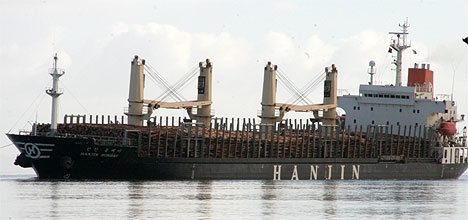
The log ship Hanjin Bombay ran aground in Tauranga harbour entrance on June 21, 2010 after engine problems were not communicated to the bridge, an inquiry into the grounding of a cargo ship finds.
The fully loaded ship was leaving port for Korea when its main engine began overheating because of a malfunctioning valve. The engine room crew did not tell the bridge about the problem and began attempting to fix it.
The Hanjin Bombay after running aground.
Unaware there was an issue, the bridge team continued to take the ship towards the entrance, increasing speed for the turn from the Cutter Channel into the entrance to improve steerage.
The engine-cooling water's temperature continued to rise and reached the point where the engine safety control system slowed the engine down, then shut it down completely to prevent permanent damage.
The Hanjin Bombay was making the right turn from the Cutter Channel into No. 2 Reach when the engine shut down. The loss of propulsion reduced the steering performance of the vessel and the rudder was unable to arrest the turn before the ship left the channel and grounded on the eastern shore near North West rock.
When the bridge alarms sounded but the master did not tell the pilot what they meant and did not translate the conversations he was having with engineers in Korean.
When the pilot began asking why the ship was slowing down instead of speeding up, the captain didn't tell him. Bridge recordings reveal he was telling the officer at the forecastle to prepare to let the anchors go.
The pilot was unable to learn from the master what the problem was with the main engine, so he radioed the tugs to return and stand by to assist as soon as possible.
The main engine shut down at about 7.58pm. Two minutes later the ship was approaching North West Rock light abeam to starboard. The ship was in the main channel moving at about 2.6 knots, with the bow swinging towards shore and ran aground at about 8.04pm.
The tugs arrived just after the Hanjin Bombay grounded. They kept the ship from swinging against the outgoing tide and then against the incoming tide until she re-floated about two hours later.
The Hanjin Bombay was holed in one of its water-ballast tanks, dented the hull plating in the bow area. There was no pollution and the ship later re-entered the port, where it underwent temporary repairs before resuming its voyage. It later entered a dry-dock in China to make permanent repairs.
The Transport Accident Investigation Commission report says the grounding could have been prevented if the automatic engine-shutdown condition had been overridden for long enough to stabilise the heading of the vessel, and/or if the tugs had been in attendance to help maintain directional control.
Either option could have been achieved through better knowledge of the engine systems, better communication between the bridge and engine room crew, and if the bridge crew had informed the harbour pilot of the escalating engine problem.
The TAIC report also says the Port of Tauranga Ltd's risk assessment for its port, and Harbour Safety Management system, did not fully address the risk of departing vessels experiencing failure of propulsion and manoeuvring systems at critical locations in the entrance channel.
Its recommendations are that the Director of Maritime New Zealand resolve the safety issue of adequate tug escorts for vessels in all New Zealand ports, and that he develop a national system allowing port authority staff access to new and previous information on vessel and crew performance in the interests of preventing similar accidents and incidents in the immediate future.
A key lesson is that shipboard operations must be conducted using an agreed common language that everyone can understand. Crew members lapsing into their native tongue during an emergency is a breakdown in communication that can seriously hinder any response to deal with the emergency.

1 comment
TCC needs a new tug
Posted on 05-05-2013 13:43 | By YOGI BEAR
About 11 of them actually to hold up the submerged bow as TCC makes all efforts to become a submarine in dive dive dive mode ...
Leave a Comment
You must be logged in to make a comment.