


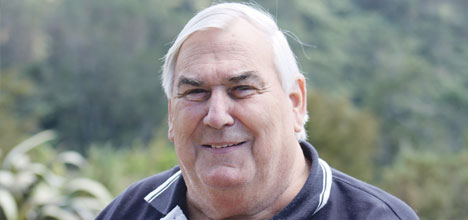
Sustainable farming is the only future for New Zealand and profitable farming can co-exist alongside a healthy, vibrant
natural environment says Ian Pirani, retiring trustee and management committee member of the Bay of Plenty
Ballance Farm Environment Awards.
Farmers and growers are adopting sustainable methods, some faster than others and the Ballance Farm Environment Awards, whose entrants lead by example, is a powerful tool towards creating change, believes Ian, who was also a trustee for the National Farm Environment Awards.
Ian Pirani is a farmer with international experience in farm and conservation advisory work and a keen deer, pig, goat and game bird hunter.
'New Zealand farmers won't respond to the big stick approach, but they will rise to a challenge. If they look over the fence and see the neighbour doing better than them, then they will want to know why and how.”
Children are also an effective force for change.
'If the kids come home and ask why their friends down the road have more bush, ponds or wetlands and wildlife than on their farm, that can get parents interested too.”
Education is another factor says Ian, who believes there is a need for sustainability to be taught at tertiary level. His own story is a model for how effective that can be.
'My father (Ronald) and his friend Jim McMillan used to take me shooting and fishing and taught me to value the quality of water. Dad used to say water was liquid gold getting more valuable by the day. This was in the late '40s. Back then we couldn't catch fish from the Manawatu River because it was too polluted – not by farming but by the towns.
Would you drink that water?
'A question I often ask regarding water quality is ‘would you drink that water?' The number of ‘yes' answers have improved over time.”
Ian, who was born ‘a townie', first learnt about farming from his Uncle Charlie and later as a 16-year-old, at Flock House – an institution he says was ahead of its time.
'The tutors taught modern farming and they cared about the environment. We were taught to drive bulldozers and use horse and ploughs, but also, if we shifted top soil, to replace it and, most importantly, to never drain wetlands – this at a time when swamps were being drained to turn into pasture.”
How well he'd learnt those lessons was tested in Ian's first job as a milker on Jim Ford's 100 cow farm near Levin.
'Jim wanted to drain a gully through which a spring ran and sent me to dig a six foot wide ditch. I noticed banded rails in the area and when I stopped for a smoke saw something I'd never seen in real life – a bird standing in the rushes with its head pointing straight up – and realised it was a bittern.”
Knowing he'd probably lose his job, Ian told his boss he wouldn't drain the gully. Jim however, asked Ian what he would do and together they decided to fence out the gully to stop cows falling in, and bulldoze a dam to retain the water, creating a wetland for birds.
From Levin, Ian progressed to 39 per cent sharemilking at Pauatahanui, a move which proved life-changing.
'It was my morning off milking when I saw out the window this girl drive up in a Morris Oxford, take a 10 gallon milk can out of the boot, lift it over a fence and water her horse. I thought then and there ‘I'm going to marry that girl' and I did.”
Dawn Harris and Ian have been married 52 years and Ian still can't believe his luck in finding a woman who shares his philosophies and interests, including goat farming.
The couple, who bred golden retrievers, began running a boarding kennels.
'Friends kept asking us to look after their dogs, so we decided there was a demand.”
Among their clients were two former British policemen who ran a security business and asked Ian to train their dogs. Before long, Ian was working the security nightshift at the Todd Car Factory for 10 shillings an hour.
'That was good money for 16 hours back then.”
When Armour Guard bought the company, the new owners asked Ian to join the firm. Ian and Dawn moved to Hamilton, where Ian managed the Waikato branch and Dawn continued with her interest in breeding waterfowl, including the protected Pateke ducks.
Saving wetlands
Ian became co-founder and the first president of Ducks Unlimited NZ, which works to save wetlands through protection, funding, technical aid and education.
Ian's health hasn't been so good in recent years and he's retired from many of the organisations he has been involved in but that doesn't mean he's giving up on helping enhance and protect New Zealand's natural environment and the opportunities for the public to enjoy it.
There are still projects he plans to bring to
fruition and based on his past record, he'll make them happen.

0 comments
Leave a Comment
You must be logged in to make a comment.