


Prominent fishery figures in the Coromandel have endorsed the Government’s indefinite ban on collecting certain sea creatures along the district’s shorelines and rockpools.
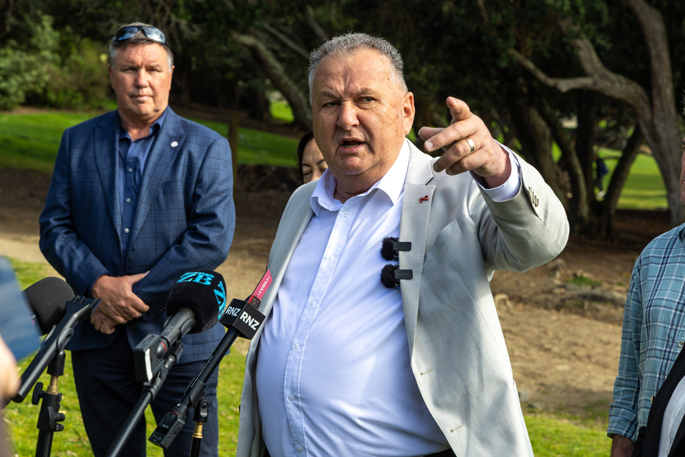
A two-metre depth limit will be the benchmark for the “intertidal zone“ across Auckland and Coromandel’s shores, Ocean and Fisheries minister Shane Jones said when announcing the ban early Thursday morning on Auckland’s Takapuna Beach.
Jones said he hoped to target the ”select few“ over-harvesting.
Species covered by the ban, which comes into effect November 1, include cat’s eyes, chitons, periwinkles and limpets, while marine invertebrates such as mussels and starfish are also banned.
Harvesting limits for several species remain unchanged.
Warren Maher, Waikato Regional Council chairperson and Hauraki Gulf Forum co-chair, said most coastal communities affected by “the rape and pillage” are happy to see the ban.
“This is the first time there’s been protection like this in such a large area. It actually allows regulation to be put in place [and] infringements to be eventually handed out,” Maher said.
“In the Coromandel, the mussel closure in that space out to 2 metres deep will help ... there’ll be a few people not too happy with that, but hey, you need to learn to snorkel and you’ll be away again.”

Without the regulations, Mercury Bay Game Fishing Club immediate past president Gordon McIvor thinks Mercury Bay coastlines such as Whitianga could be at a real risk. Photo / Christel Yardley, Waikato Times
Maher accompanied Jones for the announcement, as New Zealand Sport Fishing Council president.
He said he’s seen an increase in groups overharvesting rockpools in his home town of Tairua, with social media playing a strong role.
“People put things out there [saying] ‘hey this is a great place to go to harvest this and that’ so people become more aware and happy to travel a little bit of distance when their local areas are cleaned out.
“There are some organisations that have advertised beach combing tours, and that’s exactly what they promote. They’ll go to a bit more of a remote area and they’ll harvest that sea life out of those rock pools which is, again, breaking the rules.“
Fisheries New Zealand acting director fisheries management James Andrew said submissions expressed concerns about green-lipped mussel beds in the Coromandel, such as at Kūaotunu.
He added impacts of land-based activities and climate change have also negatively affected the situation.
The ban follows community outrage in January after as many as 300 tourists daily stripped clean shellfish using hammers, chisels and piano wire on Auckland’s Whangaparāoa coastline.
“You’ve got to look at some of our migrant communities and it’s an education piece as well,” Maher said.

Tairua has seen decreases in rock pool kaimoana over the past five to six years, Warren Maher says. Photo / Kelly Hodel, Waikato Times
Domestic tourists are more to blame than internationals according to Maher, with Mercury Bay Game Fishing Club immediate past president Gordon McIvor adding other areas have been “stripped clean”.
“I don’t think that’s happening in our area yet, but it would be a real concern if it did,” McIvor said.
“There’s a real good reason for [the ban] ... I think the next generation of fishing kids have all played in rock pools and isn’t it great when they’re a thriving ecosystem?”
Jones also set a daily limit of 10 for all other shellfish outside the intertidal zone, with Oceans and Fisheries under-secretary Jenny Marcroft saying a new infringement regime to deliver instant fines was “rapidly” developing.
Andrew said any tightening or loosening changes will be evidence-based, adding there will be a “higher presence” of officers present in the busy Coromandel summer.
“They will continue to educate people about the rules and can prosecute people found to be harvesting prohibited species from the closure area.”
LDR is local body journalism co-funded by RNZ and NZ On Air.


0 comments
Leave a Comment
You must be logged in to make a comment.