


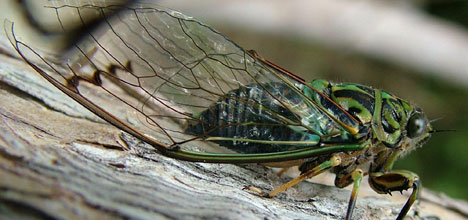
Recent rain may be the vital factor that triggers off the other ingredient missing from the New Zealand summer so far – the cicada chorus.
The Bugman Ruud Klienpaste says the cicadas are probably a bit late because they are still trying to dig their way out from underground.
'The ones that you hear singing, the chorus cicada and the clapping cicada, they have a life cycle in the soil that lasts something like seven years.”
Cicadas live most of their lives as wingless cream-coloured nymphs, armed with two claw-like forelegs and four smaller legs.
They burrow using the powerful, digging forelegs. Cicada nymphs may dig as deep as a metre but usually about 40cm. Nymphs feed on sap from plant roots, using needle-like mouthparts.
'I don't know if you have ever tried burrowing through soil that is rock hard from drought conditions,” says Ruud.
'It's bloody impossible. You need a kango hammer, and cicadas don't have kango hammers so they are waiting for some moisture and changes in relative humidity patterns to actually make their way out of the soil.
'But now it's rained they could be announcing themselves any day.”
As the nymphs grow they shed their skins, usually going through five stages.
'When they are ready to come out they come to higher levels in the soils, three or four inches, and once again shed their skin once more into adult cicada as wings,” says Ruud.
'They burrow out as nymphs, attach themselves to trees, split their back open and the adult cicada comes out.”
The other factor governing the lack of cicadas, says Ruud, is there may be fewer cicadas.
'Some years are good years, some years are bad years for cicadas,” says Ruud.
'Go back seven years and see if that was a good or a bad year for cicadas. Because if you have a bad year for cicadas with low numbers, there are not many matings going on which means that seven years later there are still low numbers in the soil for that cohort from seven years ago.
'So there could be low numbers from that low number seven years ago, and on top of that the almost inability to burrow out of the rock hard ground. You will probably find tonight or tomorrow night they will come out.”
The loudest and most common of New Zealand's estimated 70 cicada species is the green and black Amphipsalta zelandica, the chorus cicada. There is also a clapping cicada that only an entomologist can tell apart from the chorus cicada by looks, but is easily distinguished by the noise it makes. The noise cicadas make can reach more than 100 decibels in the bush, exceeding standard noise safety limits.
'The singing is all about sex,” says Ruud.
'Males attracting the females; they all think they are Tom Jones, females of the same species come closer and check them out.”
The parents die a few weeks after mating.
Enemies cicadas in New Zealand include tiny wasps that infest cicada eggs, predatory beetles that attack nymphs, and fungal diseases that destroy both nymphs and adults. As they migrate towards the surface, near-mature nymphs can become food for kiwi. Adult cicadas may be taken by birds or caught in spider webs.
Ruud believes it's a brave bird that takes on a cicada in full noise.
'Can you imagine being a bird with a 90 Dcb cicada in your beak, all your filings would fall out and you would get a headache.”

2 comments
.
Posted on 05-02-2013 08:25 | By charob
Had several singing here the other day but only for one day. they gone now. crickets havent emerged yet
Tom Jones
Posted on 05-02-2013 11:07 | By Katzeye
I have one outside my bedroom right now doing his impersonation of Tom Jones... So happy to hear him!!
Leave a Comment
You must be logged in to make a comment.