


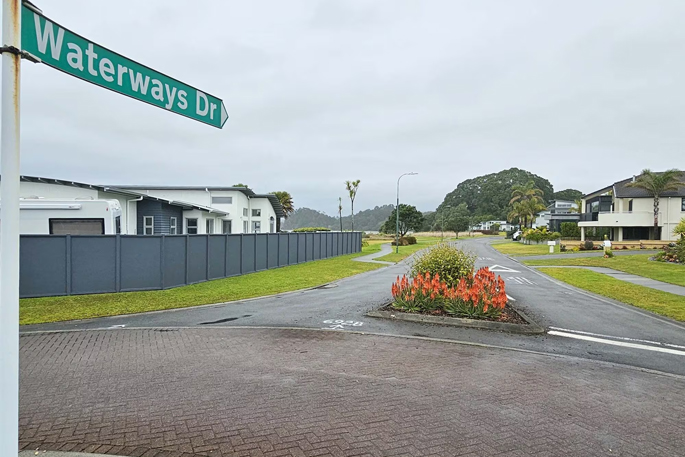
Ōhope’s Waterways subdivision will be chip sealed this summer, despite objections from residents wishing to retain their smooth asphalt street surface.
The road was scheduled to be chip sealed last summer, as the asphalt surface laid by the developer in the late 1990s was reaching the end of its life, but residents intervened.
After receiving notification of the work in February, just a week before work was expected to begin, 17 residents of Ōhope’s Waterways subdivision signed an open letter to the Whakatāne District Council asking it to investigate other options to chip sealing.
Chris Stone, who authored the letter, asked the council to look into a rejuvenation treatment that was new to the market that would extend the life of the original asphalt and cost much less than new asphalt.
The letter prompted the work to be postponed for further engagement with residents and a comprehensive report on the matter was brought to a recent projects and services meeting.
The report, by transportation manager Ann-Elise Reynolds, showed that chip seal was by far the cheapest option.
The committee voted unanimously to chip seal the road.
Councillor Gavin Dennis, who moved the option, said he could “appreciate a lot of people would like to have asphalt”.
“I’d like to have asphalt on my road and I’d like to have gold-plated curbing too,” Dennis said.
Stone said he accepted the decision, but was disappointed in the outcome.

Waterways resident Chris Stone has accepted that the quality asphalt surface of his street will soon be downgraded to chip seal.
“What they’re doing is taking an expensive, high-grade surface and replacing it with an inferior surface.”
He likened the move to putting “old tyres on a new car”.
“This is an unfortunate logic in budget-conscious times,” he said.
“I still believe that the rejuvenation of asphalt surfaces is the most logical long-term use of a high-value asset.”
Reynolds’ report showed that, although the rejuvenation treatment was a much cheaper option than a new asphalt surface, it was still two to three times the cost of chip seal.
It was an issue that came up whenever asphalt roads laid by developers came up for renewal.
Developers often used asphalt in preference to chip seal due to its attractiveness to prospective property buyers.
Asphalt provided a smoother finish, a tidier appearance, an absence of loose chip after treatment and was a quieter surface to drive on.
However, once the roads were vested to local councils to maintain, it was necessary to use the cheapest whole-of-life option for the road.
Although chip seal has a shorter lifespan of 10 to 15 years rather than 15 to 25 years, the relative cost made it the cheapest whole-of-life option for the road surface.
The chip sealing of the Waterways street, for example, would cost $21,000 compared to $228,000 for asphalt. The rejuvenation treatment would cost $52,000 and require pre-treatment of any cracks.
New Zealand Transport Agency, which co-funds 65% of resurfacing costs on local roads in the Whakatāne district, would only fund the cheapest whole-of-life option.

The chip sealing of the Waterways street, for example, would cost $21,000 compared to $228,000 for asphalt.
The policy meant the councils’ portion of the cost would be $214,000 for asphalt or $38,000 for a rejuvenation treatment, as opposed to $7350 for chip seal.
The report also stated that, as rejuvenation treatments were relatively new to the roading industry, they were not as thoroughly tested as chip seal and asphalt.
Based on other towns in New Zealand where they had been used, the expected life of the treatments were approximately six to 10 years.
Resident Deb Woollett, who first alerted the neighbourhood to the chip sealing in February, said she was happy with the plan now that there had been improved communication between residents and council staff.
She had been reassured by Reynolds that the grade of chip would be much finer and smoother than that used on nearby higher-traffic roads.
She felt that her feedback had been taken on board and that, in cases when road surfaces were being dramatically changed from what residents were used to, the council would recognise the need for more “tailored messaging”.
Shortly after Local Democracy Reporting’s story about the resealing of Waterways was published in February, the council had been approached by Muriwai Drive residents where a section of asphalt road was also due to be resurfaced in chip seal.
The residents asked that rather than chip seal the section, the asphalt be extended to the entire length of the road.
This section of road was also put on hold to be considered alongside Waterways, but will now receive chip seal this summer.
The committee approved staff to draft a Road Maintenance Policy, to be brought back to a future committee meeting for endorsement to provide clarity and consistency in the future when similar situations arose.
LDR is local body journalism co-funded by RNZ and NZ On Air.


5 comments
Chip seal = waste of money
Posted on 17-08-2026 12:34 | By Rosieterry
If you need any proof of how bad chip sealing is, you should look at Fairview Road in Katikati. 18 months ago chip sealing was applied on top of the smooth tar seal, and for months little stones broke away and left ruts and bumps in the road. 6 months ago it was rechipsealed. The result is awful and small stones are still breaking away and getting into shoe soles, tyres and lawns. Fairview Road is a very rough ride now.
seal
Posted on 17-08-2026 13:30 | By terminal
well mate put your money were your mouth is
chip seal
Posted on 17-08-2026 17:22 | By peter pan
Its all to do with what the council can afford ,maybe if the residents were prepared to pay the différance the council would do as they wanted .Ive lived here for over 60 years and like thousands of other ratepayers have never had anything else but chipseal, so suck it up my friends and welcome to the real world.
Two Important Points
Posted on 18-08-2026 07:41 | By Yadick
There are two important points here that Tauranga City Council can learn from:
1. . . . she was happy with the plan now that there had been IMPROVED COMMUNICATION between residents and council staff.
2. . . . the grade of chip would be much finer and smoother than that used on nearby higher-traffic roads.
Communication and the willingness of compromise.
Chipseal costs the same
Posted on 11-09-2026 07:41 | By Concerned1
TCC has agreed with the papamoa residents association that over the full life of a road there is very little difference in costs between the two surfaces. The headline of 6x or 12x as here is a poor analysis if the situation and shows staff inadequacies. See report on papamoa residents websites. Same applies here.
Leave a Comment
You must be logged in to make a comment.