



Warning: This story deals with the death of a child and may be distressing.
A coroner’s inquest has heard about a “large boggy swelling” observed on the back of toddler Sadie-Leigh Gardner’s head, and the significant head injuries that led to her death.
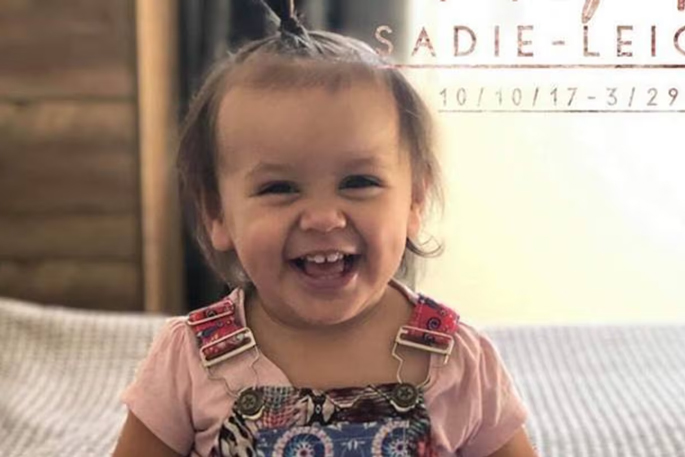
The 17-month-old died in March 2019, with her death the subject of two earlier trials where her mother’s former partner was charged with her murder.
Adrian Clancy was found guilty at the first trial, but after the Court of Appeal quashed his conviction, he was acquitted at a retrial.
Now the toddler’s death is at the centre of a coroner’s inquest before Coroner Tracey Fitzgibbon, attempting to establish how and when Sadie-Leigh’s injuries occurred, and if they were non-accidental.
The coroner will hear from civilian witnesses, including Clancy and Sadie-Leigh’s mother, who has interim name suppression, Sadie-Leigh’s grandmother, and neighbours.
The first part of the inquest has largely focused on medical evidence related to Sadie-Leigh’s injuries.
Dr Sarah Edmunds, a paediatrician at Tauranga Hospital at the time of Sadie-Leigh’s admission, explained that when Sadie-Leigh arrived at hospital she had a “decreased level of consciousness” and a low heart rate.
Clancy told medical staff that he’d heard the toddler “cough or gag” while he was looking after her, while the toddler’s mother was at an appointment.
When he went in, he saw the 17-month-old’s “eyes were rolled upwards”.
After doing CPR, he picked her up and ran with her to their neighbour, Chantelle Flynn, who reported there was “blood all over her mouth”.
Paramedics also observed blood around the toddler’s mouth.
Coroner Fitzgibbon asked Edmunds if there was an explanation for the blood, and the doctor said it could have been caused during CPR, or direct trauma to the inside of the mouth.
When ambulance staff arrived at the block of flats where Sadie-Leigh lived, they observed the toddler floppy with no spontaneous movement and only intermittent respiratory effort.
They gave her oxygen using a bag and mask and opened her airway.
When in the emergency department, Sadie-Leigh’s oxygen levels improved, but she was having brief pauses in her breathing and needed a “jaw thrust” to maintain her airway.
Her eyes were deviated to the left, she had “abnormal, non-purposeful movements of her limbs at time”, and was found to have a “large boggy swelling” on the back of her head.
She had blood tests, X-rays, and a CT scan, and her blood pressure was abnormally high, indicating a severe head injury, and she was found to have a linear skull fracture.
When her eyes were re-examined, they’d become further dilated and fixed bilaterally.
She was transferred to Starship Children’s Hospital for urgent neurosurgical input, but once there, her injuries were found to be catastrophic and unsurvivable.
On March 29, 2019, she died in Starship Children’s Hospital with her mother and grandmother by her side.
 Sadie-Leigh was just 17-months-old when she died.
Dr Peter Heppner, a neurosurgeon at Starship Children’s Hospital, gave evidence about Sadie-Leigh’s injuries – including his understanding of the level of force required to cause them, and how her brain would have responded once the injury happened.
A key unanswered question is the timing of the injury, and how Sadie-Leigh would have presented immediately after the blunt force trauma to her head.
Heppner was asked whether it was more likely she would have been immediately unconscious, or whether there could have been a “lucid period”.
He said both scenarios were possible, and he didn’t have data to support which was more likely.
But once the impact occurred, the blood would begin building up in the head, causing pressure, and within about “10 to 15 minutes” she would be unconscious, if she hadn’t been unconscious already.
Clancy’s account to police was that 10 minutes after Sadie-Leigh’s mother left, about 3.30pm, he heard the toddler coughing, and when he checked on her, he found her struggling to breathe.
Sadie-Leigh’s mother said she checked on her daughter before she left, and she was sleeping and breathing normally.
Clancy’s lawyer Rob Stevens suggested Sadie-Leigh’s mother inflicted the injury before she left.
At the trials, the Crown said Clancy must have become frustrated with the child and caused the injury while alone with her, and the child became unconscious immediately.
In search of information to assist with timing, the lawyers involved in the inquest asked Heppner about the “bogginess” on the back of Sadie-Leigh’s skull.
This was observed at the hospital, but not by an experienced paramedic who examined her at the flat.
Heppner, when first asked, said this made it more likely that the injury happened “reasonably proximate” to when the paramedic examined her.
He explained the bogginess was caused by bleeding from the skull itself, and there was no reason for that process to be delayed – essentially giving an impression it could have happened relatively quickly.
However, when asked about this further by Clancy’s lawyer Rob Stevens, Heppner said he wasn’t sure he could comment on whether the lack of bogginess observed could help in terms of timing.
When questioned further by Sadie-Leigh’s mother’s lawyer Ben Smith, he clarified further.
“When I answered the first time, it was an intuitive answer, which was you would expect the bleeding to be occurring from the time of the injury, and hence you would think it could give some indication that the injury must have happened, you know, just before the assessment.”
On reflection, he said that when thinking about it with “evidentiary level of rigour”, he had no data about the rate of bleeding.
Counsel to assist the coroner, Nick Chisnall KC, asked if it made any difference if Sadie-Leigh was lying on her back, as to the speed with which the bogginess formed, but Heppner said he wasn’t able to answer that.
 Coroner Tracey Fitzgibbon.
Coroner Fitzgibbon asked about the coughing reflex, and Heppner explained it’s one of the last reflexes to go and is often used to test whether someone is brain dead, by using external stimuli like a tracheal tube to see if someone had a reflex cough.
The coroner said there was evidence that Sadie-Leigh was heard having a “coughing fit” before being found in her cot, struggling to breathe.
“That is tricky,” Heppner said.
“That implies that, I guess it’s the degree of stimulus that’s triggering the cough and it’s a slightly different mechanism to us pulling on a tube or something. I’m not sure I can answer what the implication of that is, necessarily.”
Sadie-Leigh’s medical history detailed
An overview of Sadie-Leigh’s medical history before her brain injury was also heard by the coroner.
She was born at 38 weeks by emergency C-section, after labour did not progress as expected, and was admitted to the Special Care Baby Unit (SCBU) for respiratory support and intravenous antibiotics.
She had very low blood sugar, requiring steroids and high levels of glucose.
After being released from SCBU, she was later seen at an outpatient clinic where she was observed to be doing well.
She’d had other common childhood sicknesses, including bronchiolitis and symptoms of asthma or wheeze, and had a salbutamol inhaler.
Because of her significant neonatal hypoglycaemia, she was referred for developmental monitoring, and was assessed by a specialist in February 2019, who found she was meeting normal, expected milestones for a child her age.
Police inquiries revealed Sadie-Leigh had attended regular Plunket visits – the earlier ones with her grandmother, who had cared for her while Sadie-Leigh’s mother served a short term of imprisonment on dishonesty charges.
While concerns about Sadie-Leigh’s mother’s situation had placed her on the vulnerable unborn baby list, a hospital social worker did not identify any further care or protection concerns.
In later visits, Sadie-Leigh’s mother was observed to be a “good and attentive mother”, and Sadie-Leigh an “active and happy child”.
The inquest continues.
Hannah Bartlett is a Tauranga-based Open Justice reporter at NZME. She previously covered court and local government for the Nelson Mail, and before that was a radio reporter at Newstalk ZB.
Join the NZ Herald’s Open Justice team for Case by Case, a video and podcast series examining the disputes and decisions making headlines across New Zealand.


0 comments
Leave a Comment
You must be logged in to make a comment.