


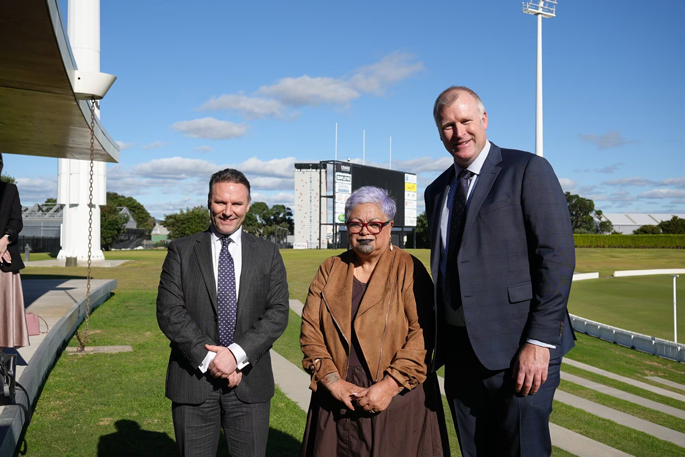
Tauranga City Council and the Western Bay of Plenty District Council will decide today whether to pursue a merger through the Government’s Head Start pathway.
Their joint meeting comes three days before the August 9 deadline for proposals.
The Government gave councils just 90 days to come up with voluntary amalgamation proposals for its Head Start local government reform pathway, or face forced reforms later – the Back Stop process.
It has been a pressured process for councils – Western Bay councillor Laura Rae took to social media this week likening the Head Start process to a “fat migraine”.
Unitary authority
Staff from both councils have recommended Tauranga and Western Bay submit a joint Head Start proposal to create a subregional unitary authority.
The two councils already have a joint water organisation, are partners in a regional deal and share various assets.
The unitary authority would replace both councils, take on most of the Bay of Plenty Regional Council functions and serve a population of about 221,000 people.
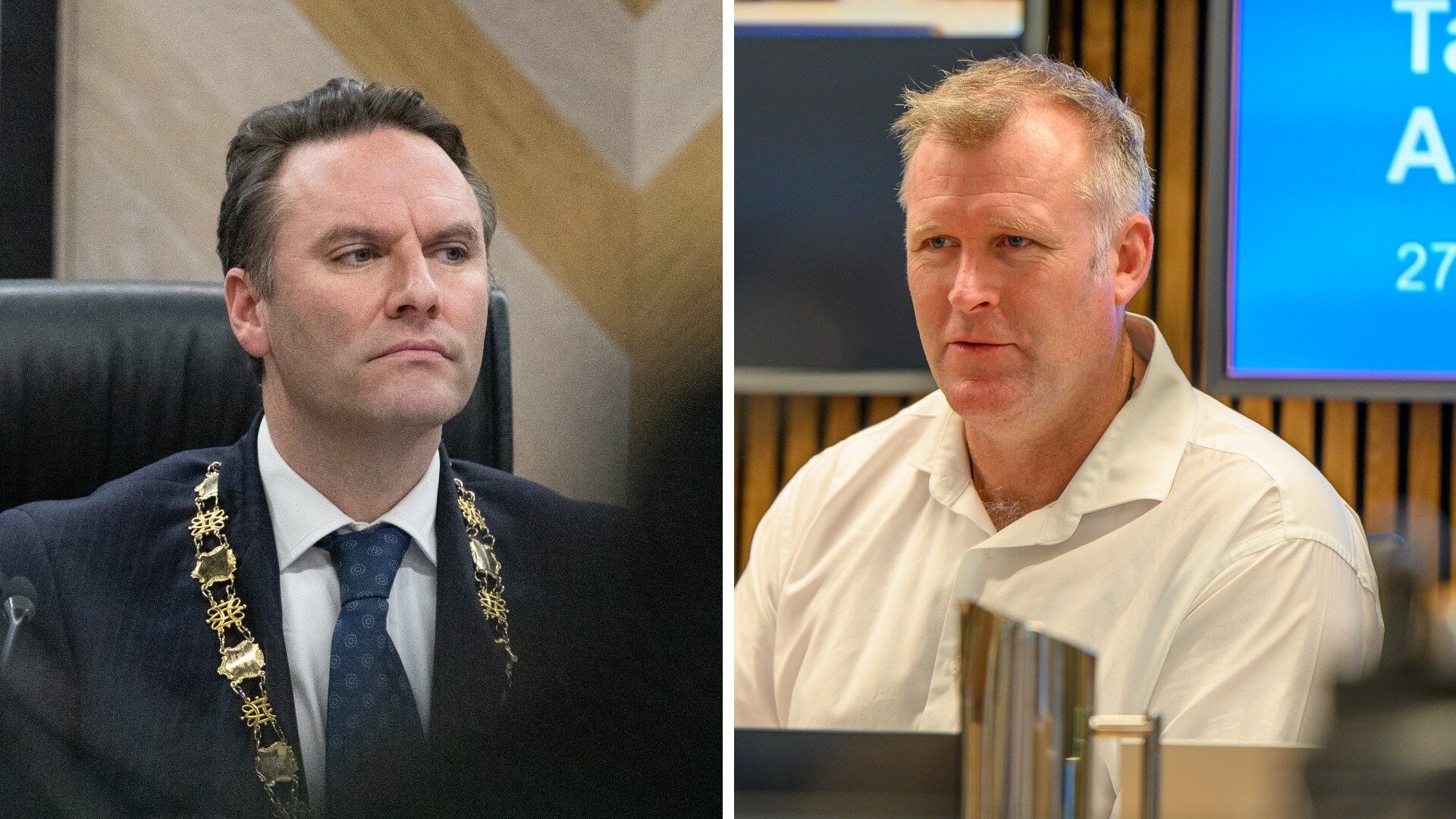
Councils led by Western Bay of Plenty Mayor James Denyer and Tauranga Mayor Mahé Drysdale will meet today to discuss a possible merger. Photos / NZME
A report by Tauranga mayoral office manager Gareth Green and principal strategic adviser Anne Payne said the alternatives were to wait for the backstop process or create a “super council” with eastern and central Bay of Plenty councils – an option not favoured by tangata whenua.
The Tauranga/Western Bay unitary authority was proposed to include two-tiered governance with a governing council and local representation bodies, similar to local and community boards.
Debt
Council reports for the meeting identified three key issues for the merger: debt, local representation and long-term plan priorities.
Western Bay local government reform programme manager Emily Watton wrote that community feedback included concerns that Western Bay ratepayers would end up paying for Tauranga’s debt.
The city council has net debt of $1.3 billion, compared to the district council’s $159 million.
Annual Plans for 2026/2027 show Tauranga’s net debt is projected to rise to $1.84b – including Infrastructure Funding and Financing debt – and Western Bay’s to $295m.

Tauranga Airport could be considered a subregional asset under the proposal. Photo / Andrew Warner
Both councils’ reports suggested existing debt could be ring-fenced to the communities that incurred it, with new debt to be spread across the new combined authority.
The issue was how to treat debt associated with assets used by many residents of Tauranga and Western Bay, such as Tauranga Airport, Baypark, BayWave, Bay Oval, and major roading and growth infrastructure.
Representation
There was concern that smaller communities such as Katikati, Ōmokoroa, Waihī Beach, Te Puke and Maketū would struggle to retain influence under a larger council.
There was fear that Tauranga’s much larger population of 160,000, compared to Western Bay’s 61,000, would mean smaller Western Bay communities would be overlooked or dominated by Tauranga.
The reports included support from Ngāti Pūkenga and Ngāti Ranginui for the merger, stating their expectations that Treaty commitments were maintained, existing co-governance arrangements were protected, Māori representation was retained or strengthened and there was local control over assets and environmental management.

Representation for smaller Western Bay of Plenty communities, such as Te Puke, featured as a concern in feedback. Photo / Kelly O'Hara
Iwi did not support expansion to include Thames-Coromandel in the new authority, emphasising the importance of maintaining existing iwi relationships, governance arrangements and communities of interest.
The councils would have to decide how they would manage the first three years of the 2027-37 Long-term Plans so key projects would not be deprioritised or delayed.
If the councils could not agree, the proposal included an “off-ramp” exit clause in case mediation attempts failed, meaning the councils could withdraw support for the proposal and further work would cease.
What’s next?
The reforms are part of the Government’s Simplifying Local Government programme, which aims to have fewer but bigger councils.
Cabinet will assess Head Start proposals and advise councils on the outcome in September.
Final proposals for those chosen to progress were due in March next year, with subsequent decisions expected in May.
If proposals were declined or a council opted for the backstop pathway, this process would begin after the 2028 local elections.
Surrounding councils
In a Tauranga City Council meeting in June, councillors looked at surrounding councils to merge with, looking at the Western Bay of Plenty, Rotorua, Kawerau, Whakatāne, Ōpōtiki, Thames-Coromandel and Taupō.
Since then, Ōpōtiki, Kawerau and Whakatāne have agreed to explore the viability of an Eastern Bay subregional unitary.

Whakatāne Mayor Nandor Tanczos, Kawerau Mayor Faylene Tunui and Ōpōtiki Mayor David Moore – the Eastern Bay councils are pursuing their own unitary authority.
Rotorua Lakes Council looks likely to seek to form its own unitary authority, as part of a wider Bay of Plenty plan, after proposed merger deals fell apart. It will meet on Friday for a decision following a workshop yesterday.
Taupō District Council decided not to submit an amalgamation proposal and is instead likely to be dealt with through the backstop process.
Matamata-Piako, Hauraki and Thames-Coromandel have agreed on a draft proposal to join forces.
Regional council
The Bay of Plenty Regional Council will also discuss the reforms in its meeting this afternoon.
A report for the meeting by governance manager Steve Groom said the council’s preferred option was “a single Bay of Plenty unitary authority supported by legislatively empowered local leadership authorities”.
Councillors will be asked to endorse a draft letter to ministers that argues against the model of multiple subregional unitary authorities favoured by other councils in the region.
The letter claims that proposed model could complicate local government by splitting regional functions, and that financial modelling has shown Eastern Bay and Rotorua communities will “face considerable extra costs of regional and shared functions”.

Bay of Plenty Regional Council chairwoman Matemoana McDonald.
Its preferred option was a Bay of Plenty regional unitary authority comprising Tauranga, Western Bay of Plenty, Rotorua, Kawerau, Whakatāne and Ōpōtiki councils.
It claimed the option was the “most likely to achieve long-term financial stability, effective regional co-ordination and support for Government reforms”.
The regional council is not eligible to submit a Head Start proposal; however, it did conduct surveys and assessments and sent a letter with its preferred option to the mayors.
Ayla Yeoman is a Local Democracy Reporting journalist based in Tauranga. She holds a Bachelor of Arts majoring in communications, politics and international relations from the University of Auckland, and has been a journalist since 2022.
LDR is local body journalism co-funded by RNZ and NZ On Air.

1 comment
Overit
Posted on 06-08-2026 13:32 | By overit
Look at each Councils eye watering DEBT! And they manage my water?
Leave a Comment
You must be logged in to make a comment.