


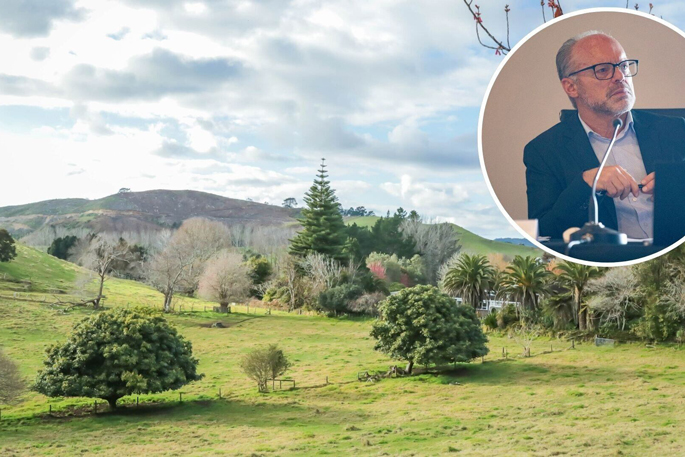
A developer plans to appeal a decision declining resource consent for a proposed 129-lot residential subdivision just over the Tauranga border.
Waikite Road Limited Partnership (WRLP) sought approval for the subdivision on about 10ha at 157 Waikite Rd in Welcome Bay.
The rural-zoned site is in the Western Bay of Plenty District, next to the Tauranga City boundary and across from Tauranga’s Ballintoy Park subdivision.
The applicant argued the development represented a logical extension of Welcome Bay’s urban area.
The application had limited public notification and attracted opposition from iwi, neighbouring landowners and residents.

The proposed development site is at 157 Waikite Road, Welcome Bay, in Western Bay of Plenty and on the border with Tauranga.
Concerns were raised about potential impacts on stormwater, flooding, traffic, cultural, ecology, rural character and infrastructure capacity.
Western Bay of Plenty District Council recommended consent be approved, subject to conditions.
The council appointed independent commissioner Greg Hill to make the consent decision on its behalf.
The resource consent hearing was held on June 4-5, with 14 submissions: one in support, 10 opposed and three neutral.

The proposed subdivision faced opposition over its environmental and infrastructure impacts. Photo / Kelly O'Hara
The applicant’s planning and urban design experts argued the land sat on an established urban edge, was close to existing services and public transport, could connect to existing water and wastewater infrastructure and would help provide much-needed housing.
The development would have involved new internal roads, stormwater and wastewater reserves, significant earthworks and water and wastewater connections to Tauranga City Council infrastructure.

Opponents argued the development would fundamentally alter the area's rural character. Photo / Kelly O'Hara
Ngāti Hē representative Des Heke told Local Democracy Reporting the hapū opposed the proposal because of concerns about potential environment, cultural and planning impacts.
Heke said the main concerns were increased stormwater runoff and contamination from urban development, flooding risks in a catchment prone to saturation and slips, potential impacts on wetlands and ecological values downstream and long-term cumulative effects on waterways flowing into Tauranga Harbour.
In the iwi’s view, the catchment was not suited to intensive residential development.
Heke said there were historic pā sites and archaeological features nearby and the iwi was concerned earthworks could affect cultural heritage.

Ngāti Hē representative Des Heke.
Hill’s written decision said he ultimately found the project’s adverse effects would be more than minor and the project was contrary to the objectives and policies of the District Plan.
He said this meant he had to refuse the consent.
Hill found the proposal would introduce an urban-scale subdivision into the rural environment.
He said rural zone provisions sought to maintain rural character, protect rural production and direct growth to planned urban areas.

Independent commissioner Greg Hill. Photo / Andrew Warner
Hill identified concerns about loss of rural character, landscape and visual effects, amenity impacts, cultural effects and uncertainty around stormwater effects and downstream impacts.
He also noted submissions from nearby farmers who feared their farming activities would attract complaints from new urban neighbours.
“While I accept there would be positive effects in the greater supply of residential housing, the adverse effects of the proposal, particularly those related to amenity, rural character, landscape and visual effects and reverse sensitivity, would not be able to be appropriately avoided or mitigated,” Hill’s decision said.
Another issue was “critical” Bay of Plenty Regional Council stormwater and earthwork consents had not been decided, creating uncertainty about downstream environmental effects.
Veros development director Sean Haynes told Local Democracy Reporting the company acted as the development manager for the project, including co-ordinating the experts involved in preparing and progressing the resource consent application.

Veros development director Sean Haynes.
He said the company was “disappointed with the decision” and the applicant intended to appeal.
“We remain confident in the strategic rationale for the development and the work completed by the project team in support of the application.”
Haynes said Veros respected the concerns raised by the submitters.
“These matters were considered through the technical assessments, evidence and proposed conditions prepared as part of the consent process and we remain confident in the work undertaken by the project team.”

Welcome Bay ward councillor Hautapu Baker. Photo / Alex Cairns
Tauranga City Council Welcome Bay Ward councillor Hautapu Baker said he personally had been opposed to the proposed development.
Baker was pleased consent had been declined and said residents of the area were also “very happy” with the decision.
He said those on the Western Bay side of the site were concerned the development would change the character of the area, replacing lifestyle-block living with a more urban and densely populated subdivision.
Those on the Tauranga side were worried about infrastructure capacity, including roads, water, wastewater and community facilities, saying they were “already nearing capacity”.
Ayla Yeoman is a Local Democracy Reporting journalist based in Tauranga. She holds a Bachelor of Arts majoring in communications, politics and international relations from the University of Auckland, and has been a journalist since 2022.
LDR is local body journalism co-funded by RNZ and NZ On Air.


2 comments
The Master
Posted on 05-08-2026 13:43 | By Ian Stevenson
So, Tauranga apparently needs more development, more houses and more generally of all as its (according to TCC?) the fastest growing urban area in NZ.
With these kinds of decisions that status may well be misleading?
I guess being in an "Urban" area and the development occurring next door, then saying that want to retain the "Rural" aspects kind of does not add up in any kind of sensible way? You want "Rural", logically then go live in a rural area well away from the city.
Flooding? No evidence of that?
Does not seem to be any kind of valid objection.
Perhaps its more about not having paid all the "Necessary" parties whatever they want to say "yes" rather than "NO"?
TCC confusing
Posted on 06-08-2026 13:18 | By Kancho
Seems the main objection is actually traffic congestion and strain on infrastructure ,water, sewage etc is quite valid .
Especially as Mahe is off to a talkfest that includes slowing urban sprawl , smart growth the joke that keeps on giving . . However the Papamoa east swamp that TCC is involved in development runs contrary to increased sections ? Rates still ratcheting up annually but no sign of restructuring of council to make savings nor stop of any of the nice to haves frippery
Leave a Comment
You must be logged in to make a comment.