


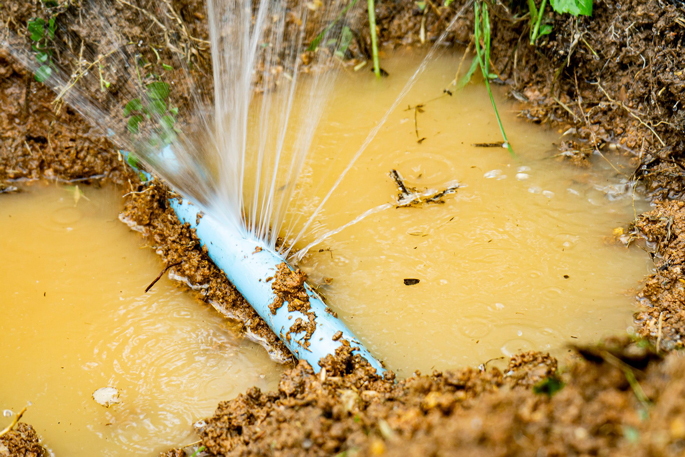
Kawerau and Ōpōtiki district councils have come out sparkling in a national report showing the amount of water leaks from public water supplies.
Whakatāne District Council fared less well, showing up as having the eighth highest loss of water per connection out of all councils.
Kawerau comes in sixth lowest with 49 litres, while Ōpōtiki is seventh lowest with 76 litres. Five councils had amounts of less than 1 litre.
National water services authority Taumata Arowai released its Network Environmental Performance Report for the financial year ending June 30, 2025, this week.
The report contains tables listing councils according to how they measure up on what they spend per person on water supply, how much water they supply per person, how much the average household uses, and how much is lost through leaks, per connection.
Water losses, through leakage, pipe bursts and reservoir overflows, were calculated by comparing water supplied to the network with customer consumption.
Whakatāne council lost 374 litres per connection, per day, according to the report – the eighth highest in the country.
The council’s three waters transition director, Nic Johansson, said although benchmarking was important, it was also important to recognise the limitations of comparing councils based on a single measure.
“The Taumata Arowai report itself notes differences in data quality, assumptions and reporting approaches between councils,” he said.
“Factors influencing the level of water loss reported across Whakatāne district include the age and configuration of the water network, operating pressures and the length of the network relative to the number of connections it served.”
Reducing water loss remained a priority for council, he said.
“Council produces an annual water balance report that assesses leakage across each of its eight water supply schemes. This allows us to closely monitor leakage levels and identify where investment will have the greatest benefit.
“We continue to invest in renewals, leak detection and network monitoring to improve the reliability and resilience of our water network over time.”
Kawerau and Ōpōtiki are among the 10 councils at the other end of the list.
Ōpōtiki has the distinction of having spent the least on water supply of all the public suppliers in the country. It spent $120 on water supply over that financial year for each person in the district.
This was made up of $10 per year for capital expenditure (investment into improved assets) and $110 on operating costs (day-to-day expenses).
Ōpōtiki council three waters service delivery operations manager Annette Munday said the water supply infrastructure for Ōpōtiki township – the district’s major scheme – was relatively new.
Most of it was replaced in the 1990s, including a new bore water source, new treatment plant and new reticulation throughout the township.
“Our current capital expenditure is therefore low,” Munday said.
“This means that the infrastructure, for the most part, is in good condition.”
The low operational expenditure in Ōpōtiki was also because of geography.
“The Ōpōtiki scheme is fed by a bore water source only a few kilometres from town. This bore provides good quality raw water that has been verified as well as filtered through confined alluvial aquifers,” she said.
“This means that the treatment system does not require extensive multistage processes to produce high-quality potable water.”
For the first time, since it started producing the reports three years ago, Taumata Arowai has included information about wastewater systems, including comparisons showing how many wastewater overflows they have had per 100km of piping.
Ōpōtiki and Whakatāne both had 28, while Kawerau had five. The median among all councils was nine.
The authority’s head of systems, strategy and performance, Dr Sara McFall, said the report provided a crucial evidence base as the water sector entered a period of significant change.
“The report shows that many networks are under immense pressure and better data, maintenance and targeted investment are needed to reduce risks to public health and the environment and increase long-term system resilience,” McFall said.
The reliability of data provided was a concern in many areas, including wastewater asset condition, water loss, overflow monitoring, bypass reporting and financial information.
LDR is local body journalism co-funded by RNZ and NZ On Air.


0 comments
Leave a Comment
You must be logged in to make a comment.