


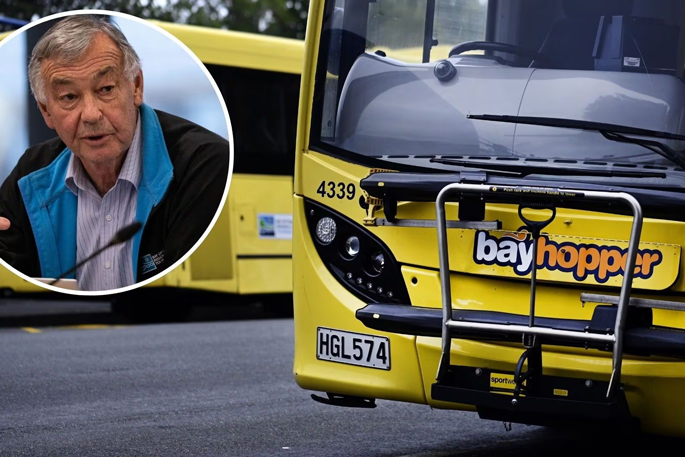
Bus lanes allowing cars with three or more people, contactless payment, fare capping, off-peak discounts and traffic-light priority.
These are some of the changes being introduced in the Bay of Plenty to encourage more people to use buses and to help free up a key road.
This comes as the Bay of Plenty Regional Council aims to increase public transport use by 10% per year until 2030.
Regional Transport Committee chairman Ken Shirley told Local Democracy Reporting the goal was “ambitious” but possible given the region’s projected growth.
The council has drafted its regional public transport plan for 2026-36. It is available for public consultation until August 6.
Targets include increasing use by 10% per year, ensuring more than 95% of services depart within five minutes of their scheduled time and that less than 1% of scheduled services are missed.
Council transport strategy manager Andrew Williams said 79% of bus journeys in Tauranga and 80% of Rotorua services departed within five minutes in 2024/25.
During the same financial year, 0.81% of scheduled trips across the Tauranga and Rotorua urban networks were missed. This comprised 0.96% in Tauranga and 0.56% in Rotorua.
The plan says demand for services continues to increase, and passenger boardings were 3.38 million in 2024/25, a 22% year-on-year increase.
Shirley said projected growth should drive demand.
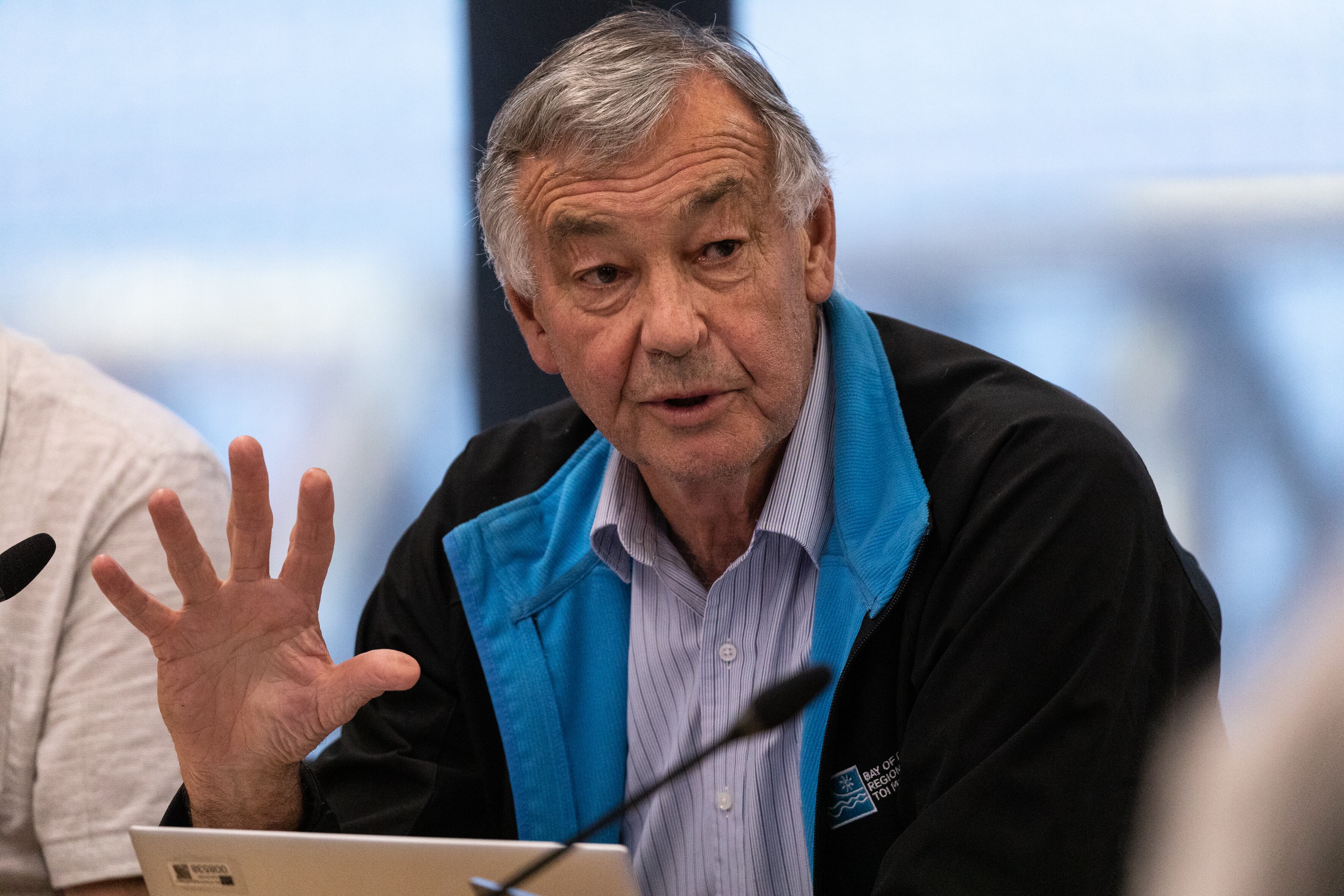
Regional Transport Committee chairman Ken Shirley. Photo / Alex Cairns
He said the plan focused on improving frequency, reliability and punctuality.
“We’ve also got to provide sufficient cover in rural areas, including some quite remote communities.
“We’ve got to co-ordinate bus services better, but it’s tied with planning, infrastructure and land use changes.”
He said that early next year the council would introduce Motu Move – a scheme with contactless payment, off-peak discounts, fare capping and incentives to encourage greater use of buses.
It is a national scheme being rolled out in regions.
He said there would be staged implementation of bus priority measures such as dedicated bus lanes and traffic-light priority for buses.

Buses in Tauranga. Photo / George Novak
“The key thing is coming back to making the service reliable, punctual, [and] that it meets people’s needs. There’s nothing more frustrating than waiting for a bus, and it doesn’t turn up.”
Tauranga City councillors were asked if they used buses; two said they did. Three did not respond.
Matua-Ōtūmoetai ward councillor Glen Crowther told Local Democracy Reporting he was a daily user.
“The bus is my preferred option, and I use it whenever practical, but it depends on a few factors, especially the combination of bus reliability and frequency.”
He said he would use buses 80 to 90% of the time if there were more services.

Matua-Ōtūmoetai ward councillor Glen Crowther (left) and Te Papa ward councillor Rod Taylor. Photo / Kelly O'Hara
Te Papa ward councillor Rod Taylor said he used public transport occasionally but found it “less than reliable”.
He said he found it useful and value for money if it arrived on time.
The public transport plan highlights a focus on making buses faster, more frequent and more reliable.
This would be achieved by improving services on key routes, infrastructure investment and providing greater priority for buses in congested areas.
It says 96% of Tauranga residents are within a 500m walk of a bus service.
Tauranga is the largest network in the region with 20 services across Tauranga and the Western Bay of Plenty, excluding school bus services.

The Tauranga CBD bus stop on Durham St. Photo / Mead Norton
The report looks at potential areas for improvement for Tauranga and the Western Bay. These include timetabling, providing verbal stop announcements, creating traffic signal bus priority and upgrading bus stops.
The council’s performance monitoring report 2024/25 said the main cause of missed services continued to be congestion.
The performance report says bus use during the period between July 1, 2024, and June 30, 2025, was up 0.25% on the previous year.

The Baybus OnDemand. Photo / Bay of Plenty Regional Council
During Tauranga’s OnDemand trial, 41,737 trips were taken in the 2024/25 financial year.
However, the service will be scrapped this year after regional councillors decided ongoing funding could not be justified.
The report says services including school routes are growing; however, core urban use is falling and bus use is down 5% annually in the Western Bay.
The network’s operating revenue is $52.4m, $7m under budget. Expenditure is $48.8m, $16.5m under budget.
NZ Transport Agency Waka Kotahi (NZTA) had lowered funding to these services, which had encouraged underspending, the report said.
There were 146,826 mobility trips, an increase of 21.4% year on year, and the Total Mobility scheme membership increased by 24% to 6093 users.
The scheme helps eligible people with permanent disabilities and long-term impairments access transport.
The report says customer satisfaction was 82% and complaints per boarding are falling year-on-year; however, service frequency, coverage and reliability targets were not met, and customer satisfaction is below the long-term goal of 85%.
About 39% of regional council customer service calls were related to transport.
Hewletts Rd project funding approved
An NZTA spokesperson said funding had been confirmed for design, consenting and construction phases to manage State Highway 2/ Hewletts Rd lanes.

Bus lanes on Hewletts Rd. Photo / John Borren
The managed lanes project sought to convert the existing bus lanes to T3 lanes, which would permit cars with three or more occupants to use them.
“This will contribute to more efficient use of the available road space for all users.”
The project has started and NZTA and the city council are working to confirm critical matters such as enforcement approach and support for the required bylaw change.
Ayla Yeoman is a Local Democracy Reporting journalist based in Tauranga. She holds a Bachelor of Arts majoring in communications, politics and international relations from the University of Auckland, and has been a journalist since 2022.
LDR is local body journalism co-funded by RNZ and NZ On Air.


7 comments
Congestion??
Posted on 27-07-2026 10:50 | By FRANKS
So if the main cause of bus delays is congestion how are more buses going to fix the problem??
Seems that all the fancy suggestions will do is increase the cost to ratepayers.
Ambitious? Funny…
Posted on 27-07-2026 14:20 | By Shadow1
…. Way to describe a service (?) that is just a money pit. That’s the problem when you decide to blanket the whole city with buses instead of growing the service as needed. Obviously the owners of the bus company is happy that the seats will stay, as new, for the foreseeable future.
My feeling is that if people won’t walk 500m or less to catch the bus, they will probably take their car even if it drives past their house.
Council has already done everything they can think of to get ratepayers on buses, including removing car parks, making Cameron Road undriveable, constructing bus lanes so the empty buses can drive past at the lights. Why not limit the service to 10 minute intervals on Cameron Road, Maunganui Road, and the busiest arterial routes and dump the rest.
Some people may even pay for the ride.
Shadow1.
Scrapping The Baybus
Posted on 27-07-2026 20:13 | By reactn2u
I am a great user of the Baybus service Greerton Pyes Pa to hospital and also Tauriko. It has been a great asset to me and I cant understand why it is being scrapped.
Put more on the roads all over Tauranga. It can seat approximately 9 people on 1 trip. They are battery powered.
Keep the buses for schools.
You can't get on them when packed with kids.
The big buses go by with 2 in them at times and are a waste of petrol and road space.
Pack the roads with Baybuses and you WILL GET RESULTS!
I am so going to miss them and I know this email won't make a damned bit of difference those who made the decision to scrap them.
Shame I reckon!
Marilynn
The Master
Posted on 27-07-2026 21:12 | By Ian Stevenson
Ambitious?
That is a little adrift from the truth....!!!
Currently, like last year, the buses generated around $2m in fare revenue and the costs operational costs were close to $40m... = $1 in means $20 out... yeah the gap is MASSIVE!!!!!
So the "Ambitious" plan is gong to close that gap how exactly? If and I mean "IF" there is a 10% increase in passenger numbers means $200k increase per year. That would take 190 years to catch up to the cost now, no cost increase for 190 years to break even.
Looks like just another well planned, expertly delivered plan of Council.
The Master
Posted on 27-07-2026 21:16 | By Ian Stevenson
Congestion?
What causes that: -
1 One massive cause results from huge buses trundling around empty most of the day.
2 Council "Planning" is cornerstone in everything Council touches, the result, massive losses, huge numbers of bura-rats, nothing to show for the millions gone...
3 Bus lanes deliberately creates congestion on the remainder of the road
4 Eliminating car parks, so less and less parking available means more congestion
The outcomes are intentional here, it then allows more bura-rats to "plan" which is then harmful to the ratepayers 24/7 in so many ways.
We need more
Posted on 28-07-2026 14:06 | By an_alias
Yes we need more empty buses on the streets to solve the congestion.
Scrap The Big Yellows
Posted on 29-07-2026 13:12 | By Yadick
During Tauranga’s OnDemand trial, 41,737 trips were taken in the 2024/25 financial year.
. . . the service will be scrapped . . . after regional councillors decided . . . funding could not be justified.
Well neither can the funding I'm forced to give be justified for the big yellow buses. So scrap those as they're costing a hell of a lot more and running round mostly empty and congesting the streets. Save the vans and put more on the road to replace the much needed to be scrapped big buses.
Quit tinkering and do the job properly. It's not a game!
Leave a Comment
You must be logged in to make a comment.