


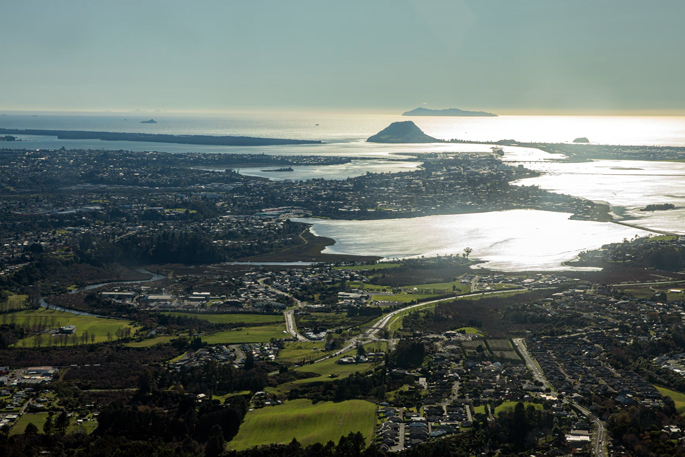
Of thousands of homes built in Tauranga in the past five years, only 16 have been on Māori land, the Tauranga City Council says.
A papakāinga housing specialist describes this as “a travesty”, and says finance is the biggest hurdle.
The council has set up a $400,000 Papakāinga Fund, aiming to help address some of the barriers to developments being built.
The fund was set up to prioritise multi-dwelling developments that were ready to progress. It would help with costs such as planning, engineering, and resource consenting.
Te Awanui Ward councillor Hēmi Rolleston said Tauranga was one of New Zealand’s fastest-growing cities, yet only 16 code compliance certificates had been issued for homes on Māori land in the past five years.
He said these were in Matapihi, Hairini, Bethlehem and on Cambridge Rd.

Te Awanui Māori ward councillor Hēmi Rolleston. Photo / Kelly O'Hara
Rolleston said the number reflected factors including Māori Land Court processes, multiple ownership structures, limited access to finance and infrastructure constraints.
He said the council’s initiative targeted one of the biggest barriers — funding the work required to move a project from an idea to a build-ready development.
“The greatest funding gap is often before construction begins.”
He hoped this would help unlock stalled developments that might not have otherwise been built.
He expected the fund could help progress up to five papakāinga projects, totalling about 60 homes.
“While $400,000 will not solve every challenge facing papakāinga development, it has the potential to make a meaningful difference.”
Infrastructure limits
Rolleston said infrastructure was another big challenge.
Communities such as Hangarau, Bethlehem and Matapihi had suitable land and strong demand, but access to council infrastructure could be limiting.
The sewerage southern pipeline ran through Matapihi, for example, but homes still relied on septic tanks because they could not connect to it.
He said solutions around water, wastewater, transport and infrastructure servicing should be considered alongside planning and funding support.
The council has proposed a Papakāinga Taskforce to look at opportunities and how to overcome barriers to building on Māori land.

Papakāinga housing specialist and founder of Uira Consulting Victoria Carroll.
Papakāinga housing specialist Victoria Carroll said the council fund was “very much needed” and filled a funding gap.
She described the recent build rates of 16 homes in five years as “a travesty”, and said wider barriers were slowing progress.
Access to finance remained a major issue. Carroll said the “only finance available” was a kāinga whenua loan via Kāinga Ora and Kiwibank, and uptake was extremely limited.
This meant for many whānau, securing lending was “a nightmare”.
She said the new fund would help with the early stages, but a gap remained.
“The step that’s missing is the project management element,” particularly for complex multi-home developments on communally owned Māori land.
She said experienced project management was essential to help landowners navigate shared infrastructure, legal agreements and multiple ownership structures.
Carroll said she would like to see the initiative expanded to better ensure projects reached the building stage.
Multi-layered issue
Ranginui No. 12 Trust board member Pare Taikato said the $400,000 was “a great start” and hoped the results would encourage the council to grow the fund.
She said papakāinga housing could be highly effective, citing a fully tenanted nine-home development in rural Welcome Bay.
She said there was strong demand, with overcrowding, homelessness and housing security still common.
Although the fund filled a gap, she said there were still areas dragging the chain, including limited lending options on Māori land, restrictive banking models, and strict criteria for loan schemes.

Ranginui No. 12 Trust board member Pare Taikato. Photo / Alex Cairns
She described the wider housing system as multi-layered and under pressure with insufficient supply, too much regulation and competing government priorities.
She said a stronger, long-term commitment to systemic change from central and local government, alongside better support from banks, was needed to scale solutions like papakāinga.
Minister for Māori Development Tama Potaka said the council’s Papakāinga Fund was a practical example of local government working alongside whenua Māori owners to help unlock housing opportunities and overcome barriers that could delay development.

Minister for Maori Development Tama Potaka. Photo / Alyse Wright
He said even relatively modest investments could make a meaningful difference in the planning stages, and the support was “critical” to getting homes built.
He said the Government was working to make it easier to develop papakāinga.
New National Environmental Standards for Papakāinga, announced this month, would provide consistent rules and make it easier for whānau to build homes on ancestral Māori land.
The new standards − not yet in force − permit building up to 10 homes on ancestral Māori land in rural, residential and Māori purpose zones, without resource consent.
Potaka said the Government had approved $426 million for Māori-led housing developments since December 2023, supporting about 1000 homes across New Zealand.
These developments included papakāinga housing, affordable rentals and pathways into home ownership.
“Initiatives such as Tauranga City Council’s Papakāinga Fund can complement Government efforts by helping local projects move from concept to construction, creating more opportunities for whānau to build and live on their whenua.”
Funding for the council’s Papakāinga Fund came from the proceeds of selling the council’s elder housing portfolio.
Recipients of the first round of funding were expected to be confirmed by August.
Ayla Yeoman is a Local Democracy Reporting journalist based in Tauranga. She holds a Bachelor of Arts majoring in communications, politics and international relations from the University of Auckland, and has been a journalist since 2022.
LDR is local body journalism co-funded by RNZ and NZ On Air.


10 comments
Another Handout.
Posted on 29-06-2026 08:16 | By Yadick
This seems very racially infused. They have to jump through exactly the same hoops as everyone else. If their land is tied up in this and that then THEY need to do something about it not us. They do not have limited access to funding, rather what they have is the same access to funding as anyone else. What's happening to all the hundreds of millions of dollars being given to them by the Government? I can only see this as yet another handout.
What
Posted on 29-06-2026 09:58 | By Angels
Maori have over 100 billion in trust money . Pay no tax as are shown as being charitable trusts .
Why are not Maori helping Maori , but just making a few very rich .
Time to change the rules and make trusts taxable and help everyone not just a few .
A difference in attitude
Posted on 29-06-2026 10:40 | By beejay8
Rotorua iwi have made wonderful advances in providing housing opportunities, rental accommodation and elder care through their own efforts and innovation. Loans from Council, but no gifts. It's time the Tauranga iwi handed over the reins to a younger age group and let them take us forward.
The problem
Posted on 29-06-2026 11:57 | By Kancho
I understand the problem but why is it a ratepayer one. Didn't any of the settlement money filter down or any money put aside to give finance to build on Maori land ?
Rates
Posted on 29-06-2026 19:26 | By rogue
Correct me please if I'm wrong, but land owners don't pay Council rates on Maori land.
Why handouts
Posted on 29-06-2026 21:19 | By Marcus_Aurelius
There has been plenty of money dished out in the past, where’s it gone? Why should rate payers pay fund one race’s wish for money? This has to stop
@ Kancho
Posted on 30-06-2026 09:02 | By Yadick
Apart from understanding the problem, because anyone building is faced with problems, you've absolutely hit the nail on the head.
They have obviously chosen not to print my initial comment.
@ Marcus_Aurelius
Posted on 30-06-2026 11:06 | By Yadick
100% agree with you. Well stated. This absolutely haves to stop.
As Kancho puts it, . . . Didn't any of the settlement money filter down or any money put aside to give finance to build on Maori land ?
Let them sort out and pay for their own problems. Don't make it our problem.
Perhaps NZ wide Maori could consider
Posted on 01-07-2026 11:49 | By earlybird
starting their own bank to help their whanau by using Waitangi Tribunal settlements. No doubt it's the multiple ownership of Maori land that puts off Banks from providing mortgages. Just a thought.
@earlybird
Posted on 07-07-2026 09:23 | By Kancho
Agree but seems historical tribalism seems to hold sway
Also the elite call the shots not most Maori who just want to get on best they can
Leave a Comment
You must be logged in to make a comment.