


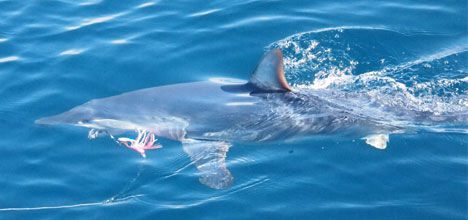
A 1.8metre mako shark named Carol is giving Niwa scientists a new look at a species that has until now swum under the radar.
Since being tagged in the Bay of Islands six months ago, a satellite transponder on the tag shows Carol has covered more than 13,300 kilometres in seven months.
Mako shark. File pic.
Carol's been to Fiji and back, she's worked her way past the Bay of Plenty and Hawkes Bay heading south, and was last seen heading down the east coast of the South Island past Kaikoura Peninsula.
The SPOT tag also reveals Carol spends a lot of time on the ocean's surface, reporting her location to the satellite several times daily. Carol averages 60kilometres per day – sometimes covering more than 100kilometres per day.
Carol is a shortfin mako, Isurus Oxyrinchus, and her relatives have been recorded swimming at speeds of about 100kph. Mako sharks are the fastest of the world's shark species.
They leap out of the water and are fast and agile when attacking prey, making them a daunting animal to confront in the wild.
They have been known to attack humans on rare occasions.
Mako sharks are oceanic rather than coastal, although they occasionally enter coastal waters. Mako sharks are found in waters up to 650 metres deep right around New Zealand and eat mainly schooling fish and squid.
There are two species of Mako shark, the long fin and the shortfin, only the shortfin is found in New Zealand.
The shortfin mako is long and slender, with a relatively long, pointed snout and small eyes. Its pointed teeth protrude from the mouth, but are smooth edged and extremely sharp.
It has short pectoral fins, a tiny second dorsal and anal fin, a crescent-shaped caudal fin, and indigo-blue dorsal surfaces and white undersides.
At full maturity, male mako sharks are about 200cm long and females are between 300 and 310cm. Males mature at eight years old and females at 20 years old.
Mako sharks are targeted for their highly prized fins and their good quality flesh. The species is listed as 'vulnerable” on the International Union for Conservation of Nature list of threatened species.
Most commercially caught mako sharks are taken by tuna longliners and most of the catch is processed.
New Zealand mako shark fisheries are managed under a quota system which limits the amount of sharks caught. Current catches are well below the quota.
Niwa scientists say there has been limited research on mako sharks and they do not know how many there are.
Niwa is currently conducting research on mako sharks, funded by the Ministry for Primary Industries.
Tagging the sharks will identify the geographical range of New Zealand sharks, and how they mix with makos from other parts of the Pacific Ocean.
This information will help determine how many makos there are. The tagging programme will also give indications on how long makos remain in New Zealand waters, and whether they make regular seasonal migrations.
The tagging study is being carried out in collaboration with Dr Mahmood Shivji at the Guy Harvey Research Institute (GHRI) at Nova Southeastern University in Florida, which is funding the electronic tags and Argos satellite time.
Because of the results from the initial trial, the GHRI and NIWA are expanding the mako migration study by tagging more makos off east Northland in February 2013.
To follow Carol's travels on a GHRI interactive website go to http://www.nova.edu/~johnmatt/makosharks.htm

1 comment
I KNOW
Posted on 14-01-2013 15:00 | By YOGI
Who she is and oh my doesn't she have lovely big teeth ...
Leave a Comment
You must be logged in to make a comment.