


As journalists, we’re trained to observe, not participate.
We ask questions, record details, and do our best to stay out of the frame.
The story isn’t about us—it’s about the people, the places, the facts.
We’re meant to bring readers close to the action without ever stepping into it ourselves.
But sometimes, to truly understand what a story means—to feel the stakes, the pressure, the trust—you have to break that rule.
That’s how I found myself strapped into a stretcher, dangling over the edge of a drop roughly the height of a one-storey building, completely in the hands of Bay of Plenty’s New Zealand Response Team 16 (NZRT16).
Spending an evening with the Civil Defence-trained volunteer team was quite literally reporting from the edge.
Once harnessed in, I surrendered control. My safety—and my perspective—now belonged to them.
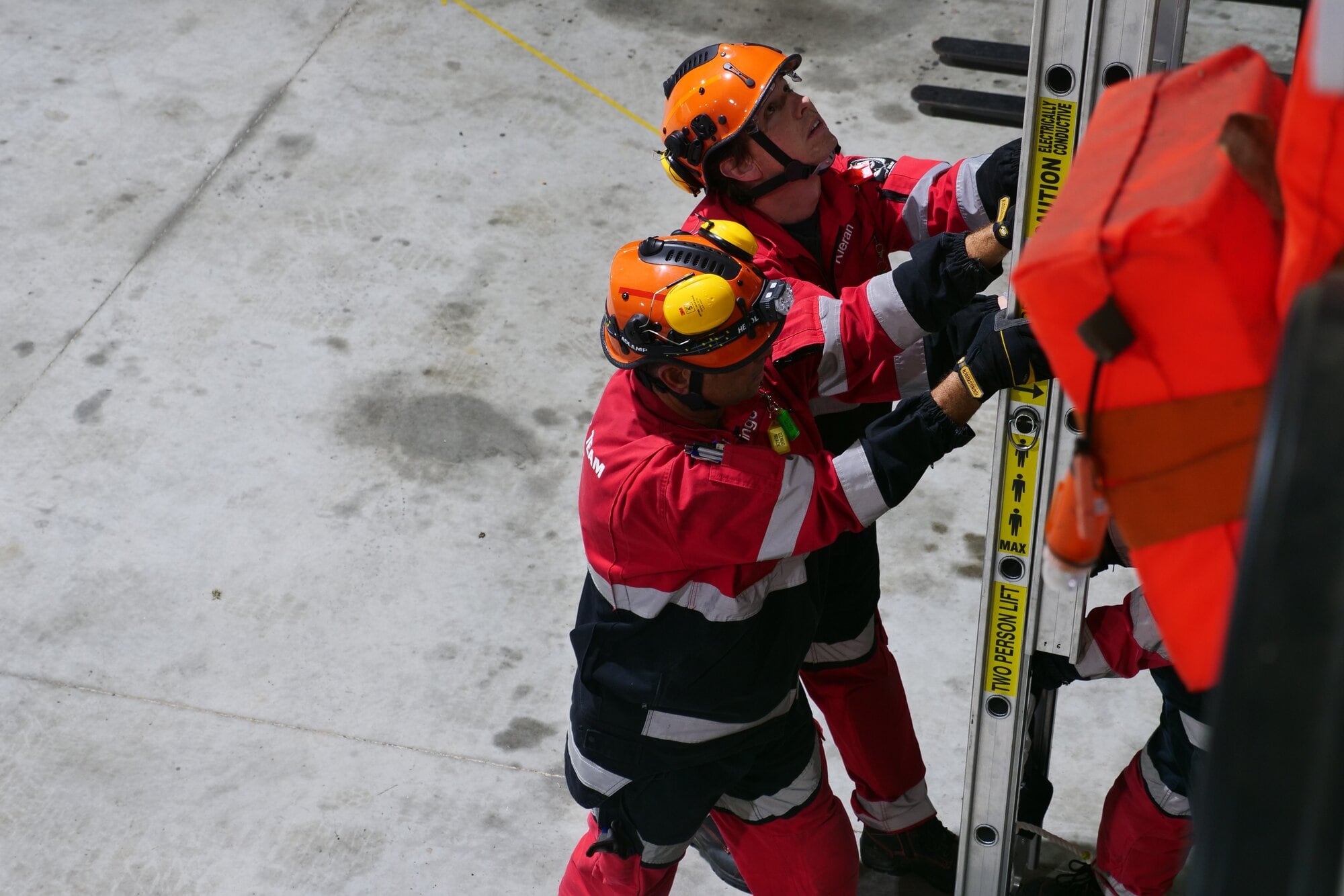
Members of NZRT16 get ready on the ladder as the stretcher is lowered to the ground.
Led by Shaun Thomson, the team meticulously checked every strap, ensuring that—just like in a real rescue—everything was secured and safety was the top priority.
Lying flat in the stretcher, helmet on and vision limited, I listened to the surreal soundtrack of carabiners clicking and ropes tightening.
I didn’t want to write this piece from a distance.
If I was going to report on what these volunteers do, I felt I had to trust them the same way a real victim would. For me, it was about perspective—and respect.
With calm precision, the team lowered the stretcher over the edge of a drop roughly equivalent to a one-storey building. Suspended in mid-air, I felt a strange mix of vulnerability and trust.
It’s one thing to report on rescue operations.
It’s a whole other experience to be the one being rescued—relying completely on a team of strangers, all focused, all communicating clearly. It made me realise how vital every small step is.
As they prepared me for the descent, the atmosphere remained calm but focused.
The clinking of karabiners, the double-checking of knots, the quiet calls of confirmation between team members—it all reflected the controlled precision that defines their work.

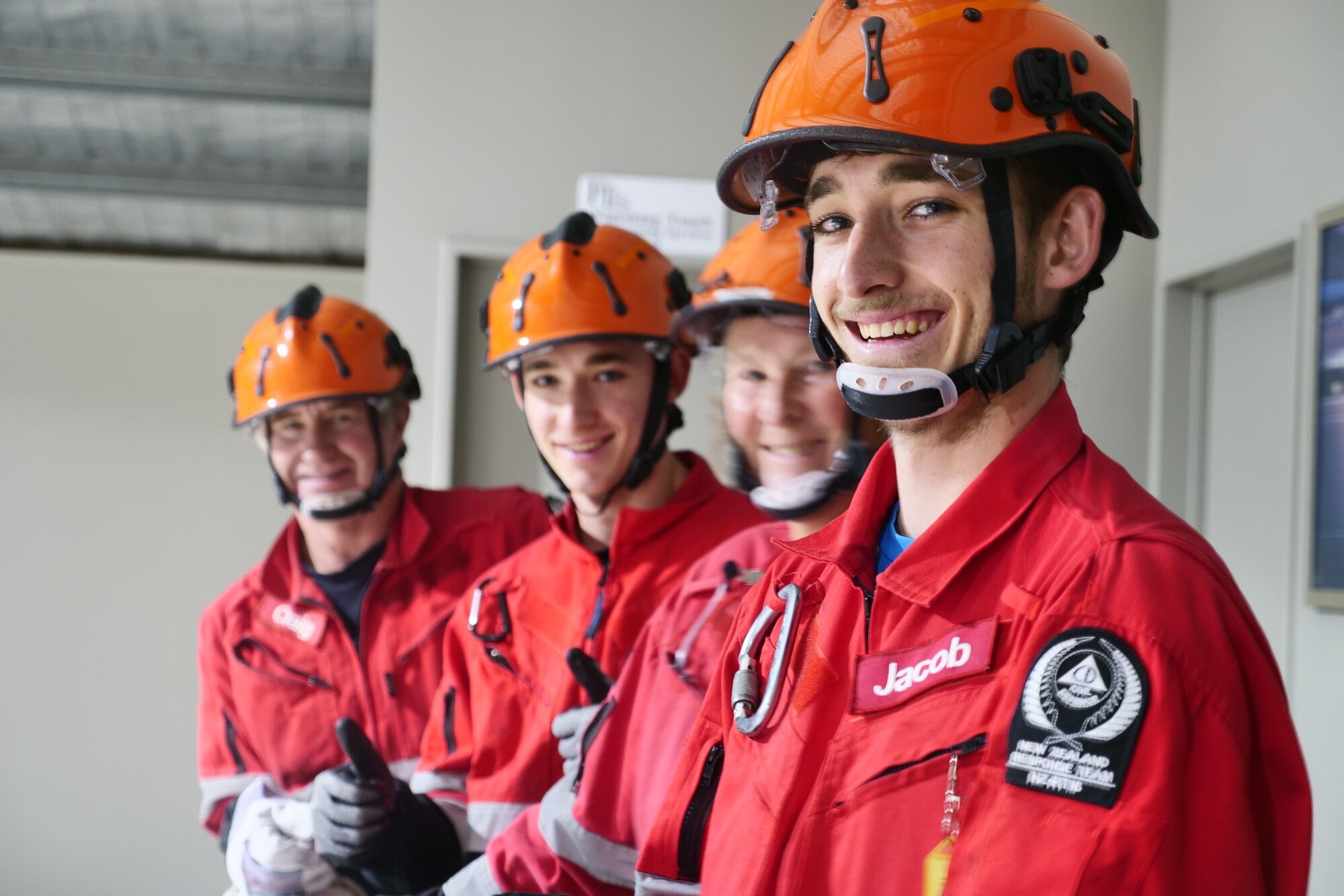
The NZRT16 team.
The experience left a lasting impression. From the outside, it might look like a routine operation, but up close, it’s clear how much discipline and coordination are required.
Once safely back on the ground, I joined the team for a debrief, gaining further insight into how even a training operation demands total concentration.
NZRT16 trains every Thursday, focusing on a different element of rescue or emergency preparedness.
The team comprises 17 volunteers, each bringing a diverse range of skills and experience in emergency services and search and rescue operations. However, they are actively seeking eight more members.
“We would like a team of 25,” said Thomson. “It does not mean we will take [anybody] if we have 10 people come through the door.”
He explained that the role is not for everyone – resilience and the ability to remain calm under pressure are essential.
There is a range of volunteer roles available, including support positions, though the team is primarily seeking operational members. Fitting in with the group is important too, as the team works closely together.
As of 2024, there are 16 nationally accredited response teams in New Zealand, with a total of 424 volunteers ready to be deployed during storms, floods or when requested by councils, according to the Civil Defence website.
NZRT16 members have previously deployed to Auckland during flooding and supported efforts following the Christchurch earthquakes.
Rather than waiting to respond, the team prefers to act early, door-knocking in communities they believe could be at risk of storm damage or flooding.
NZRT16 operates under the management of Bay of Plenty Civil Defence Emergency Management Group and works in co-ordination with New Zealand Police and Fire and Emergency New Zealand.
“You can’t just call 111 to reach Civil Defence,” said Bruce Rutherford, senior advisor at Emergency Management Bay of Plenty.
“We are very much in the background.”
If an event exceeds the capacity of standard emergency response services, Civil Defence may be activated to provide additional support.
The team will hold an open recruitment night on June 26. Anyone interested can register by emailing: [email protected] or completing the form at: https://forms.office.com/r/EM8JtMnHGu.

0 comments
Leave a Comment
You must be logged in to make a comment.