


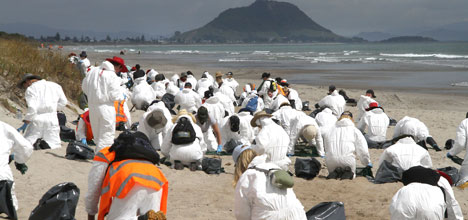
The grounding of the Rena and subsequent oil spill has heightened people's awareness and interest in the welfare of Bay of Plenty beaches.
A report delivered to the Bay of Plenty Regional Council operations monitoring and regulations committee states the Rena disaster boosted Coast Care volunteer numbers from 880 in October 2011 to 1,010 in August 2012.
The Rena grounding boosted participation in the Bay of Plenty's Coast Care programme.
Many of the new members were involved with the Rena response as volunteers in Operation Beach Clean or Adopt-a-Beach, and chose to continue through Coast Care after the oil spill response was terminated.
During the disaster 8061 volunteers registered to help through either Operation Beach Clean or later on Adopt-a-Beach on the Maritime NZ website.
The dead birds and black oily waste on white sandy beaches may have made more people aware of the potential and actual impact, humans can have on the coastal environment, says the report.
Coast Care BOP is a multi-agency and community-based programme focussing on coastal dune restoration.
Partner Agencies include the Bay of Plenty Regional Council, Tauranga City Council, Western Bay of Plenty District Council, Whakatane District Council, Opotiki District Council, and the Department of Conservation.
Coast Care BOP was established in 1994 and has grown significantly with a national status in leading dune restoration in NZ.
A coastal user survey is undertaken every second summer, with the 2011-12 survey undertaken when people's awareness of the coastal environment would have been heightened by the Rena event.
The 2011-12 survey showed that people surveyed showed a significant increase in valuing native dune flora and fauna, above that of protecting beachfront property.
The Rena is also thought to explain the significant increase in the number of people in the 2011-12 survey, who saw humans as contributing to erosion, including pollution/littering. Explanations of pollution/littering were articulated by some as oil spills, 'ships” and 'captains crashing their ships onto reefs”.
The greater sense of community that emerged from dealing with the disaster may explain some of the increase seen in the percentage of respondents who had heard of Coast Care BOP and their willingness to volunteer for Coast Care BOP in the 2011-12 survey.
Coast Care BOP is seen as doing a fantastic job by the general public, where both surveys indicated that the Coast Care BOP programme is delivered at the right level.
The overall results of the 2011-12 survey must therefore be considered within this climate of the Rena disaster, as well as Coast Care BOP and the partner agencies working together to increase the public's awareness and understanding of the fragile yet important BOP coastline.
Recommendations:
One common thread seen in the 2011-12 survey was the increasing concern with regard to the impact of vehicles on beaches and sand dunes in the BOP. This is a growing issue and one that Coast Care BOP and the partner agencies should continue to address together.
Future surveys will hopefully continue to show that people are becoming more conscious of their coastal environment, and with increased knowledge and appreciation, the future of Coast Care BOP will be bright.
This Coastal User Survey, which happens every second summer, was initiated in accordance with the Long Term Plan for Coast Care Partner Agencies. The relevant objectives in this Ten Year Plan state the following:
Survey dates are set for 2013 and 2016 as part of the Coast Care BOP Ten Year Plan.
In the 2009-10 survey, 519 questionnaires were completed, and for the 2011-12 survey, 355 questionnaires were completed.

0 comments
Leave a Comment
You must be logged in to make a comment.