


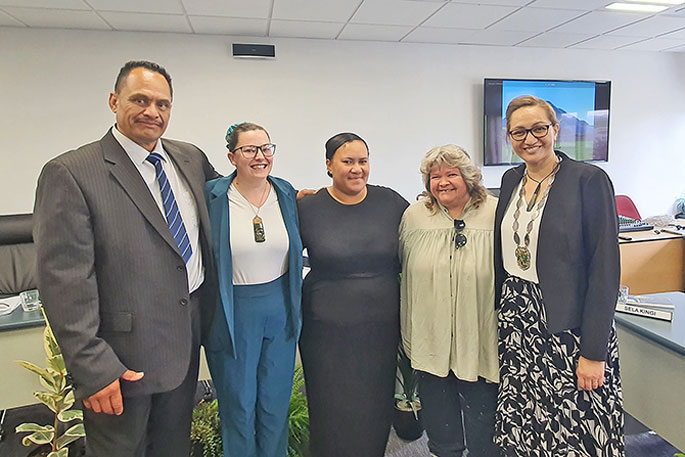
There were hugs and tears of joy in the Kawerau District Council chamber as Māori ward advocates were told “yes” after two years of asking.
At an extraordinary meeting on Wednesday, Kawerau was the third district council in the Eastern Bay to adopt a Māori ward.
Whakatāne District Council already has three Māori Ward seats in place and Ōpōtiki District Council voted on Monday for Māori wards.
A public forum was held at the beginning of the Kawerau meeting, with six of the 165 submitters speaking.
Some of those who spoke had made submissions to a review in 2021.
The council previously voted against the establishment of Māori wards for the reason it already had broad representation.
However, council committed to “do better” in future community consultation and an extensive engagement campaign was carried out with tangata whenua iwi and the community this year.
Of the 165 submissions made, 56 percent were opposed and 38 percent were in support of Māori wards. Just under 5 percent were undecided.
“The council of the day, back in September 2021, did commit to doing a better job and we’ve actually heard voices,” Mayor Faylene Tunui said.
“We have made a much more concerted, deliberate effort in having that conversation.”
Long time Kawerau resident Jenny Reynolds summed up the feeling of many of those opposed.
“Māori wards are only needed if Māori becomes under-represented," she said.
"Sadly, in many places around the motu, Māori are not well represented on councils and community boards. I can’t say that that is the case in Kawerau.
Kawerau district can be proud of the diversity of its elected members, she said.
Without wards, voters were able to vote for all eight councillors, while with wards, they will likely only be able to vote for four, she added.
“I urge the council to maintain the status quo and then review its decision prior to the 2028 election.”
Louise Hiwarau said Māori wards were long overdue and were required to give “full effect to the principles of the Treaty of Waitangi”.
“Three years ago, we had this conversation and here I am again standing up for the same kaupapa.
"With the make up of council’s current governing board we do not feel comfortable sharing our expressions of our tiro rangatiratanga in this space."
"In the past, colonialism has violated our trust and good faith, so until we observe council properly whakamana (empower) te Tiriti o Waitangi, only then can we recommend and work collaboratively towards improving outcomes for Māori."
Ms Hiwarau noted that the majority of submission responses that were opposed to Māori wards were from the over-65 demographic.
“While I appreciate the older population taking the time to complete the survey, please consider that this is our future we are talking about. They’ve lived their lives, this is our time.”
Another submitter, Heather Kuka, agreed, saying the over-65 demographic skew can lead to decisions that may not align with younger residents.
“Even if establishing these wards mean that my personal voting options are limited in future elections, I remain steadfast in my support. The depths of our community representation far outweighs the benefit of choice for any one individual.”
Deputy mayor Aaron Rangihika moved that council resolve to establish one or more Māori wards for the 2025 and 2028 elections.
This was seconded by councillor Sela Kingi, and the vote passed with only one councillor opposed.
Councillor Carolyn Ion spoke about the difficult decision and said the iwi liaison committee has been in place since 2014 to fulfil its Treaty obligations.
The number of Māori ward and general seats on both Ōpōtiki and Kawerau councils is still to be decided at representation arrangements reviews, due to be held in the first half of next year.
The balance of Māori and general ward councillors will depend on the percentages of district voters on the Māori and general electoral rolls. Around 61.7 percent of Kawerau’s population identifed as Māori at the 2018 Census.
Mayor Faylene Tunui thanked submitters for the respectful way they had shared their views.
“If there is a difference in view, that’s what makes Kawerau rich.”
Public Interest Journalism funded through NZ On Air.

4 comments
wards
Posted on 25-11-2023 18:45 | By dumbkof2
will all be gone soon
Now a referendum will be required
Posted on 26-11-2023 10:31 | By jed
Under the terms of the new Government, all Maori wards need to be put up for referendum.
Finally, some democracy comes to NZ!
Th eMaster
Posted on 26-11-2023 13:05 | By Ian Stevenson
@ Jed, yes fantastic and it should be done. That is democracy, the Queens law as per the Treaty.
Any dissenters merely want race based preferential treatment?
@Jed.
Posted on 27-11-2023 11:04 | By morepork
There is no current requirement for existing Maori Wards to be removed and then a referendum held. The current action is that FUTURE Maori Wards will require a referendum. In principle, we should be allowed a referendum but that was cancelled by the previous government. There are some cases where a Maori Ward is not such a bad thing, even though it is race based. For example, Hauraki recently elected to have a Maori Ward. The majority of the people who live there would be in favour and a referendum would have reflected this. Ideally, people should be comfortable with the existing Laws and representation. Maori should get the same attention and address as everybody else. But Maori communities don't feel that, and you can't expect them to endorse the system overnight. It will take some time for confidence in the fairness of the system to be rebuilt.
Leave a Comment
You must be logged in to make a comment.