


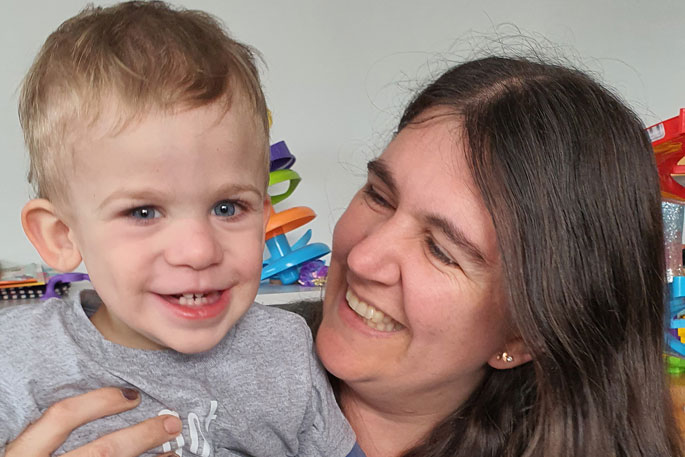
A Tauranga mother is the first from New Zealand to attend a gathering in the United States of specialists, parents and survivors of a rare condition that affects her own son.
Heather Kalisch’s 20-month-old son, James, has Prune Belly Syndrome. It gets its name from the wrinkled stomach that’s typical of babies born without abdominal muscles. The cause is still unknown but it’s common for those with PBS to have kidney or urinary tract problems.
“There are literally just a handful of people in New Zealand with PBS that I know of,” says Heather.
Thanks to a grant from the Lottery Minister’s Discretionary Fund, she was one of about 100 attendees at the Prune Belly Syndrome Convention in Columbus, Ohio, from July 19-22.
“It paid for my flights and accommodation. I couldn’t have done it without that grant. I’m so appreciative.”
Doctors first caught an abnormality at Heather’s 13-week pregnancy scan in 2021. They noticed an enlarged bladder that meant her baby’s urine was getting blocked.
“It was a difficult whirlwind of a pregnancy having to go back and forth to Auckland during the 2021 lockdown. We spent the whole time not knowing whether James was going to live or die.”
When he was born, James was diagnosed with Prune Belly Syndrome. “Statistics from medical research estimate that just one in 50,000 babies are born with this condition,” says Heather. “Most doctors in New Zealand have never seen a case. I learned so much so fast and I’m still learning so much. I wish I didn’t have to, but I do.”
Looking for answers
With no support network in New Zealand, Heather looked to the US for answers. “There’s a doctor in Columbus who’s researching whether there’s a genetic cause of PBS. She’s the only one in America and one of only a few around the world who would be considered experts, so I wanted to hear her speak.”
Heather also attended lectures by medical experts from urologists and nephrologists to physiotherapists. But it wasn’t just the doctors who passed on valuable advice. “For the first time ever, I met someone else with Prune Belly Syndrome. I can’t even describe how special that was. That, and meeting other families on a similar journey to ours, was priceless.”
Renewed hope
For Heather, hearing about breakthrough surgical methods such as muscle transposition has given her renewed hope for James’ future.
“It’s not the fault of our doctors here; it’s simply a rare condition that most have never seen. There’s no reason James can’t have the best medical care here.
“Going to the states and finding out what they’re doing for people with Prune Belly Syndrome means I’ve returned to New Zealand armed with more tools and awareness to fight for what James needs.”

0 comments
Leave a Comment
You must be logged in to make a comment.