


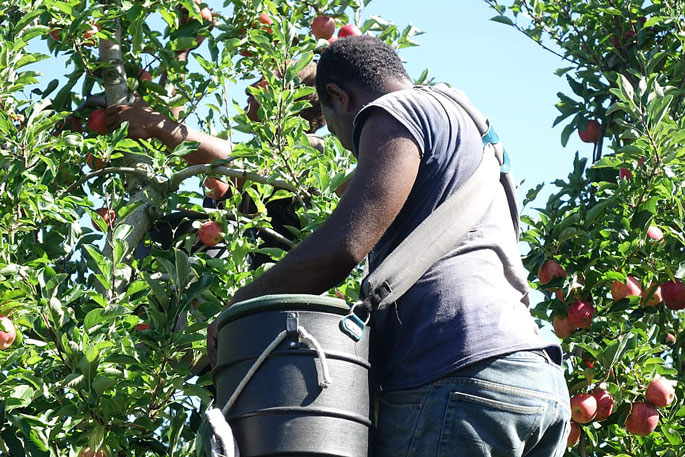
Advocates say there needs to be a fundamental culture shift for how the RSE workers are treated - but the industry says it is already putting in the work.
A report into the treatment of staff under the Recognised Seasonal Employer scheme found major gaps in the system allowing a systemic pattern of human rights abuses.
The Equal Employment Opportunities Commissioner called for an urgent review by government before the 2023 season.
Advocates say there needs to be a fundamental culture shift for how the RSE workers are treated - but the industry says it is already putting in the work.
EEO Commissioner Saunoamaali'i Karanina Sumeo says some of the conditions shocked her, that there are inherent cases of racism, and extreme cases akin to modern day slavery.
Pacific Legal's Richard Small says employers are able to exploit workers with no consequences because of the way the system is set up.
"No New Zealand worker would have a condition in their contract that forbids criticism of their employer - Immigration NZ is well aware [because] we've sent them copies - these employment agreements, although with individual employers, forbid any criticism of their employer online ever and at all."
The commissioner is calling for an urgent review and to tighten employment standards.
But Small says without a major culture shift, any solutions risk window-dressing the issue, and that there is an underlying attitude of seeing RSE workers as units of production rather than people.
"That mindset is always going to lead to abuse. It seems ironic that Immigration NZ, who have done quite a bit of work in the area of worker exploitation, when it faces the Pacific, continues to accept illegal employment conditions," says Small.
Cause Collective lead and Pacific community leader Jerome Mika says the onus ias on New Zealand to sort it out.
"We all know that a lot of our employers are getting a massive return and productivity increase, and we should just be fair for these workers and ensure they are given a fair pay when they are there and that they're able to bring money back for their family," says Mika.
The report has come as a surprise to some of the industry who say they have already got most of the commissioner's recommendations in play.
The country's largest kiwifruit grower, Seeka, relies on RSE workers to ensure all of its fruit is harvested.
Its chief executive Michael Franks says many of the recommendations are already in place at Seeka, for example how every employee has medical insurance and regular access to healthcare.
"For all employers in the horticulture space, the well-being of our workers is a priority for us all - not just the RSE workers, but the New Zealanders, the backpackers, the overseas workers."
He says the commissioner did not visit Seeka but she is welcome to come.
Seeka is a member of New Zealand Ethical Employers, which audits and accredits primary industry members for meeting human rights and workplace standards.
Its members account for 60 per cent of RSE workers across 41 employers.
NZEE chair Tanya Pouwhare says there is a zero-tolerance for unethical employers and there are many doing right.
"Our members have been really concerned with the allegations, because if they are doing everything in their power to do what's right, and then we hear of allegations of people not doing the correct practices ... it's really disappointing."
Three employers have not been able to meet its accreditation standards since launching in June - and instead of leaving them behind, Pouwhare says they are working to educate and help the employers improve.
Pouwhare also says the commissioner did not speak with NZEE for the report and would also be welcome to.

0 comments
Leave a Comment
You must be logged in to make a comment.