


From childhood, Kat Macmillan was aware of the potential damage to the environment that human activity can have.
'My dad is a Greek fisherman and when I was small, I would go out on the trawlers and see the devastation caused by drag net fishing,” she says.
'The sponges, the coral, everything would get pulled up and die and I used to spend my time trying to throw as many ‘junk fish' as I could back into the ocean in the vain hope that they'd survive. I switched to a plant-based diet when I was seven. I've always been a big animal and nature lover.”
Later at university, Kat studied for a Degree in Zoology.
'When you see the science of mass extinction and loss of rain forests, and now with climate change as well, it's a real call to action,” she says. 'I don't want to see our planet losing all its wildlife. That's what we're in danger of right now.”
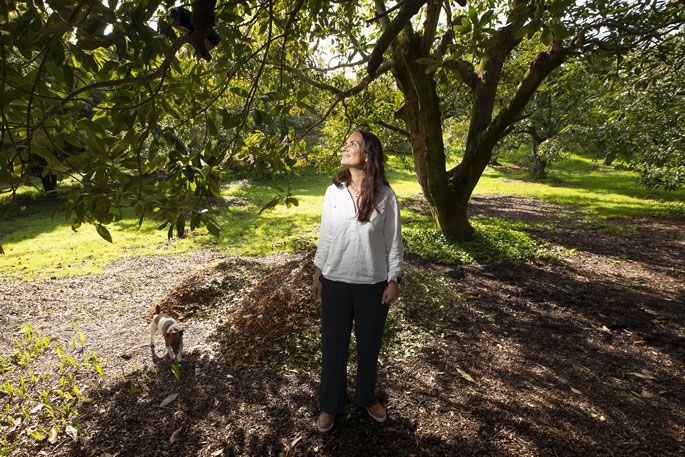
When she and her husband bought eight acres at Welcome Bay that had a small neglected avocado orchard on it, they were determined to restore it using sustainable practices.
'The trees were overgrown and very hungry. The previous owners had also been burning their household rubbish in the orchard so even eleven years later we're still finding charred plastic,” says Kat.
The Macmillans cut the trees to half their size with some drastic pruning.
'If you let them grow too much, they form a high canopy so underneath there's nothing growing and you need really tall hydra ladders to pick them so it's not efficient. Pruning them back does improve the yield but you must do it in the right way.”
She is also a big fan of composting.
'From our shelter belt trim, we had a big pile of pine chip and mulch, so we let that rot down for about four months and we're now feeding that out around the orchard. If you do it too early, it can be acidic,” says Kat.
'All compost is good, because the roots need some cover otherwise, they get soggy. When we prune the avocados, we spread the chip back around the trees. It's a circular thing.”
The small orchard is not certified organic but Kat won't use pesticide.
'If you have healthy insect life, then they can help manage pests like thrips and leafroller. Our fruit's not blemish-free but it tastes amazing because it doesn't have any spray on it.”
Now that she's on the BOP Regional Council, she wants to advocate for restored ecosystems, fresh waterways and clean oceans, sustainable green growth and a low carbon future. She's keen to work with communities, to get the best outcomes for all.
'We need to get things right now so that our grandchildren have something to inherit that's as good as what we've had. If we don't make the right decisions now then things are going to get pretty bad in terms of our biodiversity, the climate, fresh water, depleted ocean – all those things are happening now so for me becoming a regional councillor is the best use of my skill set.”
She's aware that the environment problems seem overwhelming.
'I don't want to ram the doom and gloom down people's throats. We need to showcase positive change and I think it's important that people see that good results come from small actions.”
There's a lot that can be done by those working the land.
'Our farmers and our food producers work hard,” she says. 'I'd like to be able to support farmers with best practices like riparian planting, retiring and replanting natives on steep land, looking after their waterways, not overstocking, fencing off from waterways and native land and looking at regenerative practice. We can support them with funding for community groups that work with farmers to use best practice for the environment.”
Kat says even on a lifestyle block scale, positive changes can make a difference.
'Commercially there are many challenges we all need to work through. Farming needs to be financially sustainable as well as environmentally sustainable. Of course, it's much easier on small scale.
'On our land, we've planted about 500 native trees and shrubs along the drain way that run through our property, and we have more tuis and fantails than when we first moved here. It makes me so happy because if we allow the land to regenerate and put in the right native species then the wildlife recovers.
'Some parts of our eight acres, we don't see it for a few months and when we go back it's like ‘whoa! Fantastic – ponga with little koru fronds and birdlife has returned'. It's beautiful and all we need is for each person to do it on their own little patch.”

0 comments
Leave a Comment
You must be logged in to make a comment.