


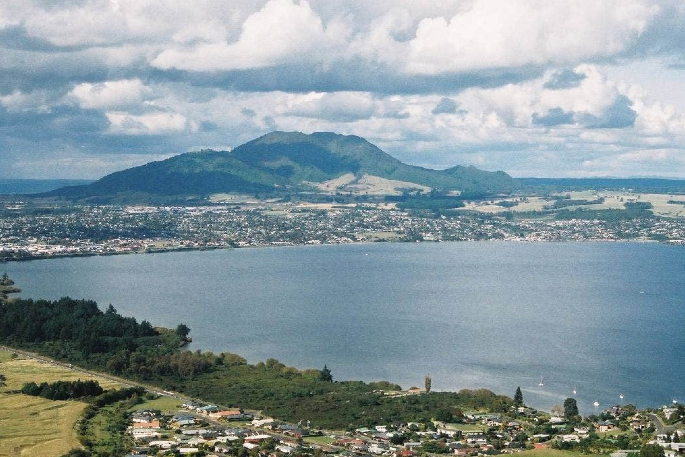
Minor volcanic unrest continues at Taupō Volcano, with ongoing earthquakes and ground deformation.
The Volcanic Alert Level for Taupō Volcano remains at 1.
GeoNet increased the alert level for the volcano below Lake Taupō for the first time last week, after a swarm of quakes around the lake this year.
The super-volcano has been rattled by 40 tremors a week since May, and 700 overall since January.
The volcano caused the largest eruption on Earth in the past five millennia when it last exploded about 1800 years ago.
In the latest update, duty volcanologist Craig Miller says the rate of seismicity has varied during the last four months but remains above typical background levels.
'We have reported the ongoing earthquake activity in our last four bulletins.
'The earthquake sequence remains beneath the central part of Lake Taupō and has continued, albeit at a slightly lower rate this last week.
'We have now located about 750 earthquakes, mainly at a depth of 4 to 13 km beneath the lake, since the unrest began in May 2022.”
Craig says the earthquakes in the last week have been concentrated in the eastern part of the lake.
In addition to seismic activity, Craig says GeoNet continuously monitors ground deformation (land movement) about Lake Taupō.
'Our GNSS (GPS) instruments around the lake are observing uplift at a rate of 60 ± 20 mm per year since May 2022 at a site on Horomatangi Reef in the lake.
'We interpret the ground uplift and earthquake activity to be caused by the movement of magma and the hydrothermal fluids inside the volcano.
'This activity could continue for the coming weeks or months at varying rates or intensities.
'While some of the earthquakes may be felt in areas around Lake Taupō, the deformation is currently only detectable by our sensitive ground-based monitoring instruments.
'GNS Science, through the GeoNet programme, continually monitors Taupō volcano and our other active volcanoes for signs of activity.”
What does this volcanic unrest mean?
Volcanic unrest is when magma or magma-heated hot water and steam forces its way through the ground beneath a volcano, producing earthquakes, ground movement and changes in hydrothermal systems.
There have been 17 previous episodes of unrest at Taupō over the past 150 years, says Craig.
'Several of these were more severe than what we are currently observing at Taupō.
'None of these episodes, or the many other episodes which would have occurred over the past 1800 years before written records were kept, ended in an eruption.
'The last eruption at Taupō volcano was in 232 AD ± 10 years. The chance of an eruption at Taupō remains very low in any one year.”
Craig says while we can't prevent natural hazards, we can prepare for them.
During volcanic activity, he recommends people follow official advice provided by your local Civil Defence Emergency Management Group.
More information about Civil Defence in the Taupō District can be found here.
For information on preparing for earthquakes or responding to volcanic activity, there are guidelines from the National Emergency Management Agency's Get Ready website.
Prepare your home. Protect your whānau.
There's a lot people can do to make their homes safer and stronger for earthquakes. Toka Tū Ake EQC's website has key steps to get you started.
Earthquakes can occur anywhere in New Zealand at any time. In the event of a large earthquake: Drop, Cover and Hold.
Find out more about Taupō Volcano
How do we monitor our volcanoes?

0 comments
Leave a Comment
You must be logged in to make a comment.