


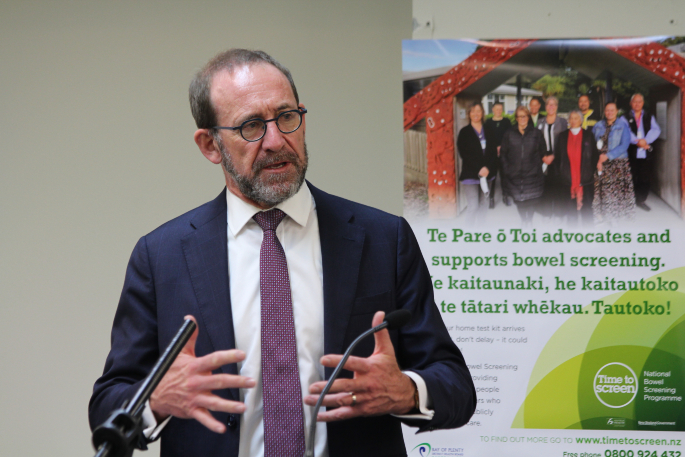
The Government's lifesaving bowel-screening programme is now available across the whole country, says Health Minister Andrew Little, at the official launch of the Bay of Plenty branch of the service at Tauranga Hospital today.
The programme has been successfully rolled out across the country over five years. In that time, cancers have been detected in 1400 people as a result of screening. Thirty-five per cent of these cancers were in the early stages and highly treatable.
'New Zealand has one of the highest rates of bowel cancer in the developed world, so it's critical we have a nationwide screening programme to help address it,” says Little.
'Bowel cancer is the second-most common cause of cancer death in this country, claiming more than 1200 lives a year, which is why in Budget 2022 we announced extra funding to extend the programme.
'This programme can be a game-changer. People who are diagnosed with early-stage bowel cancer have a 90 per cent chance of long-term survival if they get timely treatment.
'Currently, free screening is available to the estimated 835,000 New Zealanders aged 60 to 74. But because a higher proportion of Māori and Pacific people get bowel cancer before the age of 60, we're bringing the aged of eligibility for them down to 50.”
The National Bowel Screening Programme started in 2017 and is the first cancer-screening programme offered to both men and women. In that time, more than a million home-test kits have been sent out.
National Bowel-Screening Programme Clinical Director Susan Parry says she could joyfully "burst into tears at this point in time" at the thought of the programme finally going nationwide.
"This is an absolute monumentous day," says Parry.
(1).jpg)
National Bowel-Screening Programme Clinical Director, Susan Parry. Photo: Taylor Rice/SunLive.
"I want to thank Mr. Little for attending and recognising the importance of this launch."
Parry says as a gastroenterologist she understands the difficult life circumstances of people with bowel cancer, and is pleased at the thought of sparing some of the suffering that she sees so many patients go through.
As well as the 1400 cancers detected, thousands of pre-cancerous polyps (growths in the bowel) have been found as a result of the programme. If left untreated these could become cancerous.
"I urge anyone who gets a bowel screening home test in the mail to complete it and send it back without delay," says Little.
'It could literally save your life, as many people have already discovered.”
Screening is for people who don't have symptoms of bowel cancer. Anyone with symptoms, such as a change to normal bowel habit that continues for several weeks, or blood in their bowel motion, should see their doctor without delay.
A national multimedia campaign to raise awareness about bowel screening and encourage participation is expected to be launched next month.
More about the National Bowel Screening Programme can be found here.

2 comments
Great idea
Posted on 10-06-2022 19:27 | By Clio
Great screening.but why not put more funding into why we have such a high rate.look at the stats poor diet is the main cause of bowel cancer.poor physical heath is also a contributing factor.sorry but the stats say it all,let's get the minority healthy and on a good diet,that's the way forward,will take a generation but can be done.not sure why the minority always seem to get preference,same as free flu vaccine.cant see the reason to single out some more than others for preferential treatment.
Successful I disagree.
Posted on 11-06-2022 09:22 | By Gayelene Woodcock
The ministers comment that the Successful rollout and self congratulations should instead focus on the pathetic 58 percent uptake in participation nationally, a figure well below the initial pilot scheme but not one being addressed it appears. Easier to make it sound successful if you aren't dealing with the reality of what you'd have to deal with if 75 percent or more returned their kits. Point to note is rollout is also staged/staggered so a number of eligible people are invited over a 2 year period so still up to 2 year wait for some let alone the majority of under 60s. Perhaps another decade and there might be genuine progress. Rant over.
Leave a Comment
You must be logged in to make a comment.